Maine Coon Separation Anxiety: Signs, Causes, And What To Do
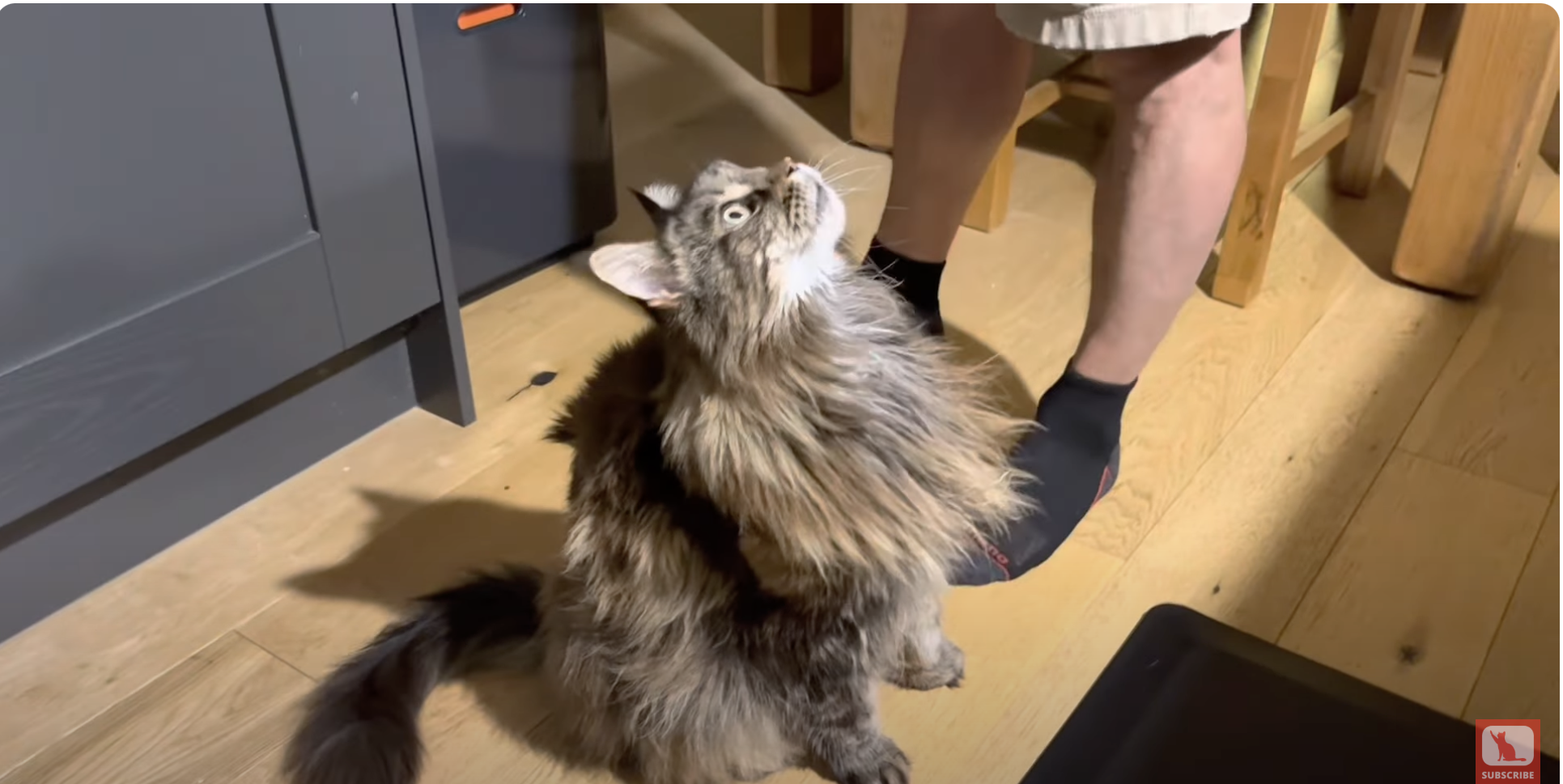
Maine Coons are affectionate, loyal, and people-focused cats, so it is normal for them to follow their owners, chirp for attention, sleep nearby, and want to be involved in daily life. However, there is a big difference between a bonded Maine Coon and a cat who becomes genuinely distressed when separated from their owner.
Maine Coon separation anxiety occurs when a cat becomes stressed, panicked, or unable to settle when left alone or separated from their favourite person. Signs may include excessive vocalising, pacing, destructive scratching, overgrooming, appetite changes, clinginess, toileting outside the litter tray, or distress before the owner even leaves.
This is not bad behaviour. It is not spite. It is not caused by loving your cat too much. It is a stress-related behavioural problem that may need environmental changes, routine support, veterinary advice, or help from a qualified feline behaviourist.
Not every Maine Coon who dislikes being alone has separation anxiety. Some cats are simply bored, under-stimulated, or lonely because their routine does not include enough play, climbing, enrichment, or companionship. If you are trying to work out how long your cat can safely manage by themselves, start with my practical guide to whether Maine Coons can be left alone. This guide is for cats showing stronger distress signs when separated from their owner.
Quick Answer
Maine Coon separation anxiety is distress caused by being left alone or separated from a trusted person. Common signs include persistent crying, pacing, destructive behaviour, overgrooming, appetite changes, toileting outside the litter tray, clinginess before departure, or agitation when the owner returns.
Because Maine Coons are sociable, intelligent, and deeply bonded cats, some may struggle more than owners expect with loneliness, routine changes, or long periods without companionship. Mild boredom can often improve with enrichment, but true separation anxiety should be taken seriously, especially if there are changes in eating, toileting, grooming, or behaviour.
A PubMed study of 136 cats with separation anxiety syndrome reported behaviours including inappropriate urination, inappropriate defecation, excessive vocalisation, destructiveness, and psychogenic grooming.
Not every Maine Coon who dislikes being alone has true separation anxiety. Some cats are bored, under-stimulated, or lonely because their daily routine does not include enough play, climbing, enrichment, or companionship. If you are trying to work out how long your cat can safely manage by themselves, start with my practical guide to whether Maine Coons can be left alone. This separation anxiety guide is for cats who show stronger distress signs when separated from their owner.
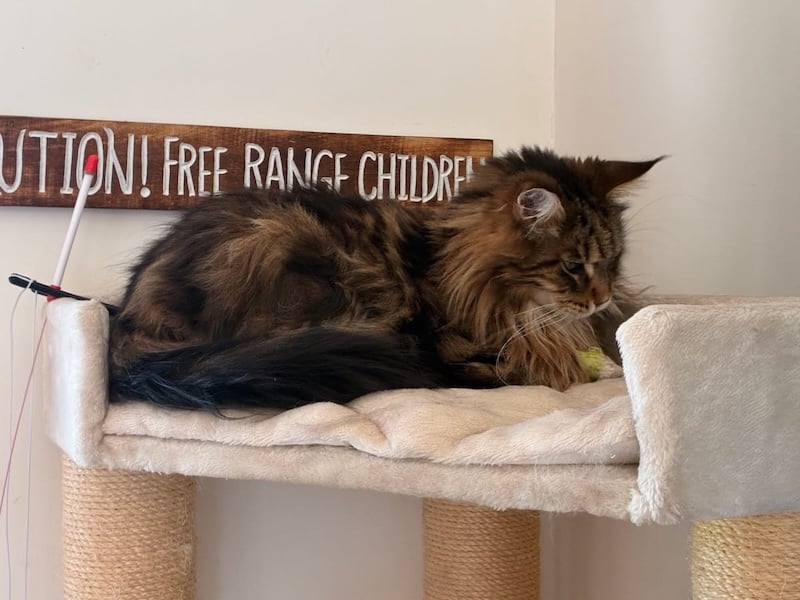
Separation Anxiety Vs Normal Maine Coon Bonding
Many Maine Coon owners worry because their cat follows them everywhere. In most cases, this is normal breed behaviour.
A normally bonded Maine Coon may:
- Follow you from room to room
- Chirp when you enter
- Sleep near you
- Watch your routines
- Sit beside you while you work
- Greet you when you come home
- Prefer your company but still settle alone
That is not automatically anxiety. Maine Coons are naturally sociable cats, and many simply like being near their people. You can read more about this in my full guide to Maine Coon personality and why Maine Coons follow their owners.
Separation anxiety looks different because the cat does not settle when separated. The behaviour is linked to the owner leaving, being absent, or preparing to leave. The cat may become distressed before you go, while you are gone, or when you return.
This distinction matters because many normal Maine Coon personality traits can look intense to new owners. Following you around, greeting you at the door, chirping for attention, or wanting to sit nearby are often signs of a sociable, bonded cat rather than anxiety. You can read more about these normal breed traits in my full guide to Maine Coon personality.
Signs Of Maine Coon Separation Anxiety
Maine Coon separation anxiety can look different in each cat, but common signs include:
- Persistent crying, howling, or yowling after you leave
- Pacing near doors or windows
- Scratching doors, carpets, or furniture
- Refusing food when alone
- Toileting outside the litter tray
- Urinating near doors, beds, or owner-scented items
- Overgrooming or fur loss
- Hiding when the owner prepares to leave
- Becoming frantic when the owner returns
- Excessive clinginess before departure
- Restlessness or inability to settle
- Loss of interest in toys when alone
- Increased aggression or frustration, biting
- Repeated escape attempts
International Cat Care explains that stress plays a role in many common cat behaviour problems and that stressed cats need appropriate resources, hiding places, high perches, and scratching posts.
Cats Protection also explains that stressed cats may show changes in body language and behaviour, including hiding, flattened ears, wide pupils, and changes in normal routine.
Separation anxiety is only one possible cause of stress-related behaviour. Pain, illness, litter tray problems, environmental stress, conflict with other pets, or changes in routine can also affect a Maine Coon’s behaviour. If your cat seems generally tense, unsettled, reactive, withdrawn, or unlike themselves, read my guide to Maine Coon stress symptoms.
Warning Signs That Need A Vet Check
Do not assume every behaviour problem is separation anxiety. Cats often show illness through behaviour.
Speak to a vet if your Maine Coon:
- Starts urinating outside the litter tray
- Stops eating
- Overgrooms or develops bald patches
- Becomes suddenly aggressive
- Hides more than usual
- Cries at night or seems disoriented
- Loses weight
- Drinks more than usual
- Seems painful, stiff, or reluctant to jump
- Has sudden personality changes
Cornell Feline Health Center has resources on common feline behaviour issues, including house soiling, destructive behaviour, overgrooming, and aggression, all of which can overlap with medical or stress-related causes.
A cat who urinates outside the tray may have stress, but they may also have urinary pain, infection, bladder inflammation, kidney disease, arthritis, or litter tray problems. For Maine Coon-specific help, read why my Maine Coon is peeing everywhere and the best Maine Coon litter trays.

If your Maine Coon seems withdrawn, sleeps far more than usual, stops playing, loses interest in family life, or appears low even when you are home, the issue may extend beyond normal alone-time stress. Read my guide to Maine Coon cat depression for signs that your cat’s emotional well-being may need closer attention.
Why Maine Coons May Be Vulnerable
Maine Coons are not emotionally weak. They are simply very social cats.
The breed is known for being people-oriented, loyal, playful, and involved in household life. Many Maine Coons like routines, recognise patterns, and form strong attachments to their owners. These traits are part of what makes them such wonderful companions, but they can also make long periods of isolation harder for some individuals.
A Maine Coon may be more vulnerable to separation distress if they are:
- The only cat
- Left alone for long periods
- Indoor-only without enough enrichment
- Recently rehomed
- Recently bereaved
- Suddenly experiencing a new routine
- Closely bonded to one person
- Under-stimulated
- Recovering from illness
- Naturally anxious or sensitive
- A senior cat with changing needs
The AAFP and ISFM Feline Environmental Needs Guidelines explain that cats need environments where they can express natural behaviours; failing to meet those needs can contribute to stress, illness, and unwanted behaviours.
Indoor-only Maine Coons are not automatically anxious, but they do need more planned enrichment because they cannot burn energy by roaming, climbing, hunting, or exploring outside. If your cat spends most or all of their time indoors, read my guide on whether Maine Coons make good indoor cats so you can build an indoor setup that supports their emotional well-being.
My Experience With Pippin, Bali, And Mika
None of my Maine Coons, Pippin, Bali, or Mika, suffered from true separation anxiety. However, living with them has shown me how important social structure, routine, and companionship can be for this breed.
Pippin: A Single Kitten In A Remote Home
Pippin was our first Maine Coon, raised from kittenhood. He was deeply bonded to us, extremely affectionate, always nearby, and intensely people-focused.
At the time:
- He had no feline companions
- We lived remotely
- Humans were his main source of stimulation
- He was raised as a single kitten
Although Pippin never showed true separation anxiety, we did sometimes wonder whether he had become too emotionally dependent on us because he had no peer interaction. He was not distressed when left alone in the clinical sense, but he was a very attached, people-focused cat.
This is where owners need nuance. A strongly bonded Maine Coon is not automatically anxious. But a single kitten in a quiet household, with limited feline companionship and limited stimulation, may be at higher risk of boredom, frustration, or over-reliance on human attention. We identified that he might need extra stimulation, so we adopted two Maine Coon brothers, Mika and Bali.
Introducing Bali And Mika
When we later introduced Bali and Mika, who were both adopted at four years old, Pippin struggled initially. His routines changed. His social structure changed. His exclusive bond with us was disrupted. Even though adding companions was positive in the long term, it still created stress at first.
In hindsight, if I’d known Pippin would only live for four additional months after adopting the brothers, I’m not sure I would have adopted two more Maine Coon cats, since the initial introduction caused Pippin stress, which is sad to think he experienced in the last months of his life. Although good-intentioned and done to give him feline companionship, maybe it was the wrong decision because his bond with us was so strong.
That experience taught me that Maine Coons can be deeply sensitive to social and environmental change, even when the change is meant to improve their life.
This is important for owners considering a second cat. A companion can help some Maine Coons, but introductions must be slow, careful, and realistic. Another cat is not an instant cure for anxiety.
After Pippin’s Death
After losing Pippin, watching Bali and Mika together changed how I viewed feline companionship. They play together, groom one another, sleep near each other, share routines, and provide stimulation that humans cannot fully replicate. Their bond gives them a kind of emotional stability that is different from human affection.
In my experience, compatible feline companionship can be hugely protective for some Maine Coons, especially if they are social, under-stimulated, or regularly left alone. It does not mean every Maine Coon needs another cat, but it does mean owners should not underestimate the value of a well-matched companion.
For more on multi-cat households, read do Maine Coons get along with other cats?.
Can Getting A Second Cat Help?
Sometimes, yes. But it depends on the cat.
A compatible companion may help by:
- Reducing loneliness
- Providing play
- Offering grooming and comfort
- Sharing routines
- Reducing boredom
- Giving the cat company while owners are out
However, a second cat can also increase stress if the personalities clash, introductions are rushed, resources are limited, or the original cat feels threatened.
A second cat is more likely to help if:
- Your Maine Coon is social with other cats
- The new cat has a compatible personality
- Introductions are gradual
- You provide separate litter trays, beds, food, and water stations
- You have enough space
- You are prepared for extra cost and care
A second cat is less likely to help if your Maine Coon is territorial, fearful, elderly, medically fragile, or already overwhelmed.
Common Triggers For Separation Anxiety
Separation anxiety can develop gradually or appear after a specific event.
Common triggers include:
- Moving house
- A change in work routine
- Owner returning to work after being home more
- Loss of another pet
- Death or absence of a family member
- Rehoming
- New baby
- New partner
- Boarding or cattery stay
- Illness or injury
- Sudden reduction in attention
- Being left alone for longer than usual
Maine Coons who rely heavily on routine may struggle when familiar patterns suddenly disappear.
What To Do First
Start by working out whether the problem is boredom, loneliness, stress, medical illness, or true separation anxiety.
Useful first steps:
- Book a vet check if symptoms involve toileting, appetite, grooming, aggression, or sudden behaviour change.
- Use a pet camera to see what happens when you leave.
- Note when the behaviour occurs: before departure, during absence, or after return.
- Increase enrichment before assuming anxiety.
- Keep departures calm and predictable.
- Avoid punishment.
- Add routine, climbing space, puzzle feeders, and play.
- Consider a qualified feline behaviourist if distress continues.
For normal alone-time planning, read can Maine Coons be left alone?. For indoor enrichment, read are Maine Coons good indoor cats?.
If your Maine Coon is bored or under-stimulated rather than truly anxious, enrichment may make a major difference. Daily play, puzzle feeders, climbing areas, window views, scratching posts, and safe solo activities can reduce frustration and help your cat cope better when you are not available. For practical ideas, read how to keep a Maine Coon entertained.
How To Help A Maine Coon With Separation Anxiety
1. Stabilise The Routine
Anxious cats often cope better when life becomes predictable.
Keep feeding, playtime, litter cleaning, and bedtime routines as consistent as possible. Predictability helps cats understand what happens next and may reduce stress.
2. Make Departures Boring
Do not make leaving dramatic.
Long emotional goodbyes can make some cats more alert and anxious. Instead, keep departures calm, brief, and ordinary. The goal is to make leaving feel normal, not like a major event.
3. Use Play Before Leaving
A short play session before you leave can help reduce restless energy.
Use a wand toy, a feather teaser, or a toy that allows stalking, chasing, and catching. After play, offer food or a puzzle feeder to encourage the natural hunt-eat-rest cycle.
For toy ideas, read best toys for Maine Coon cats.
4. Add Puzzle Feeders
Puzzle feeders give your Maine Coon something to do while you are gone.
Use measured portions of normal food rather than extra treats, especially if your cat is food-motivated or prone to weight gain.
5. Create A Cat-Friendly Home
A stressed Maine Coon needs safe resources, not just attention.
Provide:
- Large litter trays
- Tall cat trees
- Scratching posts
- Window perches
- Hiding places
- Quiet sleeping areas
- Puzzle feeders
- Safe toys
- Multiple water sources
- Separate resources in multi-cat homes
For boredom prevention, read how to keep a Maine Coon entertained.
6. Avoid Punishment
Punishment makes anxiety worse.
Do not shout, spray water, shut the cat away as punishment, or punish toileting accidents. A distressed cat is not being naughty. They need help reducing stress and feeling safe.
7. Build Independence Gradually
If your cat panics when you leave, practise very small separations.
For example:
- Walk into another room briefly
- Return calmly before panic starts
- Gradually increase the time
- Pair short absences with food puzzles or safe enrichment
- Keep the process slow
For severe anxiety, this should be done with guidance from a qualified behaviourist or vet.
8. Speak To A Vet Or Behaviourist
Professional help is needed if your Maine Coon is harming themselves, refusing food, toileting outside the litter tray, overgrooming, panicking, or worsening despite enrichment.
In some cases, vets may discuss medication or supplements alongside behaviour modification. Medication should never be used as the only solution, but it can help some cats enough to learn calmer coping patterns.
Separation Anxiety Signs And What To Do
| Sign | Could Mean | What To Do |
|---|---|---|
| Crying after you leave | Boredom, loneliness, or anxiety | Check with the camera and improve the routine |
| Scratching doors | Frustration or separation distress | Add enrichment and reduce departure stress |
| Urinating outside the tray | Stress or medical issue | Book a vet check |
| Overgrooming | Stress, pain, fleas, allergies, or anxiety | Vet check first |
| Refusing food alone | Anxiety, illness, or stress | Monitor and speak to the vet |
| Clinginess before leaving | Anticipation anxiety | Make departures calmer and more predictable |
| Destruction near exits | Panic or frustration | Seek behaviour support if repeated |
Mainecooncentral.com
Related Maine Coon Central Guides
Can Maine Coons Be Left Alone?
Start here if you want practical guidance on workdays, kittens, adults, seniors, and safe alone-time limits.
Are Maine Coons Good Indoor Cats?
Helpful if your Maine Coon spends most of their life indoors and needs more enrichment.
Maine Coon Personality
Explains why Maine Coons are sociable, loyal, people-focused, and often described as dog-like.
How To Keep A Maine Coon Entertained
Use this for boredom breakers, play ideas, and mental stimulation.
Maine Coon Stress Symptoms
Read this if your cat seems tense, unsettled, withdrawn, or unusually reactive.
Maine Coon Cat Depression
Useful if your Maine Coon seems withdrawn, low, inactive, or uninterested in normal routines.
Do Maine Coons Get Along With Other Cats?
Read this before getting a companion cat.
FAQs About Maine Coon Separation Anxiety
Is Separation Anxiety Common In Maine Coons?
Separation anxiety is not guaranteed in Maine Coons, but the breed’s social and people-focused nature may make some individuals more vulnerable to loneliness, routine disruption, or distress when left alone.
Is Following Me Everywhere A Sign Of Separation Anxiety?
Not usually. Many Maine Coons follow their owners because they are sociable and curious. It becomes more concerning if your cat panics, cries, refuses food, overgrooms, or defecates outside the tray when you leave.
Can Maine Coons Be Left Alone?
Yes, many adult Maine Coons can be left alone for a normal workday if their needs are met. Kittens, senior cats, anxious cats, and cats with medical issues need shorter periods and more regular checks.
Can A Second Cat Help Separation Anxiety?
A compatible companion can help some Maine Coons, especially if loneliness or under-stimulation is part of the problem. However, another cat is not a guaranteed cure and can increase stress if introductions are rushed or if personalities clash.
Can Separation Anxiety Develop Later In Life?
Yes. Separation-related distress can appear after moving house, bereavement, illness, owner routine changes, rehoming, or the loss of another pet.
Will My Maine Coon Outgrow Separation Anxiety?
Not always. Mild boredom may improve with enrichment and routine, but true separation anxiety often needs structured support. Early help usually gives the best outcome.
Should I Ignore My Maine Coon’s Separation Anxiety?
No. Ignoring distress does not teach a cat to cope. It may make fear worse. Instead, focus on routine, enrichment, gradual independence, calm departures, and professional support where needed.
Should I Punish Destructive Behaviour?
No. Punishment can increase stress and make anxiety worse. Destructive behaviour should be treated as communication that something is wrong, whether that is boredom, stress, pain, or anxiety.
Final Thoughts
Maine Coons are affectionate, loyal, and deeply bonded cats, but separation anxiety is not simply “love taken too far”. It is a stress-related problem that deserves patience, investigation, and proper support.
My own experience with Pippin, Bali, and Mika taught me that strong bonds do not automatically cause anxiety. Pippin was intensely people-focused as a single kitten, yet he did not show true separation anxiety. Bali and Mika, meanwhile, have shown me how valuable compatible feline companionship can be, because they play, groom, sleep near each other, and provide emotional balance in a way humans cannot fully replace.
The goal is not to make a Maine Coon emotionally detached. The goal is to help them feel secure enough to cope when you are not there.
For this breed, emotional well-being comes from connection, routine, enrichment, and stability – not isolation.