
Maine Coon Cat Size: What Owners Should Really Expect

The Maine Coon is widely recognised as one of the largest domestic cat breeds in the world. Their long body, broad chest, heavy bone structure, and thick coat make them look dramatically bigger than the average house cat.
If you want the full deep-dive (with height, length, growth stages, and real-life comparisons), read my Maine Coon Size & Growth Guide.
Many new owners worry that their Maine Coon is too small, too skinny, or not growing quickly enough. In reality, this breed follows a very different growth pattern from most domestic cats.
From our experience raising and owning three male Maine Coons, the biggest lesson we learned was that true size takes time to appear, and every cat develops at its own pace.
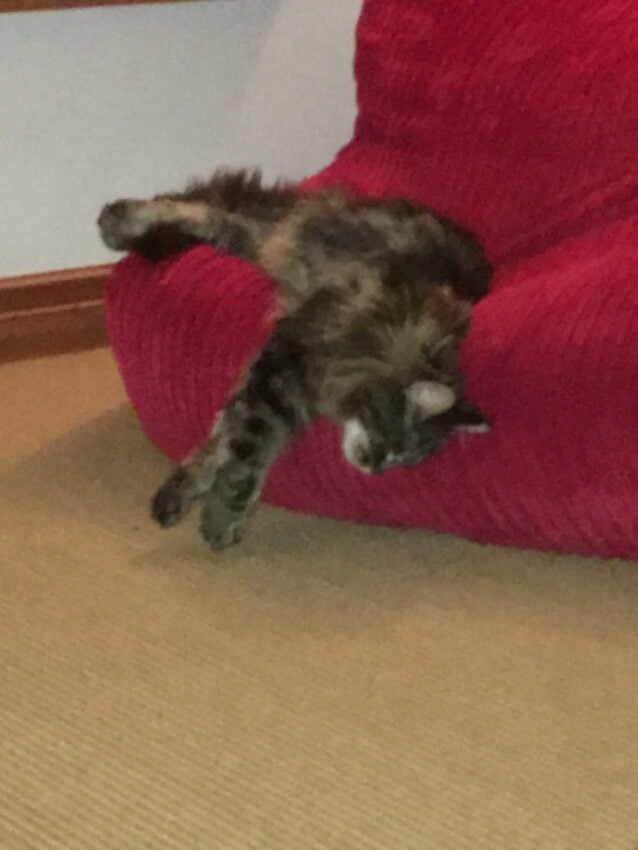
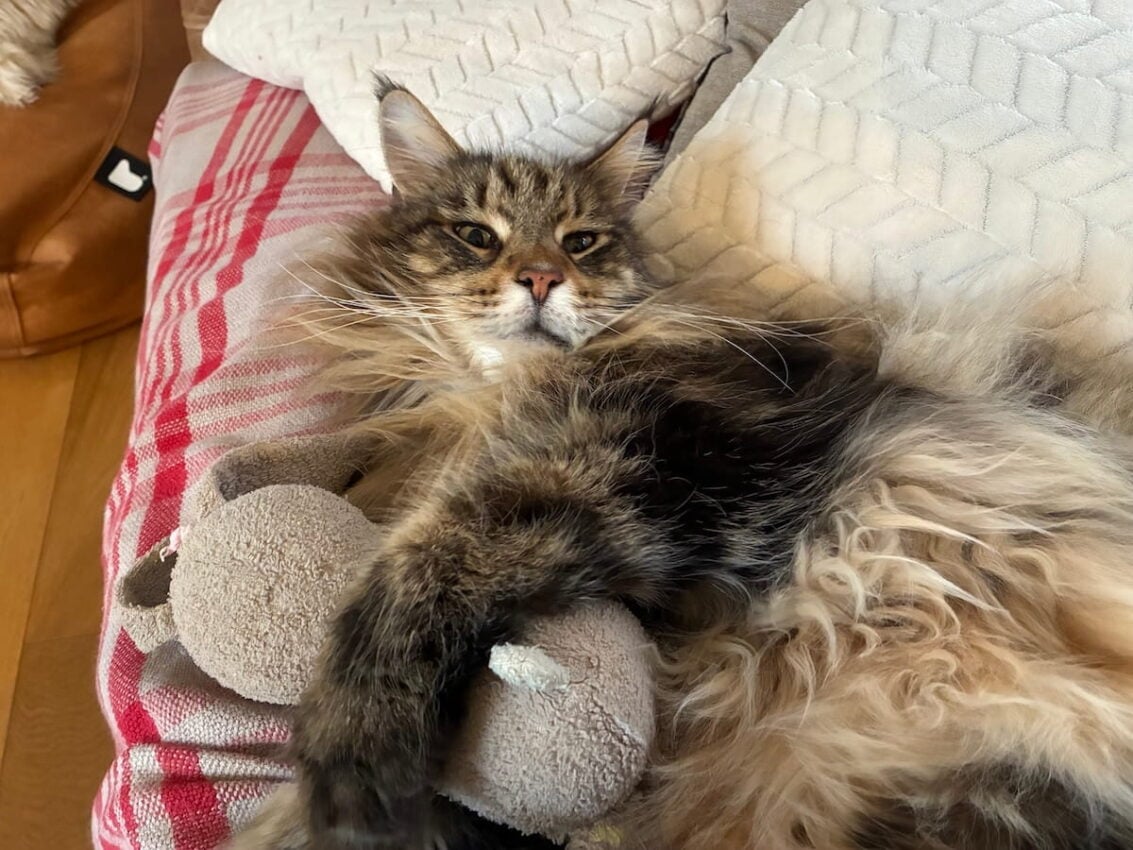
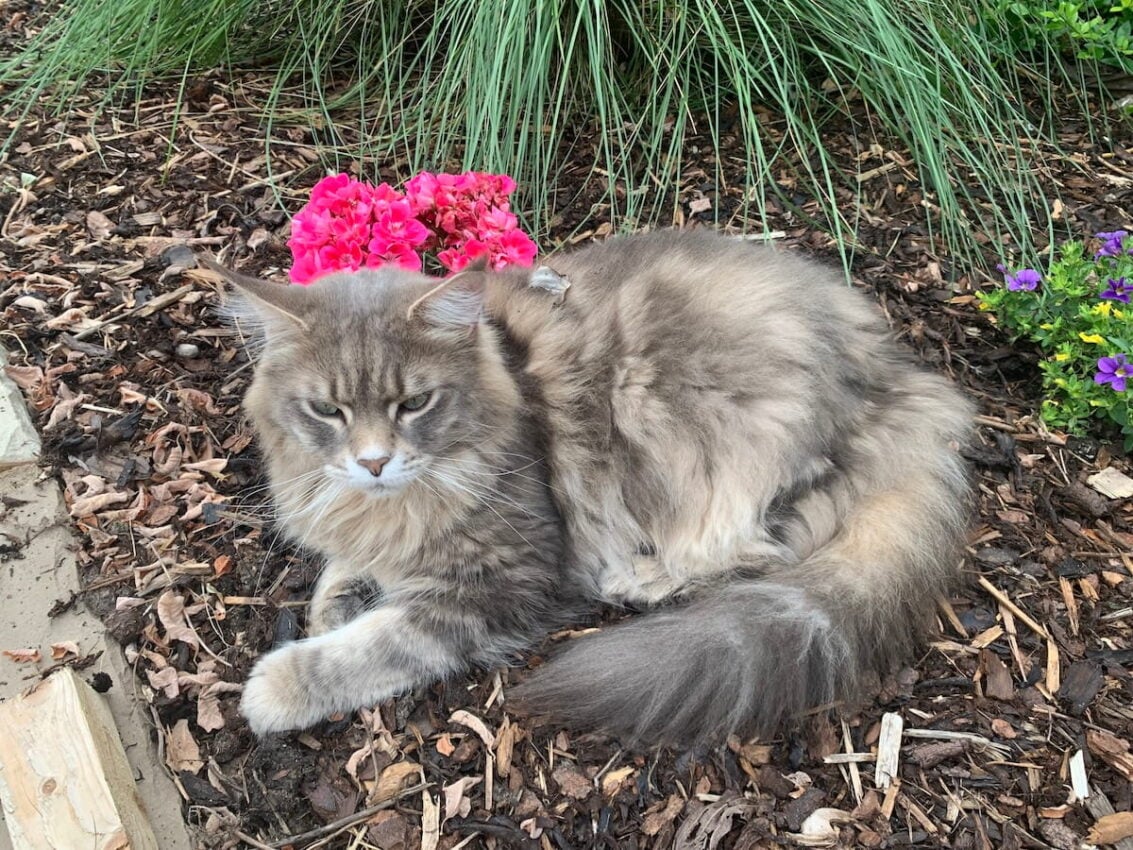
Why Maine Coons Look Bigger Than Other Cats
Maine Coons often appear much larger than other domestic cats, even when their weight is similar. This is because the breed has a long, rectangular body, a broad chest, large paws, and a thick coat that makes them look heavier than they really are.
Their long tail and heavy bone structure also add to the impression of size, which is why Maine Coons are often described as one of the biggest domestic cat breeds in the world.
Typical Maine Coon Adult Size
| Sex | Average Weight | Typical Length |
|---|---|---|
| Male Maine Coon | 18-21 lbs (8.2-9.5 kg) | Up to 40 inches (including tail) |
| Female Maine Coon | 12-15 lbs (5.4-6.8 kg) | Slightly shorter than males |
These averages are most useful as broad reference points because Maine Coon size is shaped by far more than weight alone.
Individual size varies with genetics, breeding lines, diet, and activity level, so some Maine Coons naturally fall slightly outside these averages.
The International Cat Association (TICA) recognises the Maine Coon as one of the largest natural domestic cat breeds, which helps explain why healthy adults often look dramatically larger than the average pet cat.
Real-Life Maine Coon Size Examples
Owning three Maine Coons gave us a very realistic understanding of how much size can vary, even between purebred cats of the same sex.
- Mika: 22 lbs (10 kg) – Large, muscular, and broad-chested.
- Pippin: 20 lbs (9 kg) – A solid, balanced build that sat between the other two.
- Bali: 18 lbs (8.2 kg) – Naturally tall and slender, with a lighter frame.
All three were healthy, purebred males, yet their final builds were noticeably different.
Mika developed a very muscular, heavy-boned structure, while his brother Bali retained a more elegant, streamlined look. Pippin fell somewhere in between, with a strong, balanced frame that matched the classic Maine Coon silhouette.
Despite these differences, one thing remained consistent: All three reached their full adult size at around four years old.
This slow growth is completely normal for the breed and is one of the biggest differences between Maine Coons and typical domestic cats.


Average Maine Coon Size
Average sizes are useful reference points, but they do not tell the whole story. Maine Coons are not just heavier than many cats; they are also longer-bodied, broader through the chest, more heavily boned, and slower to mature.
That is why two Maine Coons can weigh the same amount yet look completely different in person.
For a detailed month-by-month breakdown, see my 👉 Maine Coon Growth Chart
Length And Height Of A Maine Coon Cat
Weight is not the only way to measure Maine Coon size. These cats are also known for their long bodies and large overall frame.
Typical adult size:
Length (Nose to tail): Up to 40 inches (100 cm)
Height: Around 10-16 inches (25-40 cm)
Tail length: Up to 14 inches (35 cm)
Because of their long body shape, a Maine Coon can look much bigger than a heavier but shorter cat.
This is one of the reasons owners often underestimate just how large a Maine Coon can become. A cat may not look especially heavy on the scales, yet still take up far more physical space than an average domestic cat because of its:
- Length
- Height
- Chest width
- Tail size
Why Maine Coons Grow So Slowly
One of the biggest reasons owners become concerned about size is that they expect their Maine Coon to grow like a typical cat.
Most domestic cats:
- Reach adult size by 10-12 months
- Fill out quickly
- Stabilise in weight early
Maine Coons are completely different.
They:
- Continue growing for 3-5 years
- Mature more slowly
- Spend longer in a lanky “teenage” phase
Pippin, whom we raised from kittenhood, was the perfect example of this slow growth pattern. As a kitten, he had enormous paws and tall ears that looked far too big for his body. Instead of worrying, we took this as a sign of his future size.
Those oversized features were typical of the breed, and we knew he would eventually grow into them.
Over the next few years, his body gradually filled out. His chest broadened, his muscles developed, and his coat thickened. By the time he reached four years old, he had grown into a solid 20-pound adult.
This extended growth timeline is one of the breed’s defining traits. The International Cat Association states that Maine Coons “develop slowly, and don’t achieve their full size until they are three to five years old,” which is why owners should judge development over years, not months.
For a deeper explanation of the growth timeline, visit:
👉 When do Maine Coon cats stop growing?
How Maine Coon Size Develops Over Time
Maine Coons do not grow in a straight, predictable line. Their development tends to happen in stages, which can confuse new owners.
Kitten Stage (0-6 months)
During the first few months, Maine Coon kittens often look:
- Long and slightly awkward
- All paws and ears
- Less compact than other kittens
Their bodies are growing, but not yet filling out with muscle.
Teenage Stage (6-18 months)
At this stage, many Maine Coons appear:
- Lanky and stretched out
- Slightly underfilled
- Not as solid as adult cats
This is completely normal and often mistaken for poor growth.
Young Adult Stage (18 months-3 years)
The body begins to change more noticeably:
- Chest broadens
- Muscles develop
- Coat thickens
- The overall frame becomes more powerful
Full Maturity (3-5 years)
This is when the final adult size becomes clear:
- Body fills out completely
- Weight stabilises
- Final proportions settle
All three of our Maine Coons followed this slow, staged development, reaching their true adult form around four years old.
To understand how size looks in early life, see:
👉 How big is a Maine Coon kitten
Male Vs Female Maine Coon Size
Male and female Maine Coons differ quite dramatically in size and build.
Males tend to:
- Develop heavier bone structures
- Grow broader chests
- Carry more muscle
- Reach significantly higher weights
Females usually:
- Have slimmer frames
- Look more elegant and refined
- Weigh less overall
Although our household only included males, the differences between our three cats still highlighted how much variation exists within the breed itself.
Mika’s muscular frame makes him look far heavier than Pippin ever did, even though the actual weight difference was only a few pounds.
For a full comparison, see:
👉 Male Vs Female Maine Coon
Why Two Maine Coons Can Look Completely Different
Many owners expect all Maine Coons to look enormous and bulky, but this is not how the breed works in real life.
Final size depends on:
- Genetics
- Sex
- Bone structure
- Muscle development
- Diet and activity levels
In our case:
- Mika developed a broad, muscular build.
- Pippin had a balanced, powerful frame.
- Bali remained naturally slender and tall.
All three were healthy and purebred, yet their adult shapes were clearly different.
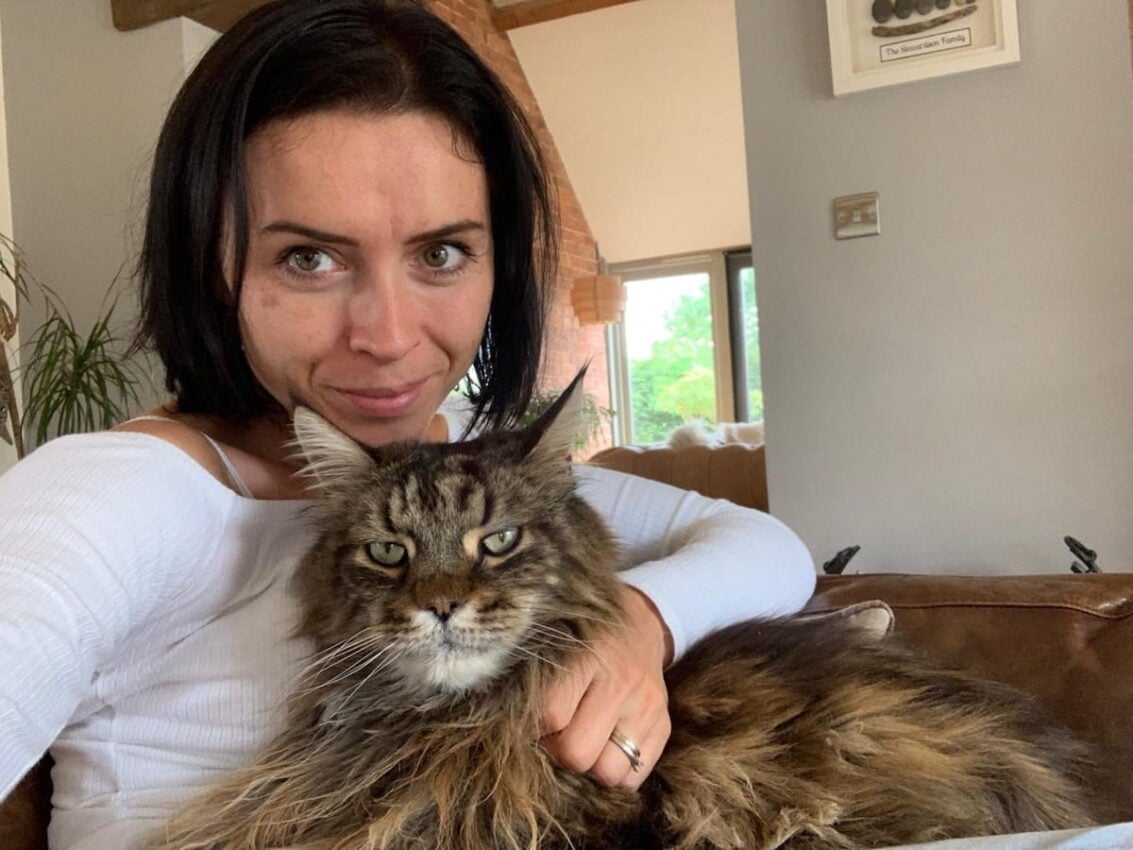


Understanding Healthy Weight In Maine Coons
Because Maine Coons are such large cats, it can be difficult to judge whether they are:
- Underweight
- Overweight
- Naturally large
We experienced both sides of this with our own cats.
Bali’s weight loss
Bali was the only one of our three cats to become underweight. This happened when he developed a severe urinary tract infection.
During that time, he lost noticeable body condition, but once the infection was treated, he regained his weight quickly and returned to his natural slender build.
Mika’s weight gain
Mika, on the other hand, became slightly chunky while eating standard Royal Canin urinary dry food. His frame is naturally muscular, so the extra weight was noticeable around his midsection.
To manage this, we:
- Switched him to the moderate-calorie version
- Monitored his body condition
- Allowed his weight to stabilise gradually
His muscular shape returned, and he looked far more balanced.
If you are unsure whether your cat is naturally slim, underweight, or carrying excess fat, read my full Maine Coon Size & Growth Guide, where I explain how to judge body condition more accurately.
Why Internet Photos Can Be Misleading
Many photos online show extremely large Maine Coons. These are often:
- Record-holding cats
- Special breeding lines
- Exceptionally large males
This creates unrealistic expectations for many owners.
In reality:
- Not all Maine Coons reach extreme sizes
- Some remain naturally slender
- Genetics plays a huge role
Bali, for example, was tall and elegant rather than bulky, even at full adult weight.
The Most Important Thing To Understand About Maine Coon Size
If there is one thing owners should remember, it is that Maine Coons are slow-growing cats, not just big cats.
Their final size:
- Takes several years to appear
- Varies between individuals
- Cannot be judged accurately in the first year
Understanding their growth timeline is far more important than comparing them to internet photos or worrying about early weight changes.
Many new owners worry that their Maine Coon is too small during the first year or two. In reality, this breed often looks lanky, awkward, or underfilled before the chest broadens, the muscles develop, and the final frame settles.
As long as your cat is healthy and following a steady growth pattern, variation between individuals is completely normal.
Why Some Maine Coons Are Smaller Than Expected
Not every Maine Coon grows to the same size. Genetics, breeding lines, diet, and whether the cat is purebred all affect how large a Maine Coon will become.
Some cats sold as Maine Coons are actually mixes, which often results in a smaller adult size. Even purebred Maine Coons can vary depending on whether they come from American or European lines.
It is normal for some Maine Coons to stay at the lower end of the size range, especially females.
Where To Go Next
For more detailed size-related guides, explore these articles:
- 👉 Maine Coon Growth Chart
- 👉 When do Maine Coon cats stop growing?
- 👉 How big is a Maine Coon kitten?
- 👉 Male Vs Female Maine Coon
FAQ
How big do Maine Coon cats get compared to normal cats?
Maine Coons are one of the largest domestic cat breeds. While most house cats weigh between 8 and 12 lbs (3.6 and 5.4 kg), adult male Maine Coons typically weigh 18-21 lbs (8.2-9.5 kg), and females usually weigh 12-15 lbs (5.4-6.8 kg).
They are also much longer and more muscular than the average cat.
What is the biggest Maine Coon ever recorded?
The longest domestic cat ever recorded was a Maine Coon named Barivel, measuring over 47 inches (120 cm) from nose to tail.
Extremely large Maine Coons are rare, and most healthy adults fall within the normal breed size range rather than record-breaking sizes.
At what age is a Maine Coon fully grown?
Most cats stop growing at around 12-18 months, but Maine Coons grow much more slowly. Many continue developing until 3-5 years of age, which is why young Maine Coons can look skinny or smaller than expected.
Are male Maine Coons bigger than females?
Yes, male Maine Coons are usually much larger than females. Males often weigh 30-40% more and have broader chests, larger heads, and heavier bone structure. Females are still large cats, but they tend to be slimmer and lighter.
Why does my Maine Coon look small?
Some Maine Coons are naturally smaller because of genetics, breeding lines, or being mixed with another breed. Young Maine Coons may also look thin or small while they are still growing, since the breed develops slowly compared to most domestic cats.
Can you make a Maine Coon grow bigger?
You cannot make a Maine Coon grow bigger than its genetic potential, but proper nutrition, good health care, and enough calories help the cat reach its full size. Poor diet, illness, or underfeeding can prevent a Maine Coon from growing properly.
Are European Maine Coons bigger than American Maine Coons?
European Maine Coons often have a more muscular build, higher cheekbones, and a more dramatic appearance, which can make them look larger. However, both European and American lines usually fall within the same overall size range.
Final Thoughts
Maine Coon size is impressive, but the most important thing to understand is that this breed develops slowly and varies more than many owners expect.
Some adults are long and lean, others are broad and heavily muscled, and both can be completely healthy.
In our experience with Bali, Pippin, and Mika, the clearest lesson was that you should judge a Maine Coon by overall body condition, steady development, and long-term growth, not by comparing your cat to giant internet photos.
