Maine Coon Colors & Patterns: Chart + Photos (2026)

Maine Coons come in an extraordinary range of colors and patterns, from traditional brown tabbies to black, blue, red, cream, white, silver, smoke, tortoiseshell, calico, shaded, golden, and combinations with white. Understanding those coats is not always straightforward.
A cat that most owners call gray is usually officially described as blue. An orange or ginger Maine Coon is normally registered as red. Tabby is a pattern rather than a color, while terms such as silver, smoke, shaded, and shell describe how pigment is distributed along each hair.
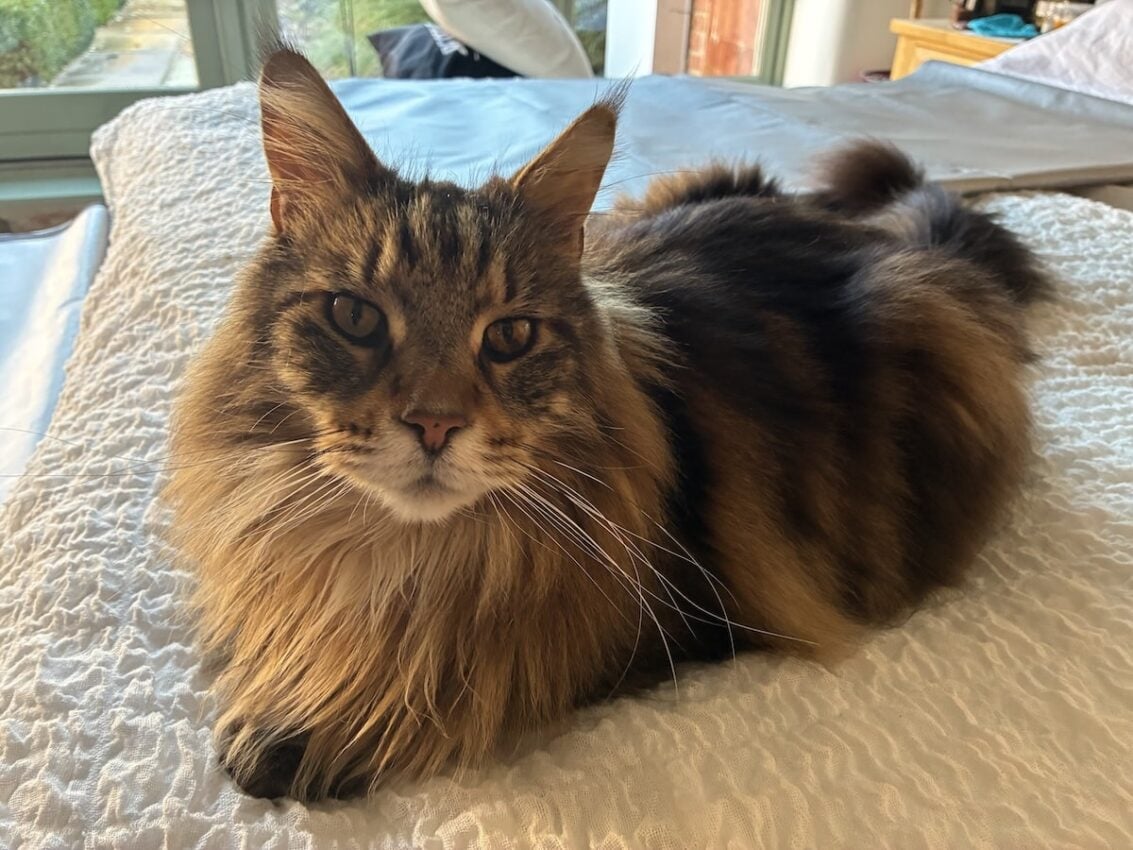
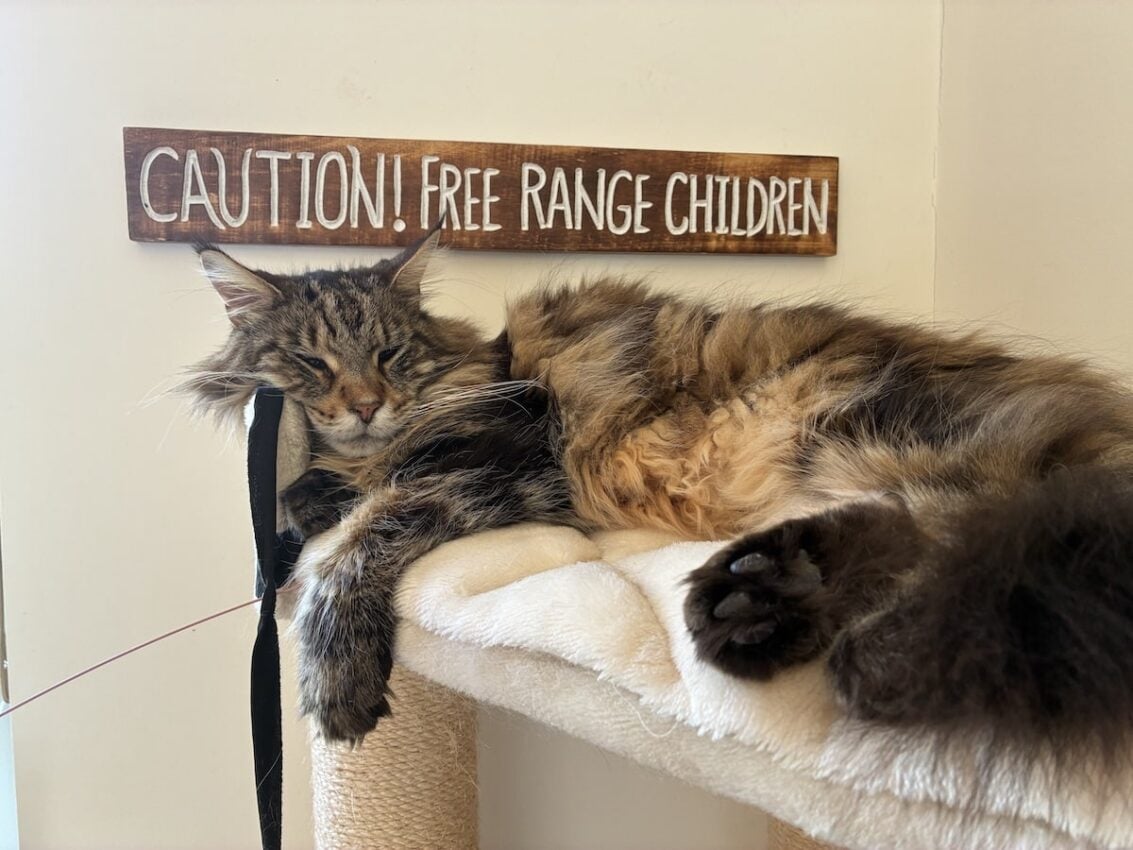
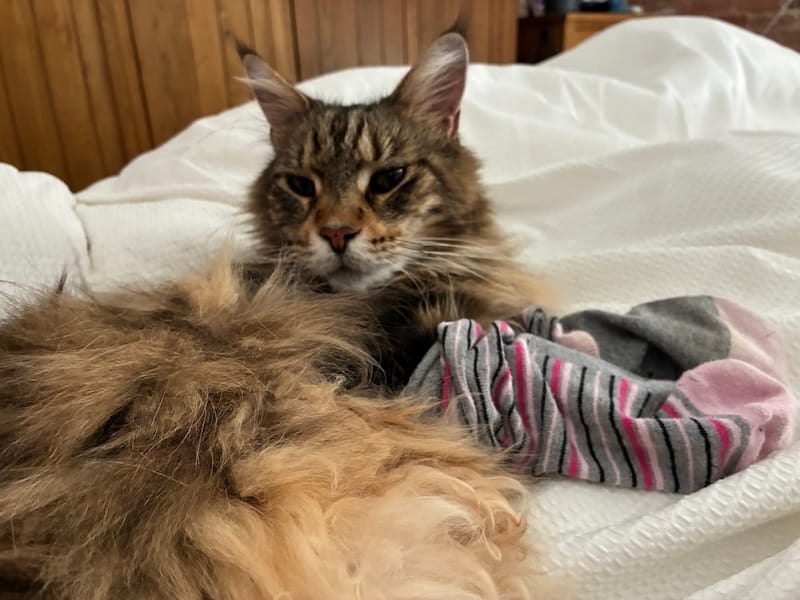
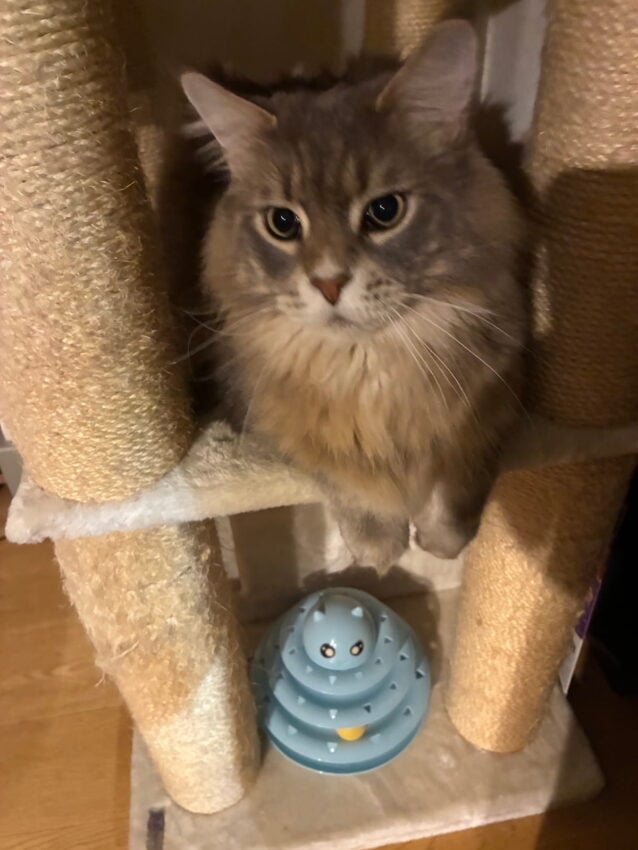
Our own Maine Coons demonstrate these differences clearly:
- Bali is a brown tabby.
- Mika is a blue tabby.
- Pippin was also a brown tabby.
“Brown” and “blue” describe their colors, while “tabby” describes their markings.
I originally thought of Mika’s coat as gray, but his correct color description is blue tabby. His markings also become far easier to distinguish in certain lighting. Bali and Pippin’s warmer brown tabby coats similarly changed in depth and fullness as their fur matured.
This guide explains the main Maine Coon colors and patterns, how to identify them, which terms appear on pedigrees, and why different cat registries may describe similar coats differently.

Quick Answer
Maine Coons are accepted in dozens of color and pattern combinations.
Their main visible color groups include:
* Black
* Blue
* Red
* Cream
* White
* Tortoiseshell and blue-cream
These may be combined with:
* Solid coloring
* Classic, mackerel, spotted, or ticked tabby markings
* Silver
* Smoke
* Shaded or shell tipping
* Golden coloring
* White spotting
There is no single universally correct number of Maine Coon colors. Registries group, name, and count the possible combinations differently.
Brown tabby is the appearance most strongly associated with the traditional Maine Coon, but it represents only one part of the breed’s accepted color range.
Maine Coon Color vs. Pattern
The easiest way to understand a Maine Coon’s coat is to build the description in layers.
1. Pigment Family
Most colored Maine Coons belong to one or both of two main pigment families:
- Black-based
- Red-based
Black-based coloring can appear as black, brown tabby, blue, silver, or smoke, depending on the other genes involved. Red-based coloring produces red or cream coats. A fully white coat can conceal the color and pattern the cat would otherwise display.
2. Dilution
Dilution lightens the main pigment:
- Black becomes blue
- Red becomes cream
The UC Davis Veterinary Genetics Laboratory explains that feline dilution is a recessive trait that causes pigment granules to become unevenly distributed within the hair shaft. Cat registries and breeders call diluted black blue, although it normally looks gray to an everyday observer.
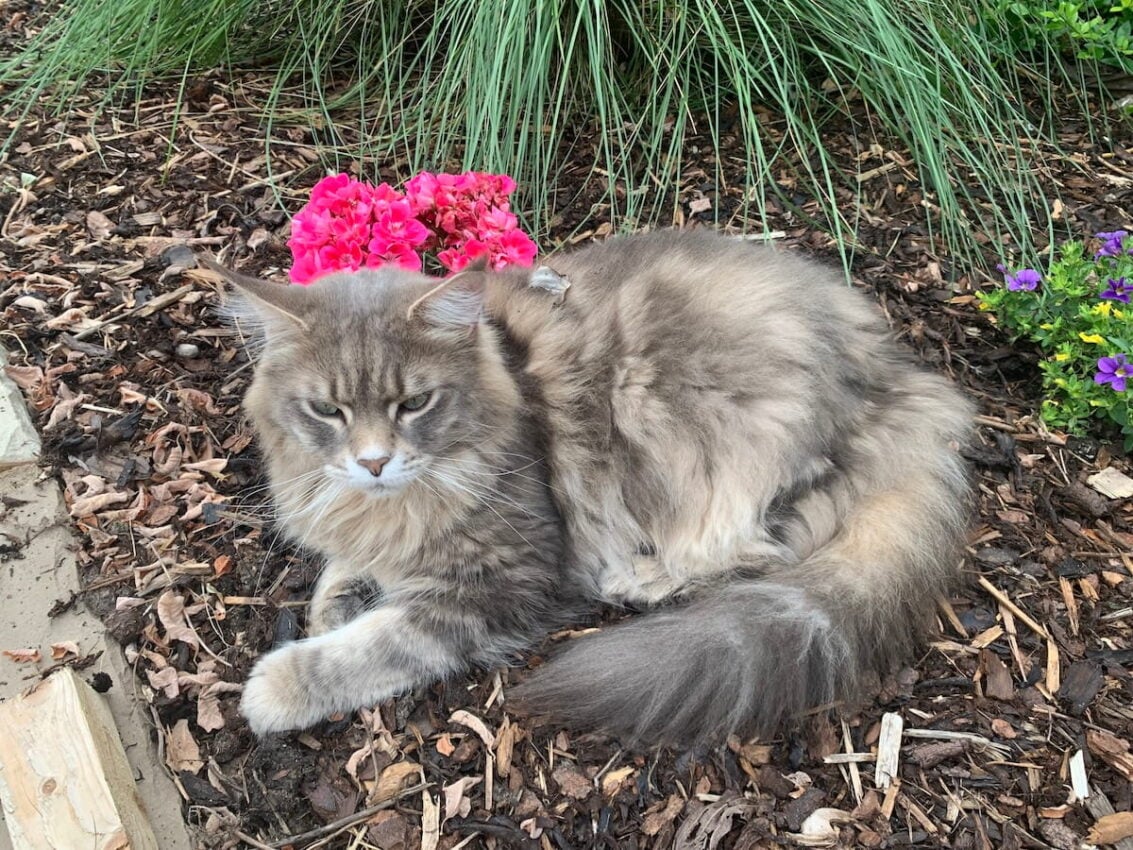
Mika is a real-life example. Most people would describe him as gray, but his correct color is blue tabby.
3. Tabby Pattern
Tabby describes visible markings rather than one particular color. Depending on the cat and registry, the pattern may be:
- Classic or blotched
- Mackerel
- Spotted
- Ticked
Tabby Maine Coons can be brown, blue, silver, red, cream, patched, golden, or combined with white.

4. Silver, Smoke, Golden, Or Tipping
These terms provide more information about pigmentation along the hair shaft.
- Silver tabby: Visible tabby markings over a pale or white ground color
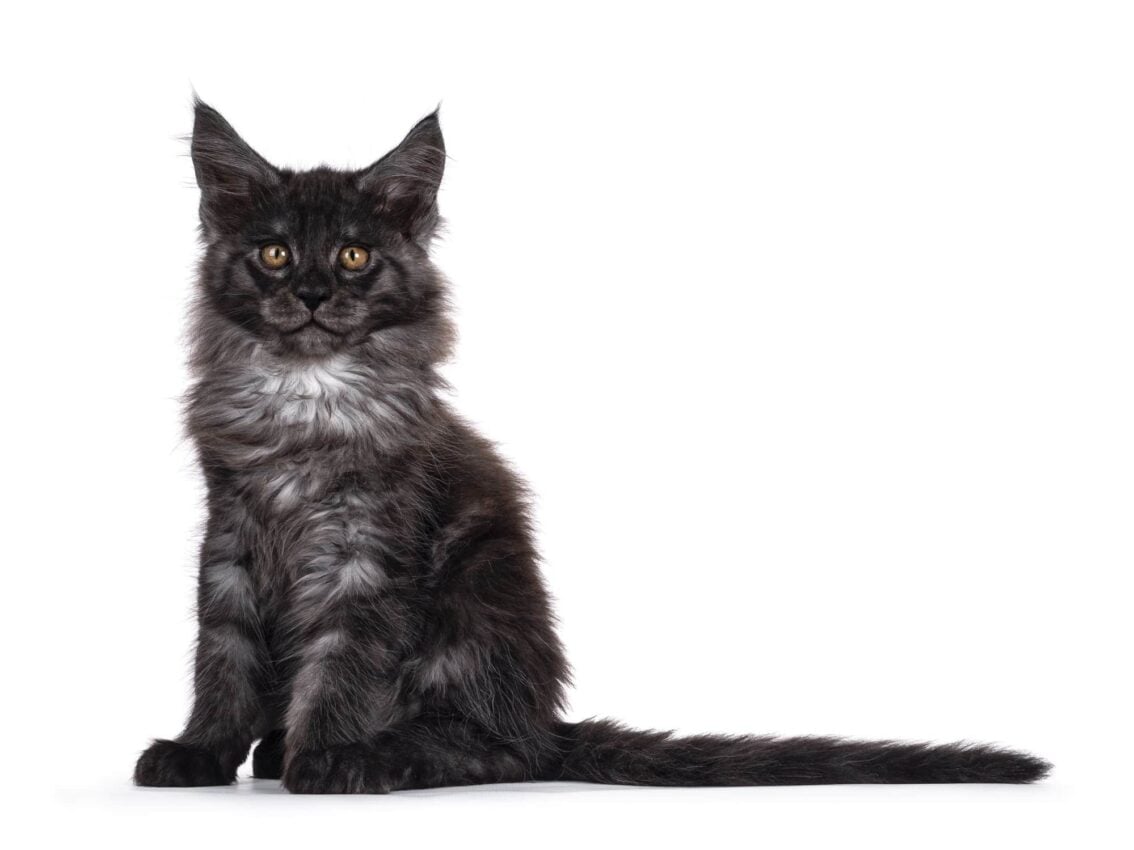
- Smoke: A largely solid-looking coat with pale or white roots beneath colored tips
- Shaded: A relatively small portion of each hair is colored
- Shell or chinchilla: Only the very end of the hair carries color
- Golden: A warm golden ground color with darker tipping or markings
5. Tortoiseshell Coloring
Tortoiseshell coats contain both black-based and red-based color areas. The diluted version combines blue and cream. When visible tabby markings are also present, the cat may be described as a patched tabby or torbie.
6. White Spotting
White spotting can be added to many underlying colors and patterns. It may appear as:
- A small white chin or chest patch
- White paws
- White on the chest and belly
- White facial markings
- A balanced bicolor coat
- A mostly white coat with colored areas
Not every coat description needs all six layers. A solid black Maine Coon may need only one color term. By contrast, blue silver classic tabby with white contains several separate pieces of information:
- Blue: diluted black pigment
- Silver: pale coloring near the base of the hairs
- Classic: broad swirled tabby markings
- With white: separate white spotting
The UC Davis feline coat-color guide explains how separate genes influence agouti patterning, dilution, color restriction, and other aspects of the finished coat.
For the letters and numbers found on pedigrees, see our guide to Maine Coon color codes.

Maine Coon Color And Pattern Chart
| What owners often call it | Registered or commonly used term | What it means | Detailed guide |
|---|---|---|---|
| Brown striped Maine Coon | Brown tabby | Dark markings over a warm brown ground color | Tabby Maine Coon |
| Black Maine Coon | Black | Black-based coat without an obvious adult tabby pattern | Black Maine Coon |
| Gray Maine Coon | Blue | Diluted black pigment producing a gray-blue coat | Blue Maine Coon |
| Orange or ginger Maine Coon | Red | Registry term for orange-colored pigment | Orange Maine Coon |
| Pale orange Maine Coon | Cream | Diluted form of red | Cream Maine Coon |
| White Maine Coon | White | White coloring that may conceal an underlying genetic color | White Maine Coon |
| Silver Maine Coon | Silver tabby, shaded silver, or shell silver | Colored markings or tips over a pale undercoat | Silver Maine Coon |
| Smoke Maine Coon | Black, blue, red, cream, or tortie smoke | Strongly colored tips over pale or white roots | Smoke Maine Coon |
| Very pale tipped coat | Shaded or shell/chinchilla | Pigment is concentrated toward the hair tips | Shaded Maine Coon |
| Tortie | Tortoiseshell | Black and red, or blue and cream, appear together | Explained below |
| Striped tortie | Patched tabby or torbie | Tortoiseshell coloring with tabby markings | Explained below |
| Calico | Tortoiseshell and white | Black and red, or blue and cream, combined with visible white | Calico Maine Coon |
| Tuxedo | Usually black and white | Informal description of a dark coat with white markings | Tuxedo Maine Coon |
| Golden Maine Coon | Golden tabby, shaded, or shell | Warm golden ground color with darker pigment | Explained below |
Maine Coon Color Gallery
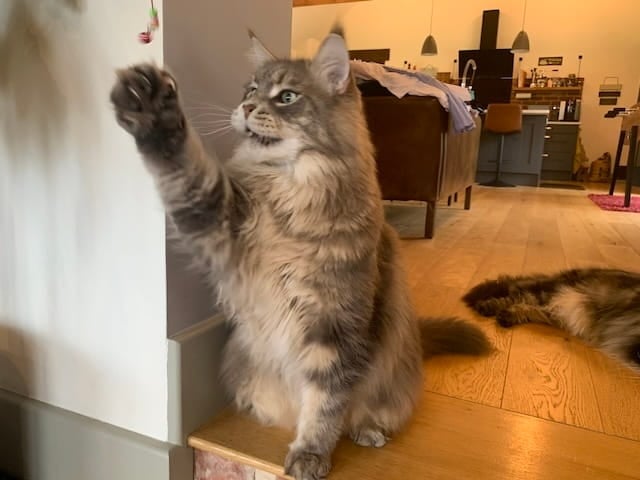
 Blue tabby Maine Coon Cat
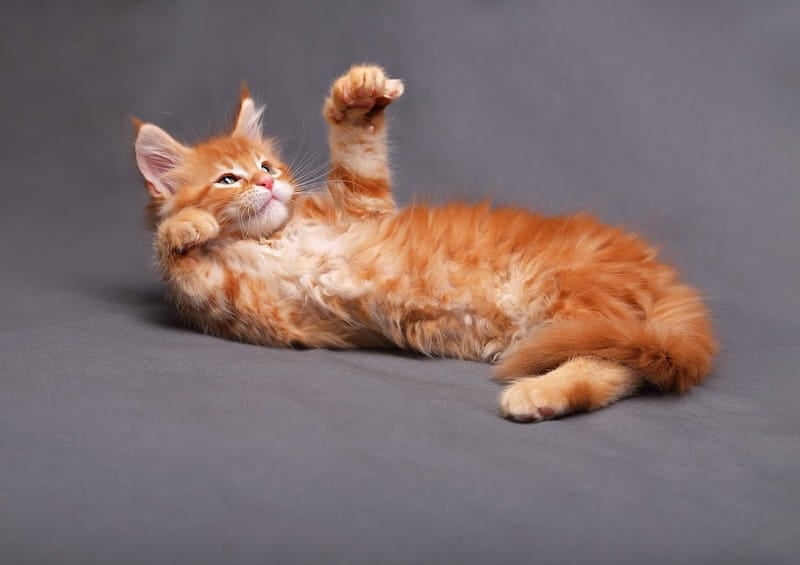
 Orange Maine Coon Kitten resting on its back
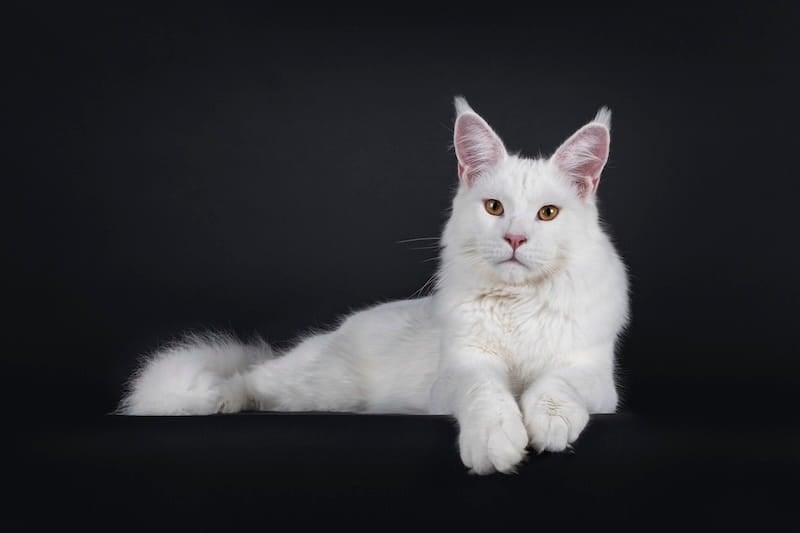
 Solid White Maine Coon Cat
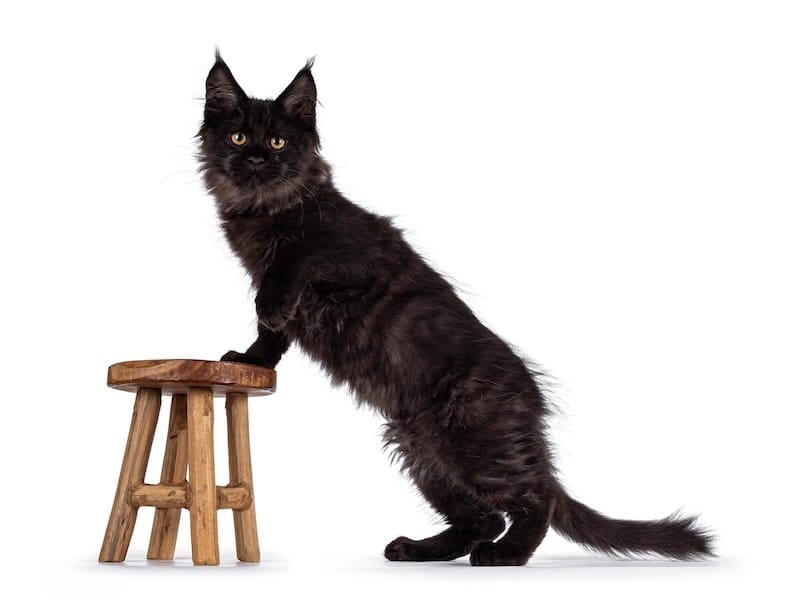
 Smoke Maine Coon kitten
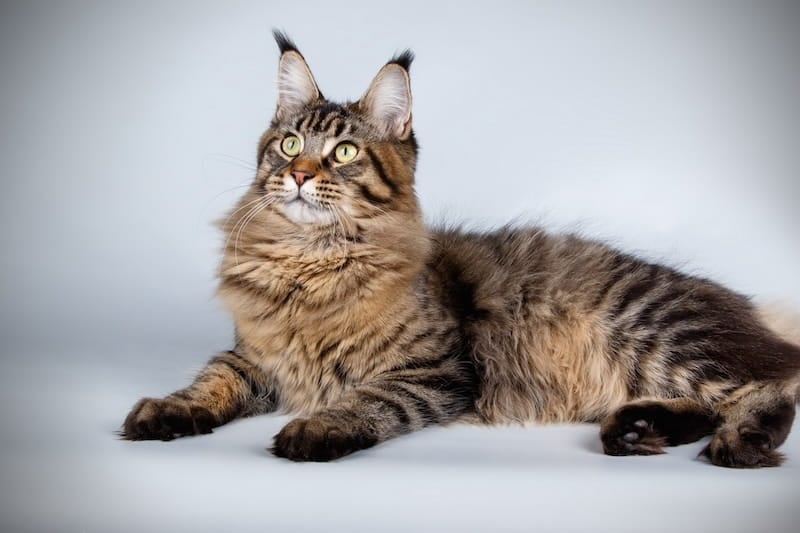
- Tabby Maine Coon Cat Sitting Down
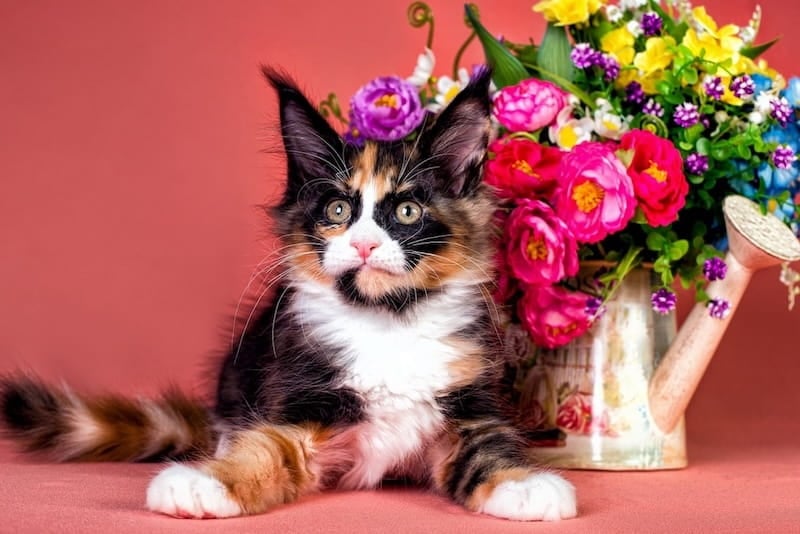
 Calico Maine Coon Kitten
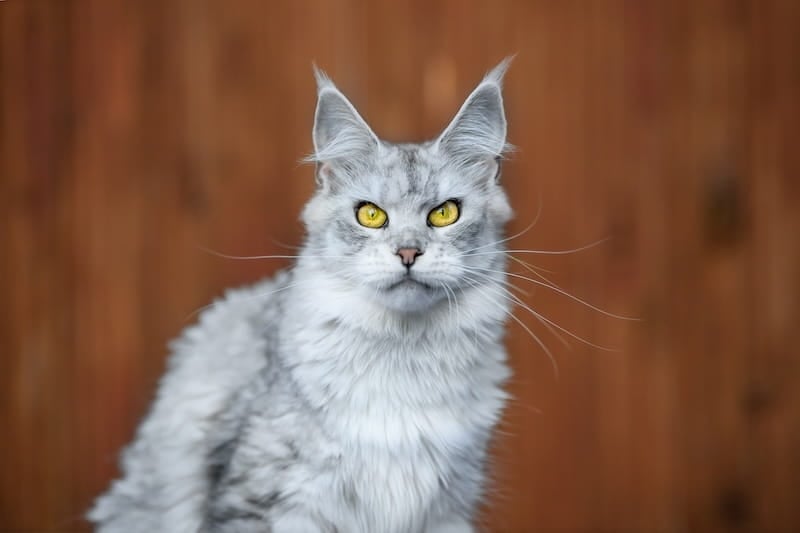
- Silver tabby Maine Coon cat
- On the left is a Solid blue Maine Coon kitten. On the right is a brown patched tabby and white Maine Coon kitten
- On the left is a Black silver tabby and white Maine Coon. On the right is a Brown tabby Maine Coon
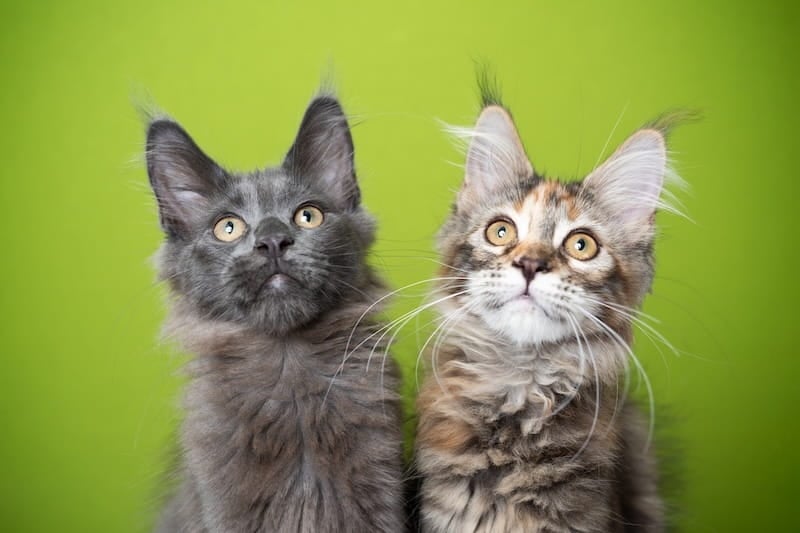
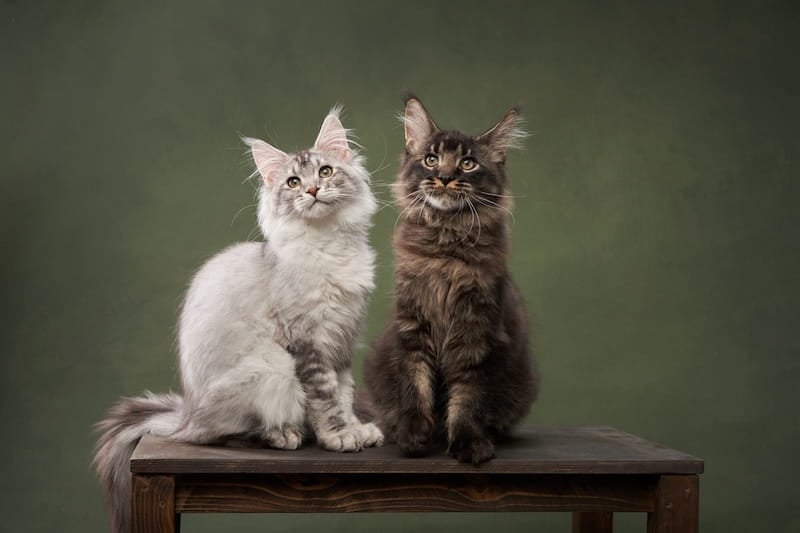
Which Maine Coon Colors Are Recognized?
Major cat registries recognize a broad range of Maine Coon colors, but they do not classify every coat in the same way.
| Registry | Current approach |
|---|---|
| The International Cat Association | Accepts ticked, classic, spotted, mackerel, and shaded or chinchilla descriptions. Pointed patterns and nontraditional colors such as chocolate, lilac, cinnamon, fawn, and caramel are excluded. |
| The Cat Fanciers’ Association | Its Maine Coon standard includes classic, mackerel, and ticked tabbies, as well as solids, silver, smoke, shaded, shell, bicolor, and particolor classes. |
| Governing Council of the Cat Fancy | Describes recognized solids, tortoiseshells, classic and mackerel tabbies, silver, smoke, shaded, bicolor, and particolor coats. |
| Fédération Internationale Féline | Uses EMS codes for color, pattern, white spotting, silver, and golden effects. Its standard effective January 1, 2026 includes golden Maine Coon color groups. |
TICA’s current Maine Coon standard lists ticked, classic, spotted, and mackerel among its accepted patterns. CFA describes classic, mackerel, and ticked tabbies, while the current GCCF breed page specifically highlights classic and mackerel tabbies.
The current FIFe standard permits black, blue, red, cream, tortie, silver, smoke, white, and golden combinations, with several patterns and amounts of white. It excludes pointed patterns, chocolate, lilac, cinnamon, and fawn.
These differences do not make a cat more or less of a Maine Coon. They mean that similar coats may be recorded, grouped, or judged differently.
A seller advertising a “rare chocolate,” “lilac,” or colorpoint Maine Coon should be able to identify the registry under which the kitten is registered and provide a verifiable pedigree. The word rare is not evidence that a color is recognized or that a cat is a pedigree Maine Coon.
Main Maine Coon Colors
Black
A solid black Maine Coon has black-based pigment throughout the visible coat without clearly defined adult tabby markings. Some kittens display faint ghost stripes that become less noticeable as the adult coat develops. Bright sunlight may also make black fur appear rusty or brown.
Black pigment is also responsible for the dark markings of a brown tabby. The warmer areas between the stripes do not mean that the markings themselves are genetically brown.
Learn more in our black Maine Coon guide.
Blue: The Official Term For Gray
In cat terminology, blue means diluted black. The coat may appear:
- Pale gray
- Slate blue
- Charcoal gray
- Silvery blue
- Warm gray under some lighting
Blue Maine Coons may be solid, tabby, silver, smoke, blue-cream, or combined with white.
Mika is officially a blue tabby, although I initially thought of him as gray. His darker blue markings become much more obvious in certain lighting, particularly around his back, legs, and tail.
A regular blue tabby may have a warmer ivory or fawn-toned background. A blue silver tabby normally has a colder, paler silver background beneath the blue markings.
See our complete blue Maine Coon guide.

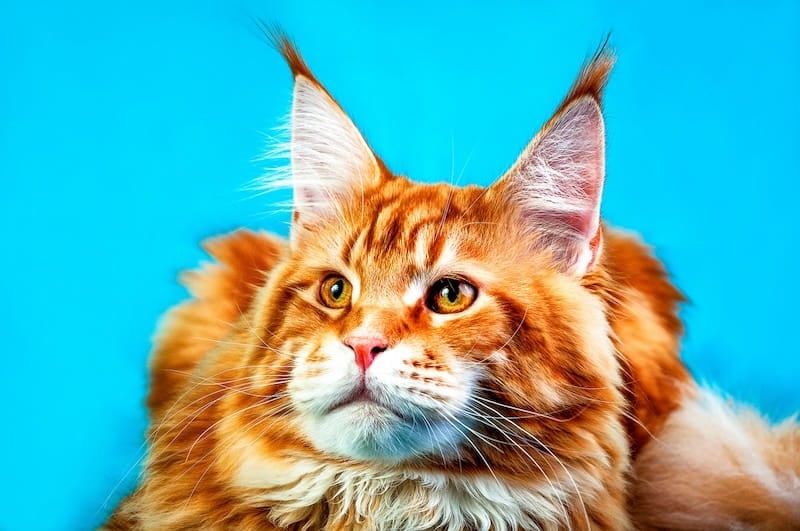
Red: The Official Term For Orange
What pet owners commonly call orange, ginger, or marmalade is normally described as red by cat registries. Red coats range from pale orange to deep copper-red. Tabby markings are often visible on red cats even when the coat appears fairly even from a distance.
Red may be combined with:
- Silver
- Smoke
- White
- Shaded or shell tipping
- Tortoiseshell-related patterns
Explore the variations in our orange Maine Coon guide.
Cream
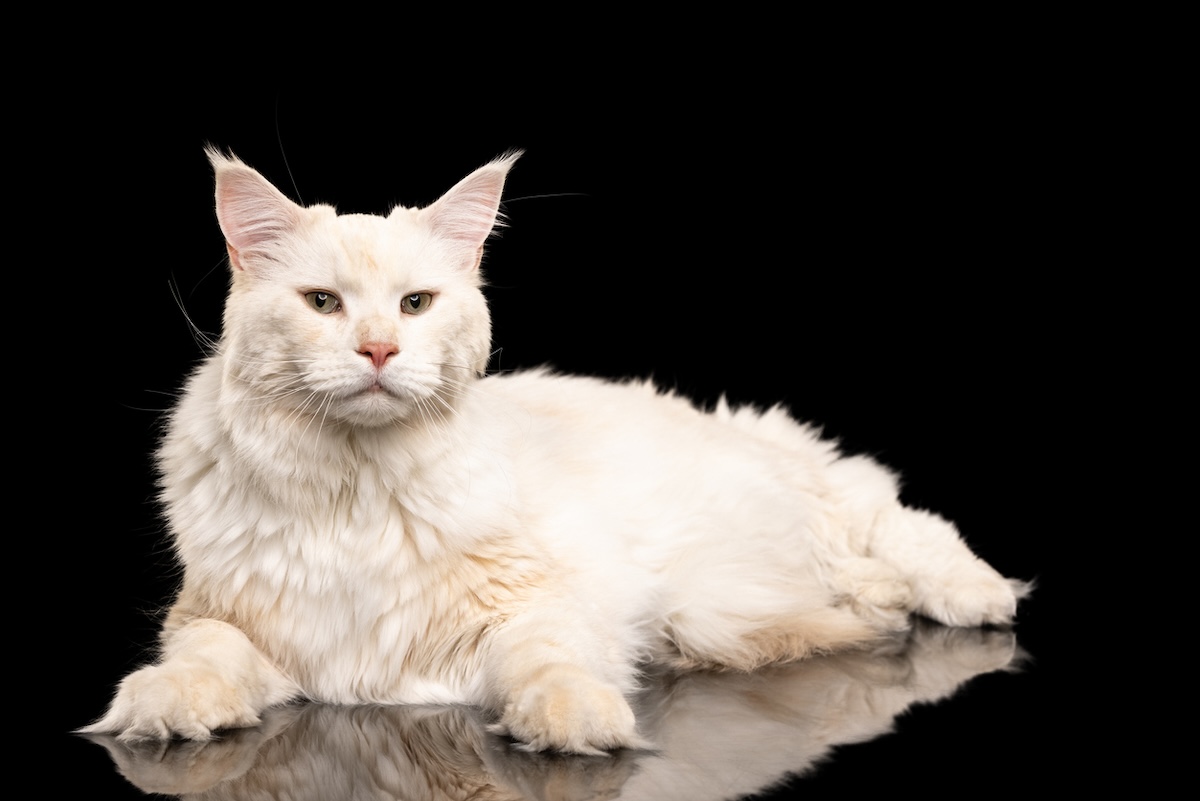
Cream is the diluted form of red. The coat may look pale peach, beige, or soft apricot. Like red, cream frequently retains visible tabby markings.
Cream combinations include:
- Cream tabby
- Cream silver tabby
- Cream smoke
- Cream shaded
- Cream and white
- Blue-cream
- Dilute calico
See our cream Maine Coon guide.
White
A white Maine Coon is not the same as a silver cat. A solid-white coat appears white throughout the visible fur, while a silver Maine Coon retains colored tips or tabby markings over a pale base. White Maine Coons may have blue, green, gold, copper, or odd-colored eyes.
Dominant-white coloring is associated with an increased risk of congenital deafness, particularly among some cats with one or two blue eyes. It does not mean that every white or blue-eyed cat is deaf. The Cornell Feline Health Center explains that the established color-linked concern is hearing, not an increased general risk of blindness.
Our white Maine Coon guide covers genetics, deafness testing, eye colors, and care.

Maine Coon Coat Patterns And Effects
Solid Or Self
A solid Maine Coon appears to have one even color without a prominent adult tabby pattern. Common solid descriptions include:
- Black
- Blue
- Red
- Cream
- White
Red and cream cats can retain visible tabby markings. Young solid-colored cats may also show ghost stripes.
Tabby
Tabby is the pattern most strongly associated with Maine Coons.
| Pattern | Appearance |
|---|---|
| Classic or blotched | Broad swirls and marbled markings, often with a bullseye shape on the sides |
| Mackerel | Narrow stripes descending from a darker line along the spine |
| Spotted | Spots or broken sections of striping |
| Ticked | Individually banded hairs with fewer obvious body stripes |
Tabby Maine Coons commonly have:
- An M-shaped marking on the forehead
- Lines around the eyes and cheeks
- Rings around the legs and tail
- Necklaces across the chest
- Spots on the abdomen
Bali, Mika, and Pippin all have or had the distinctive M marking. However, this is a general tabby feature. It does not prove that a cat is a Maine Coon.
Read our complete tabby Maine Coon guide.
Silver, Smoke, Shaded, And Shell
These terms are often confused because each can create a pale or luminous undercoat.
- Silver tabby: Visible tabby markings over a pale silver background
- Smoke: A solid-looking coat with pale or white roots beneath strongly colored tips
- Shaded: A smaller portion of each hair tip carries pigment
- Shell or chinchilla: Only a very small part of the tip is colored
A smoke Maine Coon may look nearly solid while resting, then reveal a pale undercoat as the cat walks or the fur is parted. A silver tabby retains recognizable stripes, swirls, spots, or ticking.
Compare our silver, smoke, and shaded Maine Coon guides.
Golden Maine Coons
Golden is a warm coat effect in which the ground color appears golden, apricot, honey-colored, or beige beneath darker tipping or tabby markings.
It should not be confused with:
- Red or orange
- Cream
- Brown tabby
- Warm silver affected by rufousing
Recognition varies between registries. The FIFe Maine Coon standard effective January 1, 2026 includes black, blue, red, cream, and tortie-based golden groups, with or without white. These may carry shell, shaded, classic, mackerel, spotted, or ticked codes.
Because registry rules differ, anyone buying a golden Maine Coon should check how the kitten is registered rather than relying only on a breeder’s description.
Tortoiseshell, Torbie, And Calico
These coats contain both black-based and red-based color areas.
- Tortoiseshell: Black and red appear together
- Blue-cream: Diluted tortoiseshell containing blue and cream
- Torbie or patched tabby: Tortoiseshell coloring with visible tabby markings
- Calico: Tortoiseshell coloring combined with clearly visible white
- Dilute calico: Blue and cream combined with white
Most tortoiseshell and calico cats are female because the orange color gene is carried on the X chromosome. Male tortoiseshell or calico cats can occur but are uncommon and often have an additional X chromosome.
See our calico Maine Coon guide.

With White, Bicolor, And Tuxedo
White spotting may be added to almost any underlying color or pattern. A Maine Coon may have:
- A white chin
- White paws
- A white chest and belly
- White facial markings
- A balanced bicolor pattern
- Large white areas across the body
Tuxedo is an informal description rather than a separate breed, genetic color, or temperament type. It commonly refers to a black-and-white cat whose markings resemble formal clothing. A registry is more likely to describe the cat as black and white, bicolor, or with white.
Compare our tuxedo Maine Coon and black-and-white Maine Coon guides.
Less-Common Maine Coon Color Terms
| Term | Meaning |
|---|---|
| Blue silver tabby | Blue tabby markings over a pale silver ground color |
| Cream silver tabby | Cream markings over a pale silver ground color |
| Patched tabby | Tabby coat containing areas of red or cream; often called a torbie |
| Blue patched tabby | Blue tabby coloring combined with cream patches |
| Blue-cream | Diluted tortoiseshell combining blue and cream |
| Dilute calico | Blue and cream combined with clearly visible white |
| Cameo | CFA terminology used for certain red-silver coats |
| Chinchilla blue silver | A very pale shell coat with blue pigment concentrated at the tips |
| Golden | A warm golden ground color with darker tipping or tabby markings |
These are not necessarily separate base colors. They are combinations of color, dilution, tabby pattern, silver or golden effects, tipping, and white spotting. Owners do not need to memorize every possible term. The important skill is learning to separate the different layers of the coat description.
How To Identify A Maine Coon’s Color
Use this sequence when examining a coat:
- Identify the main pigment
Does the coat appear black, gray-blue, red-orange, cream, or completely white? - Check for tabby markings
Look for an M on the forehead, facial lines, leg bars, tail rings, side swirls, narrow stripes, spots, or ticked hairs. - Part the fur
Pale roots beneath dark tips may indicate silver, smoke, shaded, or shell coloring. - Look for red or cream patches
These may indicate tortoiseshell, blue-cream, torbie, patched tabby, or calico. - Record white separately
Add white paws, chest, belly, face, or body patches to the underlying color and pattern description. - Check the pedigree
A registered color name or code is generally more dependable than guessing from a photograph.
Examine the coat in natural daylight where possible. Camera settings, artificial light, sun fading, seasonal shedding, and kitten fur can all alter the visible shade.
Do Maine Coon Kittens Change Color?
A kitten’s genetic color does not normally transform into a completely unrelated color, but its appearance may change substantially as the adult coat develops. Changes may include:
- Stronger or softer pattern contrast
- More visible silver or smoke roots
- Longer guard hairs
- A fuller neck ruff
- Greater color depth
- Seasonal differences in undercoat density
I noticed this with my own cats. Mika’s blue tabby markings became easier to distinguish in some lighting, while Bali and Pippin’s warmer brown tabby coats changed in depth and fullness as their adult fur developed.
Read Do Maine Coon Kittens Change Color? for a more detailed explanation.
Does Coat Color Affect Personality?
There is no reliable basis for predicting a Maine Coon’s personality from coat color alone. Claims that orange cats are always friendlier, tortoiseshell cats are always feistier, or black cats are calmer are stereotypes rather than dependable predictions.
Temperament is influenced by:
- Individual genetics
- Parental temperament
- Early handling
- Socialization
- Health
- Age
- Environment
- Previous experiences
Mika, Bali, and Pippin are or were all tabbies, yet their personalities have been clearly different. Mika was extremely timid and anxious when we adopted him. Bali was described by his previous owner as openly affectionate. Their different colors did not explain their behavior, and neither did their shared tabby pattern.
Choose a breeder for health testing, kitten welfare, socialization, and honest temperament information – not because one color is advertised as friendlier, calmer, larger, or more intelligent.
Our Maine Coon personality guide explains the breed’s general traits while recognizing individual differences.
Are Some Maine Coon Colors Rare?
Some combinations are encountered less frequently than traditional brown tabbies, but no reliable worldwide database shows the exact proportion of Maine Coons in every color and pattern.
Availability varies according to:
- Country
- Registry
- Bloodline
- Breeding program
- Local demand
- Time period
Be cautious with lists claiming to identify one definitive “rarest Maine Coon color.” A color that is uncommon in one area may be produced regularly elsewhere. Terms such as rare, European, exotic, or unusual do not prove pedigree quality, health, or responsible breeding.
A common-colored kitten from properly screened parents is a better choice than an unusually colored kitten produced without appropriate health safeguards.
Frequently Asked Questions
How many Maine Coon colors are there?
There is no single total that applies to every registry. Maine Coons occur in dozens of combinations involving black, blue, red, cream, white, tabby, tortoiseshell, silver, smoke, shaded, shell, golden, and white spotting.
What is the most common Maine Coon color?
Brown tabby is the color and pattern most strongly associated with the traditional Maine Coon appearance. Classic and mackerel brown tabbies are both commonly seen. No authoritative worldwide percentage is available.
What is the rarest Maine Coon color?
No reliable worldwide dataset identifies one definitive rarest Maine Coon color. Some shaded, shell, smoke, golden, tortoiseshell, calico, or heavily white combinations may be harder to find, but availability varies between regions and breeding lines.
Is a gray Maine Coon actually blue?
Usually, yes. Gray fur caused by diluted black pigment is officially called blue. A cat may be solid blue, blue tabby, blue silver, blue smoke, blue-cream, or blue with white.
Is an orange Maine Coon officially called red?
Yes. Red is the standard registry term for the color pet owners normally call orange or ginger. The diluted version is cream.
Is tabby a Maine Coon color?
Tabby is a pattern rather than one color. Maine Coon tabbies may be brown, blue, red, cream, silver, golden, patched, or combined with white.
Does the M on a cat’s forehead prove it is a Maine Coon?
No. The M is a common tabby marking found in pedigree and mixed-breed cats. Bali, Mika, and Pippin all have or had the marking, but it does not prove Maine Coon ancestry.
What is the difference between silver and smoke?
A silver tabby has visible tabby markings over a pale silver ground color. A smoke Maine Coon appears solid or nearly solid but has pale or white roots beneath its colored tips.
Are chocolate, lilac, or colorpoint Maine Coons recognized?
These colors and pointed patterns are excluded or restricted under major Maine Coon standards. A breeder advertising one should provide verifiable registration and explain which registry recognizes the cat.
Does color affect a Maine Coon’s size?
There is no evidence that coat color determines adult size. Gender, family line, overall genetics, nutrition, health, and development are more meaningful influences.
Final Thoughts
Maine Coons occur in far more colors and patterns than the traditional brown tabby alone. The key to identifying a coat is to separate its individual elements:
- Base color
- Dilution
- Tabby pattern
- Silver, smoke, golden, or tipping
- Tortoiseshell coloring
- White spotting
Bali and Pippin are brown tabbies, while Mika is a blue tabby. Their coats show how one description can contain both a color and a pattern. They also demonstrate how lighting, maturity, coat length, and seasonal fullness can alter a cat’s appearance without changing its genetic color.
Photographs provide a useful starting point, but the registered description and pedigree code offer the most reliable identification for a pedigree Maine Coon.
Most importantly, color should never be prioritized above health, temperament, ethical breeding, or responsible adoption. The coat may be what first attracts your attention, but it does not determine the quality or personality of the cat beneath it.
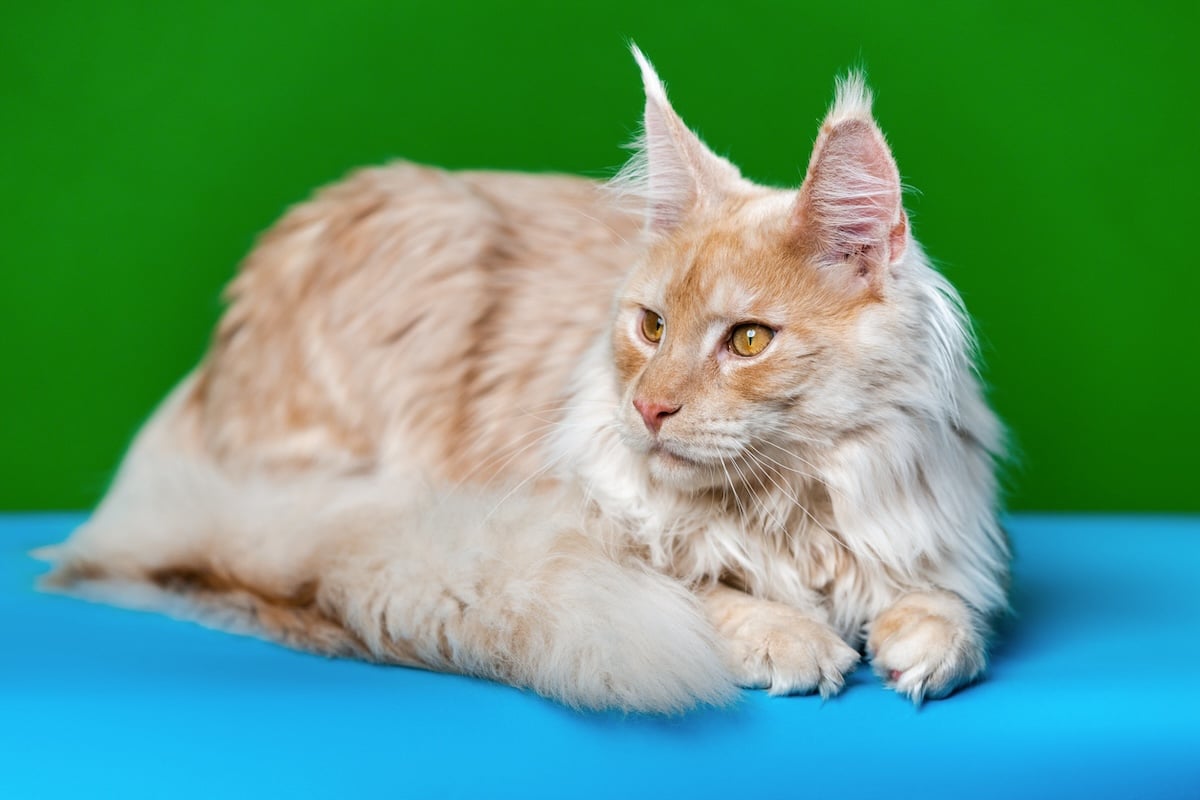
The “M” on the forehead is a tabby marking. It is not proof that a cat is a Maine Coon.