Bobcat Vs Maine Coon: 7 Key Differences Explained
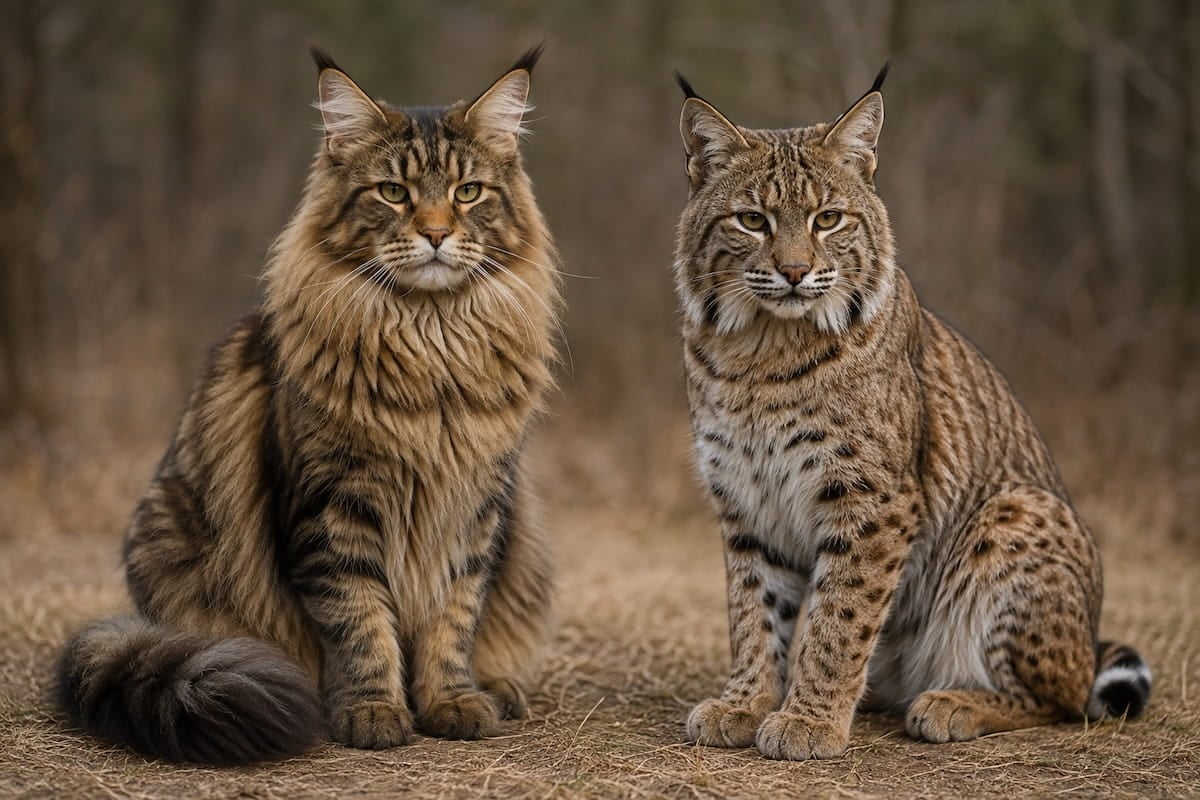
Bobcats and Maine Coons are often compared because both can be large, rugged-looking cats with tufted ears, substantial paws, and striking facial features. But one feature makes them surprisingly easy to tell apart: the tail.
Maine Coons have a long, flowing, heavily furred tail, while bobcats have a distinctive short, naturally bobbed tail. Their body shape, coloring, behavior, and ancestry are also very different.
The Maine Coon is a domestic cat breed, while the bobcat (Lynx rufus) is a wild North American cat. Although their size ranges can overlap, a Maine Coon is not simply a domesticated version of a bobcat.
If you’re unfamiliar with the breed’s defining characteristics, see our guide to What Is A Maine Coon?
Quick Answer
A Maine Coon is a large domestic cat, while a bobcat is a wild North American cat. The easiest visual difference is usually the tail: Maine Coons have long, flowing tails, whereas bobcats have short, naturally bobbed tails.
Their weight ranges can overlap, but bobcats have a more compact wild-cat build, while Maine Coons have the long, rectangular body specified in the breed standard. Despite their similar tufted ears and rugged appearance, there is no credible evidence that bobcats contributed to Maine Coon ancestry.
Bobcat Vs Maine Coon At A Glance
| Feature | Maine Coon | Bobcat |
|---|---|---|
| Type | Domestic cat breed | Wild cat species |
| Scientific classification | Felis catus | Lynx rufus |
| Typical adult weight | Females around 12-15 lb; males around 18-22 lb | Roughly 9-33 lb, with substantial regional variation |
| Body shape | Long, rectangular and substantial | Compact, muscular wild-cat build |
| Tail | Long and flowing | Short and naturally bobbed |
| Ears | Large and well-furnished; lynx tips vary | Pointed, with small ear-tip tufts |
| Coat | Wide range of domestic-cat colors and patterns | Usually buff, brown, reddish or gray with darker spots/stripes |
| Behavior | Domesticated companion cat | Primarily solitary and territorial wild cat |
| Bobcat ancestry in Maine Coons? | No credible evidence | N/A |
Which Is Bigger: A Bobcat Or Maine Coon?
Their size ranges overlap more than many people realize.
The International Cat Association states that adult female Maine Coons are typically around 12-15 pounds, while males are usually around 18-22 pounds. Bobcats vary considerably by location and individual. The Smithsonian’s National Zoo gives a broad range of approximately 9-33 pounds, with larger bobcats generally occurring farther north. This means a large Maine Coon can genuinely weigh more than a small bobcat.
The bigger difference is how that weight is carried. Maine Coons have long, substantial bodies with a rectangular outline, whereas bobcats have a more compact, muscular wild-cat build. So it is misleading to say that one animal is always bigger than the other. For realistic Maine Coon weight and development expectations, see my Maine Coon Size and Growth guide.
The Biggest Difference: Their Tails
If you only remember one difference between a bobcat and Maine Coon, remember the tail.
The Cat Fanciers’ Association Maine Coon standard describes the breed’s tail as long, wide at the base, tapering, and covered in long, flowing fur. A bobcat is almost the opposite. Its short, naturally bobbed tail is one of the species’ defining characteristics and is the feature that gave the animal its common name.
The National Park Service describes bobcat tails as roughly 3.5-7 inches long, depending on the animal and population. So although their ears and faces can occasionally look remarkably similar:
- Long, flowing tail = strongly favors Maine Coon or another domestic cat.
- Very short, naturally bobbed tail = characteristic of a bobcat.
Body Structure And Shape
Bobcat
- Stocky & Muscular: Built for bursts of speed and stealthy pounces.
- Short Tail: Bobcats have a naturally short, bobbed tail, in sharp contrast with the Maine Coon’s long plumed tail.
- Strong Paws And Legs: Bobcats have powerful limbs and paws suited to climbing, stalking, sprinting, and pouncing in a wild environment.
Maine Coon
- Rectangular Frame: Slightly elongated body supported by strong legs.
- Long, Flowing Tail: The Maine Coon breed standard calls for a long tail that is wide at the base, tapering, and covered in flowing fur.
- Large, Tufted Paws: Large, round, well-tufted paws are a characteristic feature of the Maine Coon breed.
Ears And Lynx Tips
The ears are one of the main reasons people compare Maine Coons with bobcats.
Maine Coons have large, well-furnished ears, and many develop wispy hairs extending upward from the tips. These are commonly called lynx tips because of their resemblance to the ear tufts seen on wild cats in the Lynx genus. Bobcats also have pointed ears with small tufts at the tips. However, ear tufts are an appearance trait, not evidence that a Maine Coon has bobcat ancestry.
Maine Coon lynx tips also vary considerably between individuals. Some are dramatic, while others are small and proportional.
Learn more in my guide to Maine Coon Lynx Tips And Ear Furnishings.
Coat And Coloring
Bobcats have a much narrower natural range of colors than Maine Coons. The National Park Service describes bobcats as ranging from brown and buff shades to reddish or grayish coats, usually with darker spots or streaks.
Maine Coons, by contrast, occur in a huge variety of domestic-cat colors and patterns, including brown tabby, silver, blue, red, cream, black, white, tortoiseshell, smoke, and bicolor. A brown tabby Maine Coon can therefore resemble a bobcat much more strongly than a solid black or white Maine Coon. But coloring alone is a poor identification tool. Tail length, body proportions, facial structure, and behavior are much more informative.
See my Maine Coon Colors And Patterns Guide for the full range of recognized coats.
Temperament And Behavior
Behavior is one of the most fundamental differences between these cats.
Bobcats are wild animals. The Smithsonian describes them as primarily solitary and territorial, with individuals maintaining and scent-marking home ranges. Their behavior has evolved around hunting, reproduction, territory, and survival rather than living as human companion animals. Maine Coons are domesticated cats. TICA describes the breed as gentle, friendly, playful, and people-oriented.
Maine Coons commonly live within family homes and can form close relationships with their owners and other household pets. So the distinction isn’t that bobcats are simply “meaner” Maine Coons. One is a wild felid; the other is a domesticated companion breed.
Are Maine Coons Part Bobcat?
There is no credible evidence that bobcats contributed to Maine Coon ancestry. Maine Coons and bobcats are both members of the cat family, so saying they are completely “unrelated” is technically inaccurate. But they belong to different felid lineages, and that is very different from claiming that Maine Coons are descended from modern bobcats.
Genetic research examining domestic-cat populations found that Maine Coons cluster with Western European domestic cats and breeds. That evidence fits a domestic-cat origin much better than the old theory that Maine Coons developed through breeding with North American bobcats.
I examine this wider myth in Maine Coon Lynx Mix: Are Maine Coons Really Part Lynx?
Can A Maine Coon And Bobcat Breed?
There is no established Maine Coon × bobcat breed and no verified breeding population of these hybrids. Claims of bobcat-domestic cat hybrids have been made, but appearance alone cannot establish hybrid ancestry.
In one published case, an animal’s owner claimed it was a bobcat-domestic cat hybrid. Researchers developed a genetic test to investigate the claim and found no detectable domestic-cat contribution in the animal tested. That doesn’t prove every conceivable wild/domestic feline cross is biologically impossible. It does show why a supposed Maine Coon × bobcat requires genetic evidence rather than a photograph of a wild-looking cat.
Conclusion
Bobcats and Maine Coons can look surprisingly similar, but they are fundamentally different cats.
Maine Coons are domesticated cats with long rectangular bodies, large furnished ears, substantial paws, square muzzles, and long flowing tails. Bobcats are wild North American cats with compact muscular bodies, spotted or streaked coats, tufted ears, and characteristically short tails.
Their resemblance explains why the bobcat ancestry myth has survived for so long, but modern genetic evidence does not support bobcats contributing to the Maine Coon breed.
If you’re trying to tell the two apart, start with the tail. A Maine Coon’s long plume and a bobcat’s short bobbed tail are among the clearest differences between them.
Bobcat vs Maine Coon FAQ
Is a Maine Coon related to a bobcat?
Maine Coons and bobcats are both members of the cat family, but there is no credible evidence that modern bobcats contributed to Maine Coon ancestry. Genetic research places Maine Coons among domestic-cat populations.
Which is bigger: a bobcat or a Maine Coon?
Their weight ranges overlap. TICA lists female Maine Coons at around 12-15 pounds and males around 18-22 pounds, while bobcats can range from roughly 9-33 pounds. A large Maine Coon can therefore outweigh a small bobcat, although bobcats have a more compact, muscular build.
Do Maine Coons look like bobcats?
Yes, Maine Coons can resemble bobcats due to their tufted ears, large paws, and thick fur, but their body structure and face shape are different.
Are bobcats dangerous compared to Maine Coons?
Yes, bobcats are wild predators and can be dangerous, while Maine Coons are domesticated and known for their gentle, friendly nature.
Can a bobcat be kept as a pet like a Maine Coon?
No, bobcats are wild animals and are not suitable as pets. Maine Coons, on the other hand, are bred specifically for domestic life.
Why do people confuse Maine Coons with bobcats?
The confusion comes from their similar physical features, especially ear tufts, large size, and rugged appearance.
What is the biggest difference between a bobcat and a Maine Coon?
Biologically, the biggest difference is that the Maine Coon is a domestic cat and the bobcat is a wild species. Visually, the easiest difference is often the tail: Maine Coons have long, flowing tails, while bobcats have very short, naturally bobbed tails.