Are Maine Coons Like Dogs? 13 Dog-Like Traits Explained

Maine Coons are often called “the dogs of the cat world”, but that phrase can be misleading if you take it too literally.
After more than 14 years of living with Maine Coons, including Pippin, Bali, and Mika, I would say the comparison is partly true. Maine Coons are not dogs in cat bodies, and they should never be expected to obey, submit, or tolerate handling like a dog might. They are still cats, with feline instincts, boundaries, independence, and moods.
However, Maine Coons do often behave in ways that feel surprisingly dog-like. Many follow their owners around the house, greet family members at the door, play fetch, learn routines, enjoy puzzle toys, walk on harnesses, respond to names, and seek out human involvement rather than disappearing into the background.
That unusual combination of feline independence and dog-like companionship is one of the biggest reasons people fall in love with the breed.
For the full temperament picture, read my guide to Maine Coon Personality. If you are deciding whether this breed is right for your home, also read the Real Pros and Cons of Maine Coon cats.


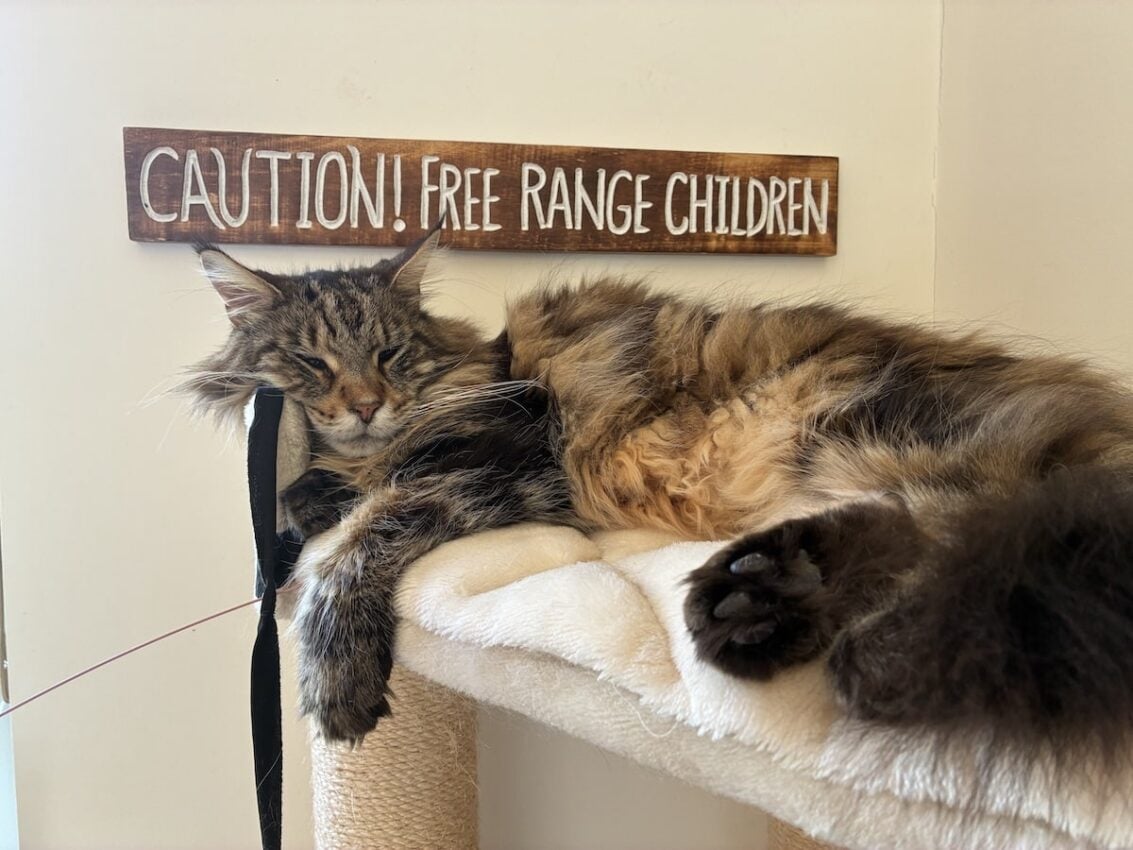
Quick Answer
Maine Coons are often described as dog-like cats because they are usually sociable, loyal, intelligent, playful, and highly people-oriented. Many Maine Coons follow their owners from room to room, greet people at the door, play fetch, enjoy training, respond to routines, and want to be involved in family life.
However, Maine Coons are still cats. They do not behave exactly like dogs, and they should not be expected to obey commands blindly, tolerate forced interaction, or need constant human direction. Their dog-like reputation comes from their companion-focused personality, not from true canine behaviour.
Maine Coons are often called dog-like because they are sociable, loyal, trainable, playful, and interested in family life. However, these traits are really part of the wider Maine Coon temperament rather than proof that the breed behaves like a dog in every way.
To understand the full range of breed traits, including sociability, confidence, intelligence, vocalisation, and individual personality differences, read my full guide to Maine Coon personality.
What Does “Dog-Like Cat” Actually Mean?
When people say Maine Coons are dog-like, they are usually talking about behaviour and emotional presence, not species identity.
A dog-like Maine Coon may:
- Follow you around the house
- Greet you when you come home
- Play fetch
- Learn commands or routines
- Enjoy interactive games
- Respond to their name
- Stay close to family members
- Show loyalty to trusted people
- Walk on a harness
- Communicate frequently
- Want to be involved in daily life
This does not mean the cat is obedient in the same way a dog might be. A Maine Coon usually participates because they are curious, bonded, and interested, not because they are trying to please you in a dog-like way.
That difference matters. Maine Coons are cooperative cats, not obedient dogs.
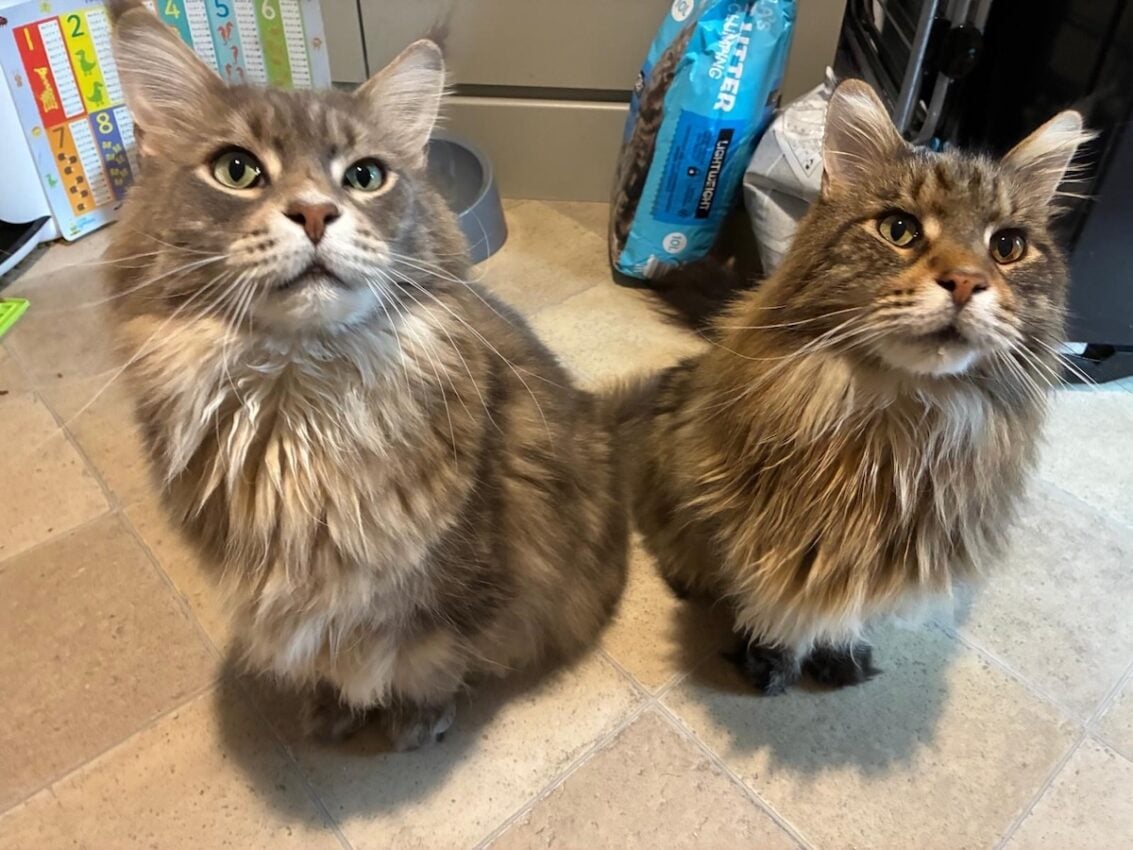
13 Dog-Like Maine Coon Traits
1. Maine Coons Often Follow Their Owners Everywhere
One of the clearest dog-like Maine Coon traits is shadowing.
Many Maine Coons like to know where their owners are and what they are doing. They may follow you into the kitchen, bathroom, bedroom, office, or hallway, then sit nearby and watch. They are not always demanding attention, but they often want to be present.
Mika is the clearest example in my home. He follows me everywhere. He does not always want to be picked up or fussed, but he likes to know what I am doing and where I am going. Sometimes he chats as he walks towards me, as if he has something important to report.
This behaviour is one of the reasons Maine Coons feel different from more independent cats. They are not content to simply share a house with you. Many want to share the routine of your day.
For a deeper look at this behaviour, read why Maine Coons follow their owners.

2. Maine Coons May Greet You At The Door
Dogs are famous for greeting their owners when they come home. Some Maine Coons do something very similar.
Pippin would wait directly by the front door. The second I stepped inside, he would begin chirping enthusiastically and follow me around while vocalising, as if he was reporting on his day or asking where I had been!
Bali shows this differently. He is naturally more cautious, but he sits on the bench near the door and watches the driveway. He does not always rush forward, but he clearly monitors arrivals and reacts when people appear.
Mika does not wait at the door in the same way, but when I come home, he walks towards me with his tail held high and chirps happily. In cat body language, a raised tail often signals confidence and friendly intent.
Not every Maine Coon will physically wait at the door, but many recognise arrival routines and respond emotionally when their person returns.
3. Maine Coons Can Be Loyal Companions
Maine Coon loyalty does not usually look exactly like dog loyalty. A dog may follow commands, seek approval, or look to its owner for constant direction. A Maine Coon is more independent. Their loyalty often shows through proximity, routine, and trust.
A loyal Maine Coon may:
- Choose to stay near you
- Sleep close to you
- Follow your movements
- Greet you when you return
- Seek you out when stressed
- Prefer one person’s company
- Sit beside you rather than on you
- Wait near doors or favourite family areas
Pippin was openly affectionate and confident with people. Bali’s loyalty is quieter and has grown with time. Mika is more emotionally complex, but his attachment is obvious in the way he follows, watches, chats, and checks in.
This is one of the most rewarding parts of Maine Coon ownership. They often feel less like background pets and more like present, involved companions.
4. Maine Coons Can Learn Tricks And Commands
Maine Coons are intelligent cats, and many can learn simple commands when training is positive, consistent, and reward-based.
Pippin was exceptionally clever. He learned to place his paw into my hand on cue, wait when asked, and respond to simple verbal instructions. His ability to pause, observe, and cooperate felt very un-cat-like at times.
Mika is also extremely smart. He can complete a difficult dog treat puzzle toy by manipulating the moving parts until the food drops out. This kind of problem-solving shows patience, memory, and cause-and-effect learning.
You won’t believe your eyes – watch Mika complete a difficult dog-treat toy in my YouTube video:
However, Maine Coons are not dogs. They are unlikely to obey simply because you told them to. They learn best when training feels like a game, and there is something in it for them, whether that is food, attention, praise, play, or curiosity.
For training support, read how to train a Maine Coon cat.

5. Some Maine Coons Play Fetch
Fetch is one of the most famous dog-like Maine Coon behaviours.
Bali loves playing fetch with his favourite mouse toy. He does not just chase it once and lose interest. He retrieves it, brings it back, and waits for the next throw. This makes the game feel genuinely interactive, almost like playing with a small dog.
Here is a YouTube video from Maine Coon Central’s YouTube channel, showing Bali playing fetch with his favorite mouse toy!
Not all Maine Coons play fetch, and owners should not expect every cat to enjoy it. Some prefer wand toys, ribbons, puzzle feeders, balls, tunnels, or stalking games. But the breed’s intelligence and social nature make fetch more common in Maine Coons than many people expect.
Fetch works especially well when the toy is:
- Lightweight
- Easy to carry
- Soft enough to bite
- Interesting in texture
- Used only during play sessions
- Associated with praise or excitement
If you want to try this with your cat, use my step-by-step guide on how to train a Maine Coon to play fetch.
6. Maine Coons Enjoy Interactive Play
Many cats enjoy play, but Maine Coons often prefer games that involve humans.
They may enjoy:
- Wand toys
- Fetch
- Puzzle toys
- Treat games
- Chase games
- Training games
- Hide-and-seek style play
- Ribbon games
- Harness walks
- Food puzzles
All three of my Maine Coons have loved thick, long ribbons. If you plan the game carefully, two cats can play with the same ribbon at the same time, each attacking a different end. It is funny, energetic, and a brilliant way to involve more than one cat in the same activity.
Ribbon play must always be supervised. Long ribbons, string, wool, and similar toys can be dangerous if swallowed, so they should be put away safely after play.
This desire to play with people, not just near people, is one reason Maine Coons appeal to dog lovers.
For toy ideas, read my guide to the best toys for Maine Coon cats.
7. Maine Coons Often Respond To Routines
Maine Coons are excellent pattern-watchers.
They quickly learn household routines, including:
- Feeding times
- Bedtime habits
- Work schedules
- School runs
- Door sounds
- Treat cupboards
- Play routines
- Grooming cues
- Where family members usually sit
This can feel very dog-like because the cat seems to understand the rhythm of family life. Pippin knew household rules early and responded well to routines. Mika recognises door and food routines with almost unsettling accuracy. Bali watches arrivals and movements carefully, even when he acts cautiously.
Routine recognition is not the same as obedience, but it does show how observant Maine Coons can be.
This is also why sudden routine changes can upset some Maine Coons. A cat that is deeply tuned into household rhythms may become unsettled if feeding times, people, sounds, furniture, or access to favourite areas change unexpectedly.
8. Maine Coons Can Walk On A Harness
Many Maine Coons can be trained to walk on a harness, which adds to their dog-like reputation.
Harness walking can be a safe way to give an indoor Maine Coon outdoor enrichment without allowing free roaming. It lets them smell, explore, watch birds, experience new textures, and enjoy fresh air while staying under control.
However, harness walking is not suitable for every cat. Some Maine Coons love it; others freeze, panic, or dislike the sensation of the harness. Training should be slow, positive, and never forced.
A Maine Coon should first get used to:
- Seeing the harness
- Smelling it
- Wearing it indoors briefly
- Receiving treats while wearing it
- Moving naturally indoors
- Exploring a safe outdoor area gradually
Never drag a cat on a lead. A harness walk with a Maine Coon should feel more like supervised exploring than walking a dog down the pavement.
For help, read how to train a Maine Coon to walk on a leash and what is the best harness for a Maine Coon cat?.

9. Maine Coons Communicate Like They Are Having A Conversation
Dogs bark. Maine Coons chirp, trill, warble, murmur, chatter, squeak, and meow.
Many Maine Coons are highly vocal, but not always in a loud or harsh way. Their sounds often feel conversational because they are directed at humans during specific interactions.
Pippin was especially vocal. He did not simply meow randomly; he engaged. When spoken to, he answered. When greeted, he responded. When I returned home, he chirped as though continuing a conversation. Conversations were a daily occurrence. Don’t believe me? … Take a look at this video on the Maine Coon Central YouTube channel, of Pippin chatting away.
Mika also chats as he approaches me, often with an expressive little voice that makes it feel as if he has several things to say. Here’s a short video of Mika talking away to me, also showing on Maine Coon Central’s YouTube channel:
This vocal engagement strengthens the dog-like feeling because the relationship feels two-way. The cat is not just making noise in the background. They appear to be communicating directly with you.
For more on their unusual sounds, read why Maine Coons make weird noises and why Maine Coons don’t meow like ordinary cats.
10. Maine Coons Often Want To Be Involved In Family Life
Maine Coons are rarely invisible pets. Many want to be part of whatever is happening, whether that is cooking, cleaning, working, folding laundry, opening parcels, sitting with children, watching visitors, or investigating bags.
This involvement is one of the breed’s most dog-like features. A Maine Coon may not sit on command, but they will often appear wherever the family action is.
Pippin was bold and confident with visitors. Bali has become more involved over time and now willingly greets cat sitters and visitors at the door, despite still being a scaredy cat underneath. Mika is nervous in some situations, but within his trusted environment, he wants to know what is happening.
This is why Maine Coons can feel so emotionally present. They are not just living around you. They are living with you.
11. Maine Coons Can Be Good For Dog Lovers
Maine Coons are often a good choice for people who like dogs but want, or need, a cat.
They may appeal to dog lovers because they are:
- Sociable
- Interactive
- Trainable
- Playful
- Loyal
- Communicative
- Routine-aware
- Often good with families
- Often comfortable with other pets
- More involved than many cat breeds
However, a dog lover should still remember that a Maine Coon is not a dog substitute. They usually need more independence, gentler handling, more respect for boundaries, and less direct control than a dog.
A Maine Coon may follow you and play fetch, but they may also refuse to cooperate, walk away mid-game, dislike being held, or choose to interact only on their terms.
For a realistic ownership decision, read the pros and cons of Maine Coon cats.
12. Maine Coons Often Have A Fascination With Water
Water interest is not exclusive to Maine Coons, but it is common enough in the breed to feel like another dog-like trait.
Mika is completely obsessed with water. He will lie with his paws wrapped around the pet water fountain and stick his entire face into the flow, soaking the front of his face. It is funny, messy, and very Maine Coon-like: curious, sensory, and completely committed to whatever has caught his interest.
Many Maine Coons:
- Prefer fountains to bowls
- Dip paws before drinking
- Splash deliberately
- Sit beside the taps
- Watch showers
- Investigate running water
- Paw at water surfaces
This does not mean every Maine Coon likes water, and it certainly does not mean every Maine Coon wants a bath. But their curiosity around water often surprises owners who expect cats to avoid it completely.
For more, read why Maine Coon cats love water.
13. Maine Coons Bond Deeply Without Becoming Dogs
The most important dog-like trait is not fetch, water, harness walking, or tricks. It is the bond.
Maine Coons often form strong emotional attachments. They notice routines, respond to familiar voices, seek trusted people, and choose closeness. That bond may be bold like Pippin, cautious but growing like Bali, or emotionally complex like Mika.
This is where the “dog-like” label makes sense, but also where it has limits.
A Maine Coon may be loyal, but they are not submissive.
A Maine Coon may be trainable, but they are not obedient in a dog-like way.
A Maine Coon may follow you, but they still need independence.
A Maine Coon may love affection, but they still need consent and boundaries.
That combination is what makes the breed special.
Maine Coon Vs Dog: Side-By-Side Comparison
| Trait | Maine Coon | Dog |
|---|---|---|
| Greets owner at the door | Often | Usually |
| Follows owner around | Very common | Very common |
| Plays fetch | Some do | Many do |
| Learns routines | Yes | Yes |
| Responds to name | Often | Usually |
| Enjoys training | Often, if rewarding | Usually |
| Walks on harness | Some do | Most dogs walk on leads |
| Needs independence | Moderate to high | Varies, often lower |
| Tolerates forced handling | No | Varies |
| Seeks approval | Less than dogs | Often |
| Communicates vocally | Chirps, trills, meows | Barks, whines, growls |
| Wants family involvement | Often | Usually |
| Obeys commands reliably | Not usually | More likely |
Mainecooncentral.com
Ways Maine Coons Are Still Very Cat-Like
Maine Coons may act dog-like in some ways, but they are still cats.
They still have feline instincts, including:
- Hunting behaviour
- Scratching
- Climbing
- Territorial awareness
- Sensitivity to touch
- Need for safe retreat spaces
- Preference for choice and control
- Strong reactions to stress or overstimulation
Mika is a good example. He is social, talkative, intelligent, and deeply bonded, but he can also become overstimulated quickly. He may enjoy attention one moment and need space the next. That does not make him unfriendly. It means he is a cat with boundaries.
This is why it is risky to expect a Maine Coon to behave like a dog all the time. A Maine Coon should be enjoyed for what they are: an unusually sociable cat, not a dog in disguise.
Are Maine Coons Easier Than Dogs?
Maine Coons are not necessarily easier than dogs. They are different. They do not usually need daily outdoor walks, toilet breaks outside, or the same level of obedience training. But they still require time, money, space, enrichment, grooming, and emotional attention.
A Maine Coon may need:
- Regular brushing
- Large litter trays
- Strong scratching posts
- Large cat trees
- Daily play
- Mental stimulation
- Safe spaces
- Veterinary care
- Pet insurance
- Dental care
- Weight management
In some ways, Maine Coons are easier than dogs. In other ways, their needs are underestimated because people assume cats are low-maintenance.
For an honest breakdown, read Are Maine Coons high maintenance?, and How much do Maine Coon cats cost?.
Are Maine Coons Good With Dogs?
Many Maine Coons can live happily with cat-friendly dogs, especially if introductions are slow and carefully managed.
Their confidence and sociability can help, but breed alone does not guarantee success. The dog’s temperament matters just as much. A calm, well-trained dog is far safer than a high-prey-drive dog that chases cats.
Successful introductions usually involve:
- Scent swapping
- Separate safe spaces
- Baby gates or barriers
- Supervised meetings
- No chasing
- Escape routes for the cat
- Positive associations
- Patience
For more details, read Are Maine Coon cats good with dogs?, and, How to introduce a Maine Coon kitten to a dog.
Are Maine Coons Good Pets For Dog Lovers?
Yes, Maine Coons can be excellent pets for dog lovers who understand cat behaviour.
They are one of the cat breeds most likely to appeal to people who want a pet that is interactive, loyal, playful, and involved. Their size, confidence, intelligence, and social nature can feel more familiar to someone used to dogs.
However, the best dog-loving Maine Coon owners are those who respect feline consent. A Maine Coon may be dog-like, but they still need to choose when they interact, where they rest, and how much handling they tolerate.
External Sources Used
The Maine Coon’s sociable and intelligent reputation is supported by major cat breed organisations.
The Cat Fanciers’ Association describes Maine Coons as sociable, loyal, and intelligent former working cats that enjoy interacting with family members. The International Cat Association describes Maine Coons as companion-like, relaxed, easy-going cats that enjoy being with their people.
For a wider cat behavior context, International Cat Care explains that play is important for cats and helps support exercise, hunting behaviour, and wellbeing. Cornell Feline Health Center also provides reliable cat health and behaviour information for owners who want to understand feline behaviour more safely.
Useful external references:
- CFA: Maine Coon Cat
- TICA: Maine Coon
- International Cat Care: Playing With Your Cat
- Cornell Feline Health Center: Health Information
Related Maine Coon Central Guides
If you are researching whether this breed suits your home, read these next:
Maine Coon Personality
A complete guide to Maine Coon temperament, affection, communication, intelligence, shyness, stress, and social behaviour.
Pros And Cons Of Maine Coon Cats
An honest owner-led guide to the best and hardest parts of living with Maine Coons.
Reasons To Get A Maine Coon
A positive guide to why so many owners love the breed, including loyalty, intelligence, playfulness, and family suitability.
How To Train A Maine Coon Cat
A practical training guide for owners who want to teach routines, commands, fetch, or harness skills.
How To Train A Maine Coon To Play Fetch
Use this if you want to try teaching your Maine Coon one of the most dog-like cat behaviours.
How To Train A Maine Coon To Walk On A Leash
A helpful guide for safe outdoor enrichment with a harness and lead.
FAQs About Maine Coons Acting Like Dogs
Are Maine Coons Like Dogs?
Yes, Maine Coons are often described as dog-like because they tend to be social, loyal, intelligent, playful, and highly people-oriented. Many follow their owners, greet them at the door, play fetch, respond to routines, and enjoy interactive games.
Why Are Maine Coons Called Dog-Like Cats?
Maine Coons are called dog-like cats because they often show behaviours people associate with dogs, such as following owners, greeting people, learning routines, playing fetch, walking on harnesses, and wanting to be involved in family life.
Do Maine Coons Follow You Around Like Dogs?
Yes, many Maine Coons follow their owners from room to room. This is usually a sign of curiosity, social bonding, and wanting to be involved, not necessarily anxiety.
Do Maine Coons Play Fetch?
Some Maine Coons do play fetch. Bali, one of my Maine Coons, repeatedly retrieves his favourite mouse toy and brings it back for another throw. Not every Maine Coon will do this, but the breed’s intelligence and playfulness make fetch more common than many owners expect.
Are Maine Coons Loyal Like Dogs?
Many Maine Coons are loyal, but their loyalty looks feline rather than canine. They may stay nearby, follow routines, sleep close, greet trusted people, or choose one favourite person while remaining independent.
Do Maine Coons Greet You At The Door?
Many Maine Coons greet their owners at the door or react when they come home. Pippin used to wait by the front door and chirp excitedly when I returned. Bali watches arrivals from near the door, while Mika walks towards me with his tail up and chirps.
Can Maine Coons Be Trained Like Dogs?
Maine Coons can often be trained, but not exactly like dogs. They respond best to positive reinforcement, treats, play, praise, and repetition. They cooperate when training is rewarding, but they are unlikely to obey commands blindly.
Do Maine Coons Walk On A Leash?
Some Maine Coons can be trained to walk on a harness and lead. This should be introduced gradually and positively. A Maine Coon should never be dragged or forced to walk like a dog.
Are Maine Coons Good For Dog Owners?
Yes, Maine Coons can be a good choice for dog owners who want a cat with a more interactive, sociable personality. However, dog owners must still respect feline boundaries and remember that Maine Coons are cats, not dogs.
Are Maine Coons More Affectionate Than Other Cats?
Maine Coons are often more people-focused than many cats, but affection varies. Some are lap cats, some prefer sitting nearby, and others show love through following, chirping, head-butting, or staying close.
Are All Maine Coons Dog-Like?
No, not all Maine Coons are equally dog-like. Breed tendencies are strong, but personality, socialisation, age, health, and past experiences all matter. Some Maine Coons are bold and interactive, while others are cautious, quiet, or more independent.
Are Maine Coons Still Independent?
Yes. Maine Coons may be sociable and dog-like in some ways, but they are still independent cats. They need choice, safe spaces, and respectful handling.
Final Verdict: Are Maine Coons Like Dogs?
Yes, Maine Coons are like dogs in some ways, but not because they stop being cats. They are dog-like because they are often loyal, social, trainable, playful, communicative, and emotionally involved in family life. They may follow you, greet you, play fetch, learn routines, walk on a harness, and interact with you in ways that feel more canine than feline.
But they are still cats. They need boundaries, independence, consent, and respect for their natural behaviour.
From Pippin greeting me at the door and chatting the moment I returned home, to Bali playing fetch and watching the driveway, to Mika solving dog treat puzzles and dunking his whole face into the water fountain, I completely understand why people call Maine Coons the dogs of the cat world.
The better description, though, is this: Maine Coons are not dogs in disguise. They are deeply social cats that offer dog-like companionship while keeping their independent feline soul.