Domestic Longhair Vs Maine Coon: Key Differences
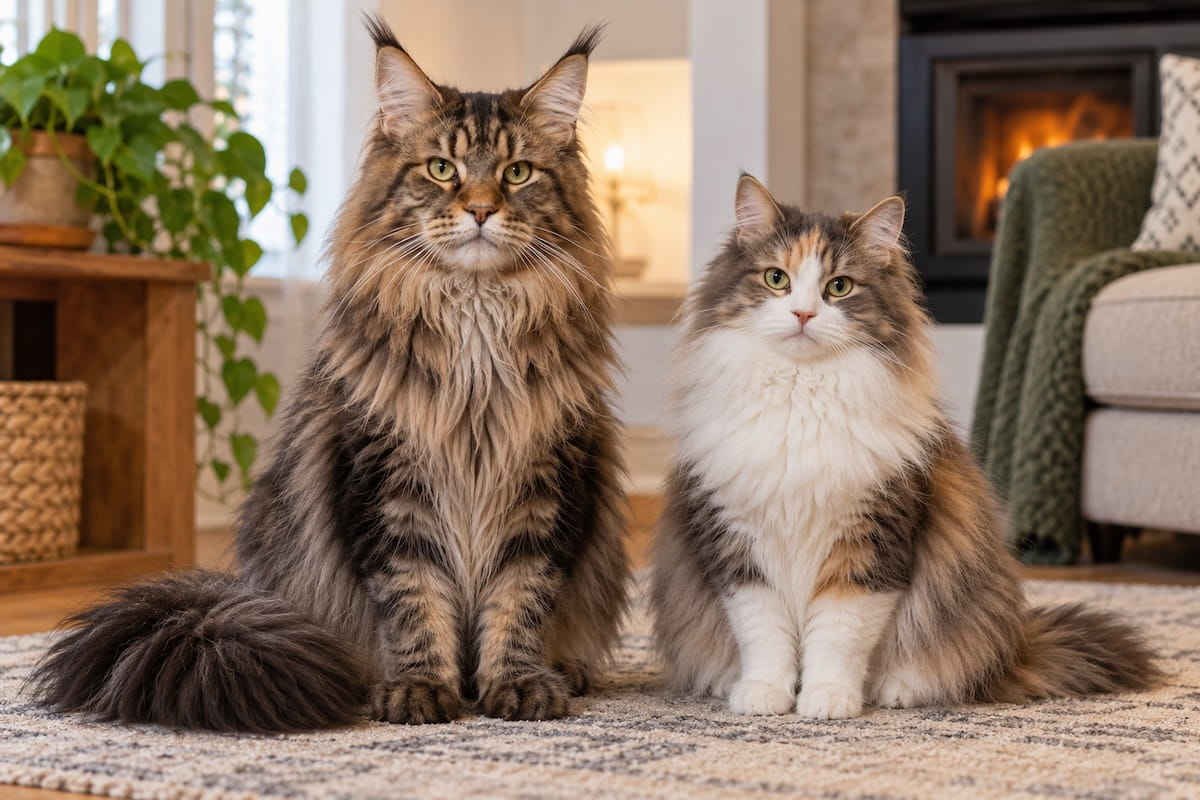
A large, fluffy Domestic Longhair can look remarkably similar to a Maine Coon. Both may have long fur, bushy tails, tufted ears, tabby markings, and substantial bodies. This is why so many cats are described as “Maine Coons” based on appearance alone.
But the most important difference is not fur length or size. A Maine Coon is a recognized pedigree breed with defined characteristics and documented breeding lines. A Domestic Longhair is not a breed; it is a descriptive term for a non-pedigreed cat with long fur.
That means Maine Coons have a relatively consistent breed type, while Domestic Longhairs can vary enormously.
Quick Answer
The simplest distinction is: Maine Coon = recognized cat breed vs Domestic Longhair = long-haired non-pedigreed cat
A Maine Coon typically has:
A large rectangular body
Substantial bone and muscle
A broad chest
A strong square muzzle
Large furnished ears
Large paws
A long flowing tail
A shaggy semi-long coat
A Domestic Longhair can have almost any body shape, face shape, size, coat texture, ear shape, color, or personality. Some look extremely Maine Coon-like. But appearance alone cannot prove that a Domestic Longhair is a Maine Coon or part Maine Coon.
Domestic Longhair Vs Maine Coon At A Glance
| Trait | Maine Coon | Domestic Longhair |
|---|---|---|
| Classification | Recognized pedigree breed | Descriptive category, not a breed |
| Ancestry | Defined breeding lines | Usually mixed or unknown |
| Body | Long, rectangular, substantial | Highly variable |
| Muzzle | Strong and square | Any shape |
| Ears | Large and furnished | Variable |
| Ear tufts | Common | Can also occur |
| Paws | Large, often tufted | Variable |
| Coat | Shaggy, uneven, semi-long | Any long-haired texture |
| Tail | Long and flowing | Variable |
| Size | Consistently large | No standardized size |
| Personality | Breed tendencies exist | Cannot be predicted from the label |
| Proof of breed | Pedigree documentation | Not a pedigree classification |
If you want a broader introduction first, my guide explaining what a Maine Coon is covers the breed in more detail.
1. Domestic Longhair Is Not A Cat Breed
This is the most important point in the comparison. “Domestic Longhair” describes a type of cat, not a standardized breed. The Cat Fanciers’ Association’s Household Pet information distinguishes non-pedigreed cats from recognized breeds that are judged against formal breed standards.
A Domestic Longhair therefore has no official standard specifying its:
- Weight
- Body proportions
- Head shape
- Ear shape
- Coat texture
- Eye color
- Temperament
One Domestic Longhair may be small and fine-boned. Another may be huge, muscular, and heavily tufted. Both are still Domestic Longhairs. This is why exact “average Domestic Longhair height,” body length, or personality claims should be treated cautiously.
2. Maine Coons Have A Defined Breed Type
Maine Coons are different because breeders work toward a recognized standard. The International Cat Association’s Maine Coon profile describes a large, substantial cat with a long rectangular body, broad chest, large feet, full flowing tail, and characteristic head structure. That gives us meaningful traits to look for.
However, one feature alone is never enough. A fluffy tail does not make a cat a Maine Coon. Neither do ear tufts. A pedigree Maine Coon should show a collection of breed characteristics rather than one impressive feature.
3. Size And Build
Maine Coons are consistently large cats. TICA currently gives typical adult weights of approximately:
- Males: 18-22 pounds
- Females: 12-15 pounds
My Maine Coon size and growth guide explains their slow development in more detail.
Domestic Longhairs have no standardized size. Some are average-sized house cats, some are petite, and others can be exceptionally large.
Can A Domestic Longhair Be Bigger Than A Maine Coon?
A large Domestic Longhair could outweigh a smaller Maine Coon. Size is therefore useful as one clue, but not proof. Body shape is often more informative. Maine Coons tend to have a long rectangular outline, broad chest, substantial skeleton, and muscular build. Domestic Longhairs can be long, compact, fine-boned, broad, or anything in between.
4. Face And Muzzle
This is one of the more useful visual differences. TICA’s Maine Coon standard calls for a well-defined square muzzle. Domestic Longhairs have no standardized facial structure. Their muzzles may be narrow, rounded, tapered, short, long, or broad. Long facial fur can also make an ordinary cat’s face appear wider than it really is.
When comparing your cat with a Maine Coon, look at the actual structure around the:
- Nose
- Whisker pads
- Chin
- Cheeks
rather than judging the amount of facial fluff.
5. Ears, Lynx Tips, And Paws
Maine Coons are famous for their large, well-furnished ears. Tufts extending from the tips are often called lynx tips. However, Domestic Longhairs can also have:
- Tall ears
- Heavy ear furnishings
- Lynx-like tips
So ear tufts do not prove Maine Coon ancestry.
The same applies to paws. Maine Coons usually have large, substantial feet, often with fur between the toes, but ordinary long-haired cats can have large or tufted paws too. These traits are supporting clues, not proof.
6. Coat And Tail
Both cats can be extremely fluffy, which causes much of the confusion.
Maine Coon Coat
The Maine Coon coat is semi-long and somewhat uneven rather than uniformly long all over. It typically becomes longer around the:
- Chest
- Belly
- Hindquarters
- Tail
The result is a distinctive shaggy appearance.
My Maine Coon grooming guide explains how coat texture can still vary considerably between individual pedigree Maine Coons.
Domestic Longhair Coat
There is no Domestic Longhair coat standard. The fur may be:
- Silky
- Cottony
- Dense
- Light
- Shaggy
- Plush
The tail may also range from only moderately fluffy to enormous. So long fur and a huge tail are not enough to identify a Maine Coon.
7. Colors And The Tabby “M”
Another common myth is that an M-shaped marking on the forehead proves a cat is a Maine Coon. It does not. The marking is associated with tabby patterning and appears in many cats with no Maine Coon ancestry.
Maine Coons also occur in a huge range of colors and patterns, as shown in my Maine Coon colors and patterns guide. Color is therefore one of the least useful identification clues.
8. Personality
Maine Coons have recognizable breed tendencies. They are generally sociable, playful, curious, and interested in household activity.
Over more than 14 years with my three pedigree Maine Coons, Pippin, Mika, and Bali, I have seen many of those traits firsthand. Bali loves playing fetch with his toy mouse, while Mika is exceptionally good at difficult food puzzles. My Maine Coon personality guide covers these behaviors in more detail.
But even my own three Maine Coons differ substantially. Domestic Longhairs are even less predictable because the label tells us nothing about their ancestry or temperament. So affectionate behavior, chirping, following people, or playing fetch cannot prove Maine Coon ancestry.
9. Traits That Do NOT Prove Your Cat Is A Maine Coon
None of these features alone proves that a cat is a Maine Coon:
- Long fur
- Large body
- Big paws
- Toe tufts
- Ear furnishings
- Lynx tips
- Bushy tail
- Tabby markings
- An “M” on the forehead
- Friendly behavior
- Chirping
- Following people
- Playing fetch
The more Maine Coon characteristics a cat has together, the more closely it may resemble the breed. But resemblance and proof are different things.
10. How Can You Know If Your Cat Is Really A Maine Coon?
For a cat being sold or described as a purebred Maine Coon, the strongest evidence is documented pedigree ancestry through breeder and registration records. Appearance cannot replace that documentation.
My guide on how to know if your cat is a Maine Coon explains the distinction between pedigree proof and simply looking Maine Coon-like.
If you have a rescue or cat of unknown ancestry and are asking “Could my cat be part Maine Coon?”, see my guide on how to tell if your cat is part Maine Coon.
A cat can resemble a Maine Coon without being purebred, while a genuine mix may not inherit every obvious Maine Coon characteristic.
11. Is A Domestic Longhair A Maine Coon Mix?
Not automatically. “Domestic Longhair” does not mean “Maine Coon mix.” It simply describes a non-pedigreed long-haired cat.
A Domestic Longhair could have Maine Coon ancestry, but it could equally have none. If you know one parent or part of the family line was Maine Coon, my separate guide to the Domestic Longhair Maine Coon mix explains what a genuine cross might inherit.
Domestic Longhair Or Maine Coon: Which Should You Choose?
If you are choosing a cat rather than trying to identify one, pedigree status should not be confused with quality as a pet.
Choose a Maine Coon if you specifically want a documented pedigree breed, predictable breed type, classic square-muzzled appearance, and generally sociable, inquisitive temperament.
Consider a Domestic Longhair if you want a long-haired companion but do not need a particular pedigree and would prefer to choose primarily according to the individual cat’s personality and suitability for your home.
A Domestic Longhair is not a “lesser Maine Coon”. It is simply a different category of cat.
Frequently Asked Questions
Is A Domestic Longhair The Same As A Maine Coon?
A Maine Coon is a recognized pedigree breed. Domestic Longhair is a descriptive term for a non-pedigreed cat with long fur.
How Can I Tell A Maine Coon From A Domestic Longhair?
Look at the whole cat rather than one feature. Typical Maine Coon characteristics include a large rectangular body, substantial bone, square muzzle, large furnished ears, big paws, shaggy coat, and long flowing tail. Documented ancestry is still the strongest proof of a pedigree Maine Coon.
Can A Domestic Longhair Have Ear Tufts?
Ear furnishings and lynx-like tips are not exclusive to Maine Coons.
Does An “M” On The Forehead Mean Maine Coon?
The marking is associated with tabby coat patterning and occurs in countless non-Maine Coon cats.
Is A Domestic Longhair A Maine Coon Mix?
Not necessarily. A genuine Maine Coon mix needs actual Maine Coon ancestry. Simply looking like the breed does not establish that ancestry.
Conclusion
The most important difference between a Domestic Longhair and a Maine Coon is breed identity, not fluffiness.
A Maine Coon belongs to a recognized breed with documented ancestry and a defined physical standard. A Domestic Longhair is a non-pedigreed long-haired cat whose appearance and personality can vary enormously.
Looking like a Maine Coon and actually being a Maine Coon are not the same thing.