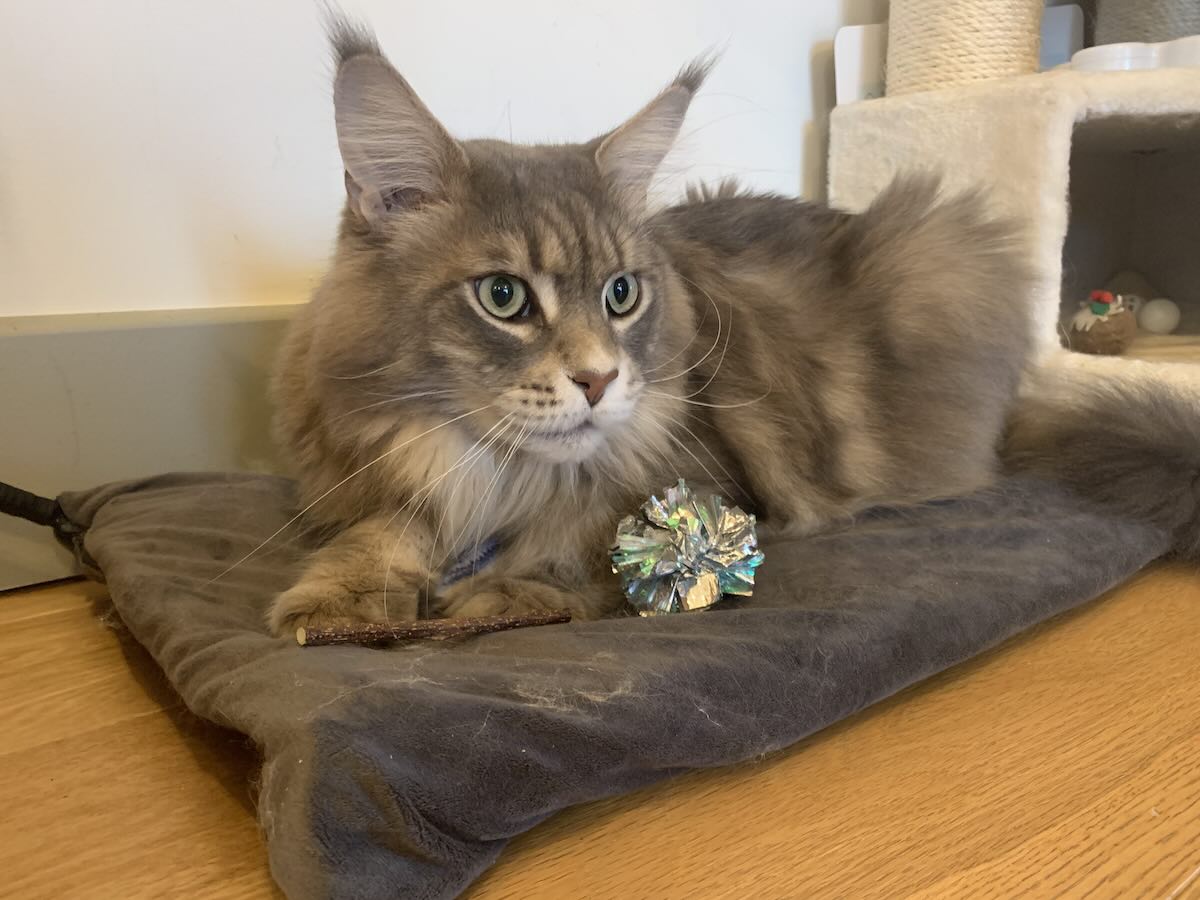
Gray Maine Coon: Is It Blue, Silver, Or Smoke?

A gray Maine Coon can have a surprisingly complex coat. Some appear evenly slate gray. Others have dark stripes over a pale background, white roots hidden beneath charcoal fur, or silver-tipped hairs that make the coat look almost frosted.
The reason for this variation is that gray is usually an everyday description rather than a complete registered Maine Coon color.
A gray-looking Maine Coon may officially be:
- Solid blue
- Blue tabby
- Blue silver tabby
- Black silver tabby
- Blue smoke
- Black smoke
- Shaded silver
- Chinchilla silver
- One of these colors combined with white
Our own Maine Coon, Mika, is a good example. When we adopted him at four years old, shortly before his fifth birthday, I thought of his coat simply as gray. His correct color description is actually blue tabby.
This guide focuses on identifying the different Maine Coon coats that can appear gray. For detailed dilution genetics and the wider range of blue coat combinations, read our separate blue Maine Coon guide.
Quick Answer
Many Maine Coons casually described as gray are officially called blue. In cat-color terminology, blue is the name used for black pigment that has been genetically diluted to gray. The UC Davis Veterinary Genetics Laboratory explains that the dilute variant causes pigment granules to clump and become unevenly distributed within each hair. Black therefore appears gray (called blue by cat breeders) while red becomes cream.
However, not every gray-looking Maine Coon is blue. Silver, smoke, shaded, and chinchilla coats can also appear gray. To identify the most likely color, examine:
* Whether the cat has visible tabby markings
* Whether the coat has warm or cold undertones
* The color at the roots of the hairs
* Whether pigment covers most of the hair or only the tips
* Whether the darkest markings look black or blue-gray
* The registered color shown on the pedigree
Gray Maine Coon Color Chart
| Gray-looking coat | Typical appearance | Most useful identifying feature |
|---|---|---|
| Solid blue | Even gray-blue or slate coat | Blue-gray pigment continues toward the roots without a clear adult tabby pattern |
| Blue tabby | Darker gray-blue markings over a lighter background | Visible stripes, swirls, spots, leg rings, or forehead markings |
| Blue silver tabby | Blue-gray markings over a cold silver-white background | Clear tabby pattern with little warm beige or fawn coloring |
| Black silver tabby | Black markings over a pale silver ground color | Darkest markings look black rather than diluted gray |
| Blue smoke | Often looks solid gray until the coat moves | White roots beneath blue-gray tips |
| Black smoke | Charcoal or black surface with a silver effect | White roots beneath deeply black tips |
| Shaded silver | Pale silver coat covered by a darker haze | Pigment is concentrated toward the ends of the hairs |
| Chinchilla silver | Nearly white with delicate dark tipping | Even less pigment at the tips than a shaded silver |
| Gray and white | Any gray-looking coat with white areas | White spotting is added to the underlying color and pattern |
Does The Gray Maine Coon Color Officially Exist?
Gray is a perfectly reasonable word to describe what a cat looks like, but major cat registries normally use more specific terminology. The International Cat Association’s Maine Coon profile describes blue as gray and confirms that Maine Coons occur in many recognized colors and patterns. TICA specifically mentions solid-colored blue cats as part of the breed’s accepted range.
A gray-looking Maine Coon may therefore have a registered description such as:
- Blue
- Blue classic tabby
- Blue mackerel tabby
- Blue ticked tabby
- Blue silver tabby
- Silver tabby
- Blue smoke
- Black smoke
- Shaded silver
- Chinchilla silver
- Blue and white
“Gray Maine Coon” is best understood as an umbrella description covering several different official coat colors.
For a broader explanation of Maine Coon coat terminology, see our complete Maine Coon colors and patterns guide.

Our Experience With Mika
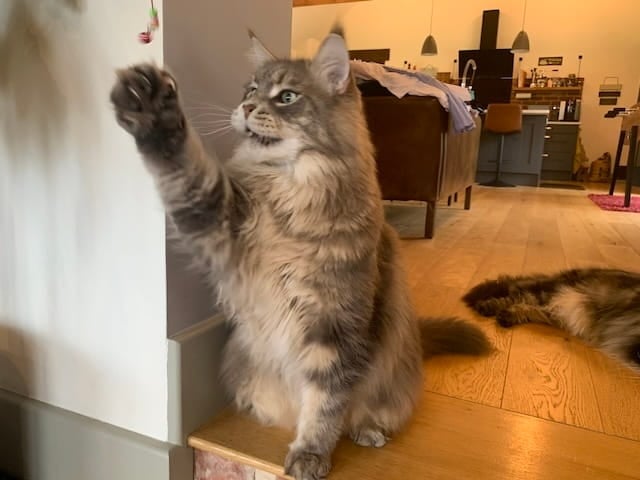
Mika is our blue tabby Maine Coon. We adopted him at four years old, shortly before he turned five. At first, I naturally described him as gray because that was the color I could see. After learning more about Maine Coon color terminology (and checking his pedigree paperwork), I discovered that his correct description is blue tabby:
- Blue describes his diluted black-based color.
- Tabby describes the visible pattern across his coat.
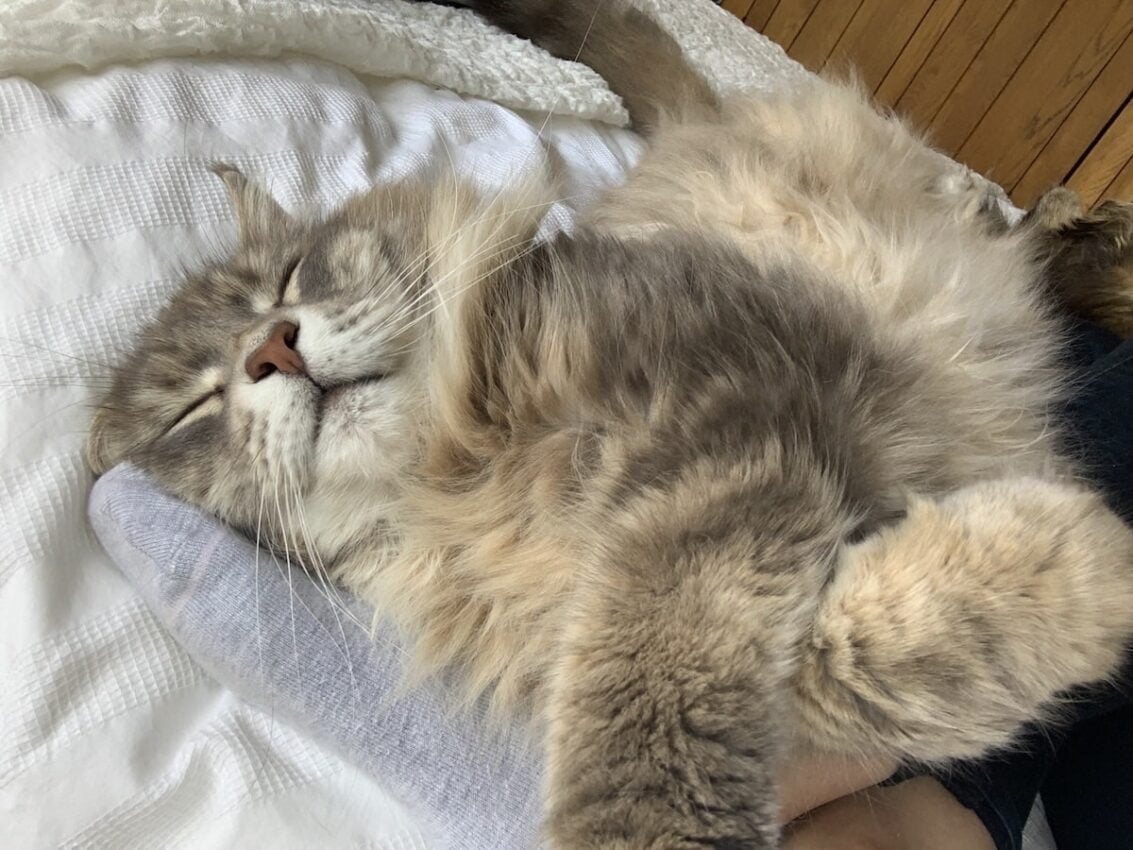
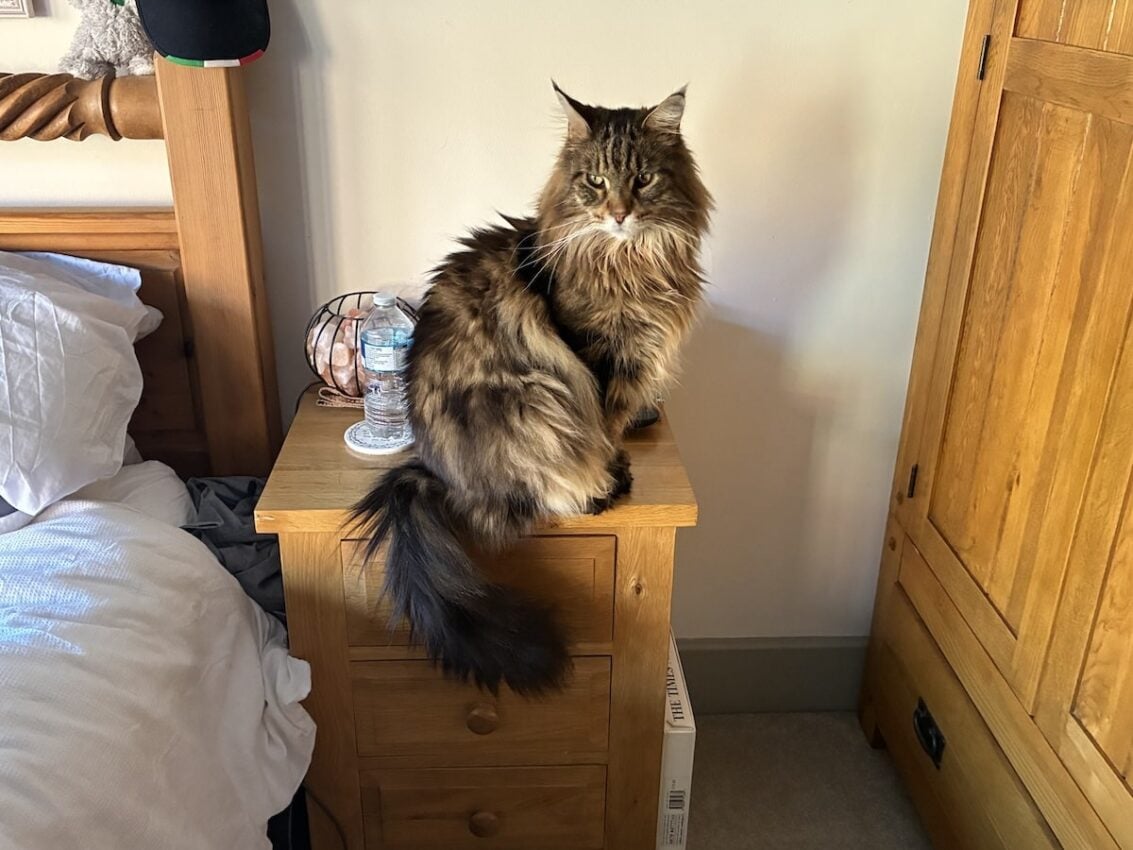
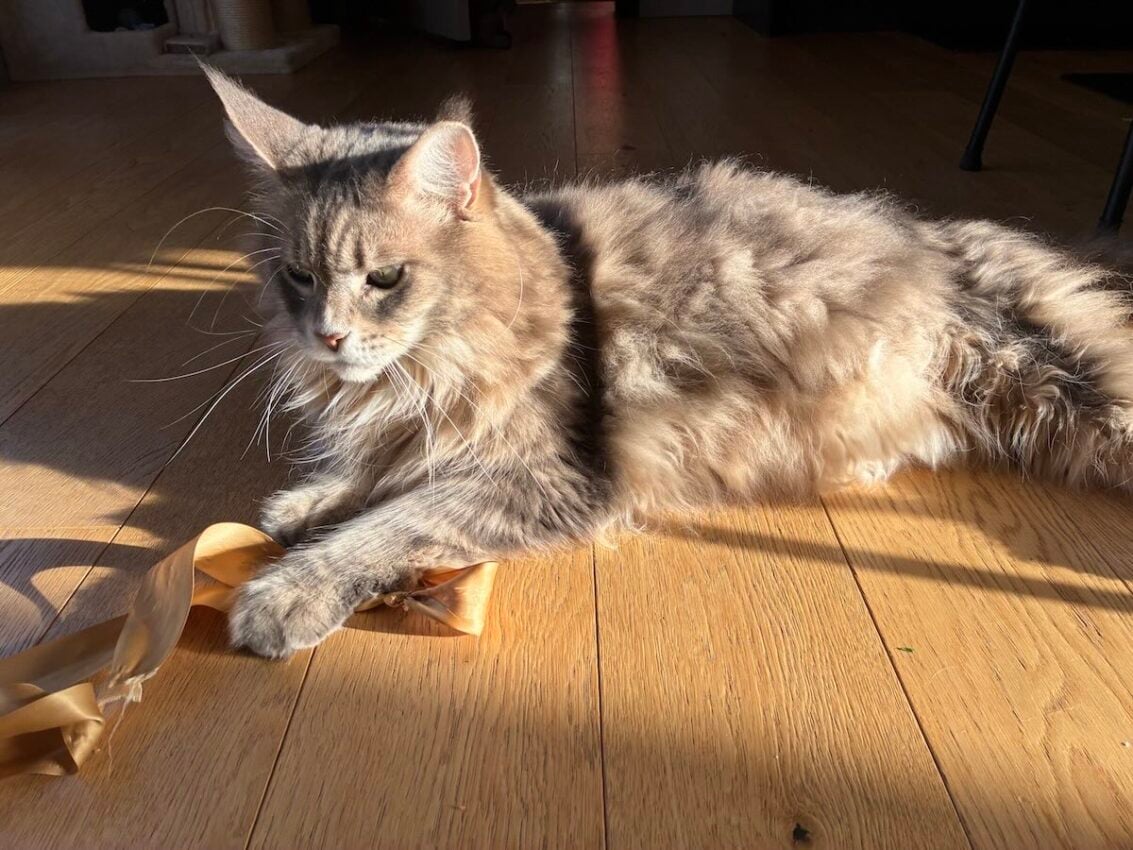
Mika also demonstrates why identifying a coat from one photograph can be difficult. Depending on the lighting, his fur can appear:
- Deep charcoal gray
- Soft blue-gray
- Pale silvery gray
- Warmer gray with beige or fawn tones
His tabby markings become much clearer in bright natural light, particularly around his back, legs, sides, and tail.
Mika is not solid blue because he has a clearly visible tabby pattern. Nor should he automatically be described as blue silver simply because parts of his coat can look pale or silvery in photographs. The ground color, hair roots, overall warmth, and pedigree description provide better evidence than a single image.
Solid Blue Maine Coon
A solid blue Maine Coon has a relatively even gray-blue coat without a clearly defined adult tabby pattern. Possible shades include:
- Pale blue-gray
- Medium gray
- Slate blue
- Charcoal gray
- Soft silvery blue
The current CFA Maine Coon standard recognizes blue as one of the breed’s solid colors. In a true solid coat, the color should continue toward the roots rather than revealing the clearly white undercoat associated with smoke.
Some solid-colored kittens show faint ghost tabby markings, especially on the forehead, legs, or tail. These markings can become less noticeable as the adult coat develops. A faint kitten pattern does not always mean the cat will ultimately be registered as a tabby.
The most useful comparison is:
- Solid blue: Blue-gray pigment continues toward the roots.
- Blue smoke: Pale or white roots sit beneath blue-gray tips.
Parting the fur is therefore more useful than judging the surface color alone.
Blue Tabby Maine Coon
A blue tabby has darker blue-gray markings over a paler background. The tabby pattern may include:
- Broad classic swirls
- Narrow mackerel stripes
- Broken stripes or spots
- Ticked hairs
- An M-shaped forehead marking
- Lines extending from the eyes
- Rings around the legs
- Rings around the tail
- Spots across the abdomen
Mika is a blue tabby. His gray appearance results from diluted black pigment, while his stripes and markings on his back are due to the tabby pattern.
The CFA Maine Coon standard describes a blue tabby as having deep blue markings over a pale bluish-ivory ground color. Warm fawn overtones or a patina across the coat are also permitted. That warmth is one of the main features that may distinguish a regular blue tabby from a blue silver tabby.
Our detailed tabby Maine Coon guide explains classic, mackerel, spotted, and ticked markings in more detail.
Blue Tabby vs. Blue Silver Tabby
These coats are easily confused because both have blue-gray markings. The principal difference is the background color.
Blue Tabby
A blue tabby usually has:
- Deep blue-gray markings
- A pale bluish or ivory ground color
- Some beige, fawn, or warm tones
- A softer contrast between markings and background
Blue Silver Tabby
A blue silver tabby usually has:
- Blue-gray markings
- A cold, pale silver ground color
- A white undercoat
- Stronger contrast
- Little visible beige or fawn warmth
CFA distinguishes the two clearly. Its standard describes blue silver tabbies as having deep blue markings over a pale, clear silver ground color. In contrast, ordinary blue tabbies may have a bluish-ivory background with warm fawn overtones. This distinction can still be difficult to see in:
- Young kittens
- Long or very dense coats
- Artificial lighting
- Heavily edited photographs
- Seasonal coats
Do not classify a Maine Coon as silver solely because it looks pale in one picture.
Our silver Maine Coon guide explains silver, blue silver, shaded, and smoke-related terminology in more detail.
Black Silver Tabby vs. Blue Silver Tabby
Both coats have tabby markings over a pale silver background. The difference is the color of the markings.
Black Silver Tabby
A black silver tabby has:
- Dense black markings
- A pale, clear silver ground color
- Black paw pads commonly preferred in show standards
- Strong black outlines around facial features
Blue Silver Tabby
A blue silver tabby has:
- Softer blue-gray markings
- A pale silver ground color
- Rose-colored paw pads commonly preferred
- Blue-gray rather than black facial markings
CFA defines the ordinary silver tabby as having dense black markings over clear silver, while the blue silver tabby has deep blue markings over the same type of pale silver background.
A black silver tabby can still look gray overall because much of the body consists of pale silver fur.
Look at the darkest areas – the tail rings, forehead lines, leg bars, and markings along the spine – to determine whether they appear black or diluted blue-gray.
Blue Smoke Maine Coon
A blue smoke Maine Coon can appear almost solid gray while sitting still. The defining feature lies underneath the visible surface:
A blue smoke has a white undercoat beneath deeply blue-tipped hairs. CFA explains that a blue smoke appears blue when resting, but the white undercoat becomes clearly visible when the cat moves. A narrow band of white near the skin may only be seen when the coat is parted. This creates a flashing or shimmering effect as the cat walks.
A blue smoke may have faint ghost markings when young, but it should not have the clearly defined adult body pattern expected in a blue silver tabby. The simplest distinction is:
- Blue smoke: Mostly solid-looking outer coat with white roots.
- Blue silver tabby: Clear tabby markings over a silver background.
Black Smoke Maine Coon
A black smoke Maine Coon may appear:
- Black
- Charcoal
- Dark gray
- Silvery black
- Pale gray where the undercoat is exposed
Like blue smoke, it has a white undercoat.
The difference is the color of the tips:
- Black smoke: White roots beneath black tips
- Blue smoke: White roots beneath diluted blue-gray tips
The CFA standard describes black smoke as a white undercoat deeply tipped with black. The cat appears black while resting, but the white undercoat becomes visible in motion or when the fur is parted. In bright light, a black smoke Maine Coon can look surprisingly gray, particularly around the ruff, belly, britches, and tail. This is why some cats advertised simply as “gray Maine Coons” may actually be black smoke.
Our complete smoke Maine Coon guide covers black, blue, red, cream, tortie, and blue-cream smoke coats.
Shaded Silver And Chinchilla Silver Maine Coons
A shaded silver Maine Coon has a white undercoat with dark pigment concentrated toward the ends of the hairs.
The finished coat may look:
- Pale silver
- Frosted gray
- White with a charcoal haze
- Darker along the spine, face, and tail
- Lighter on the chest and underside
CFA describes shaded silver as a white undercoat covered by a mantle of black tipping. The shading becomes lighter down the sides and progresses toward white on the chin, chest, stomach, and under the tail. A chinchilla silver has even less dark pigment.
The CFA coat-color guide explains that smoke cats have the greatest amount of colored tipping, chinchillas have the least, and shaded silver lies between the two.
In practical terms:
- Smoke: Much of each hair is colored.
- Shaded: A smaller portion near the tip is colored.
- Chinchilla: Only a very small amount at the end of the hair is colored.
A shaded or chinchilla silver Maine Coon can therefore appear gray, silver, or almost white depending on the light and coat position.
Our shaded Maine Coon guide compares shaded, shell, chinchilla, silver, and smoke coats.
Gray Maine Coons With White
White spotting can be added to many gray-looking colors.
A Maine Coon might be:
- Blue and white
- Blue tabby and white
- Blue silver tabby and white
- Black silver tabby and white
- Blue smoke and white
- Black smoke and white
- Shaded silver and white
White may appear on the:
- Chin
- Muzzle
- Chest
- Belly
- Legs
- Paws
- Face
- Large sections of the body
White spotting does not change the underlying coat classification. For example, a blue tabby with white remains a blue tabby; the white areas are recorded as an additional part of the coat description.
How To Identify A Gray-Looking Maine Coon
1. Look For Tabby Markings
Check for:
- An M on the forehead
- Lines around the eyes and cheeks
- Rings around the legs
- Rings around the tail
- Narrow stripes
- Broad swirls
- Spots
- Ticked hairs
Clear markings indicate a tabby pattern rather than a truly solid adult coat. However, the forehead M does not prove that a cat is a Maine Coon. It is a widespread tabby marking seen in many pedigree and mixed-breed cats.
2. Part The Fur
Examine the full hair shaft.
- Even gray-blue color toward the roots suggests solid blue.
- White roots beneath blue tips suggest blue smoke.
- White roots beneath black tips suggest black smoke.
- A pale background with clear markings suggests a silver tabby.
- Very lightly tipped hairs may indicate shaded or chinchilla silver.
3. Check For Warm Undertones
A regular blue tabby may contain:
- Pale ivory
- Beige
- Fawn
- Warm gray
A blue silver tabby should have a colder and clearer silver background. This is often easiest to assess around the shoulders, sides, chest, and base of the hairs.
4. Examine The Darkest Markings
Look closely at the forehead, tail rings, leg bars, and spine.
- Black markings suggest black silver.
- Softer blue-gray markings suggest blue silver.
- No obvious markings may indicate solid or smoke.
5. Record White Areas Separately
White spotting is added to the underlying color and pattern description. Do not mistake a pale silver undercoat for white spotting. White spotting creates clearly defined areas where colored fur is absent.
6. Check The Pedigree
For a registered Maine Coon, the pedigree description is more reliable than guessing from a photograph. It may identify:
- The base color
- Dilution
- Silver or smoke
- Tabby pattern
- White spotting
Our Maine Coon color-code guide explains how these descriptions are represented on pedigrees.
Why Photographs Can Be Misleading
The same Maine Coon may look like several different shades of gray depending on:
- Direct sunlight
- Indoor lighting
- Camera exposure
- White balance
- Image filters
- Seasonal shedding
- Undercoat density
- Whether the fur is lying flat or moving
Mika can appear dark in one photograph and much paler or more silver-gray in another.
Long Maine Coon fur makes identification harder because the tips, undercoat, and pattern overlap visually. A blue tabby’s warm background may disappear under cool lighting, while a smoke coat’s white roots may remain hidden until the fur is parted.
Use photographs as a starting point rather than definitive proof.
Are Gray Maine Coons Rare?
There is no reliable worldwide figure showing how many Maine Coons have gray-looking coats.
Blue is an established and recognized Maine Coon color, while silver, smoke, shaded, and chinchilla coats are also accepted in numerous combinations. CFA’s current standard includes solid blue, blue and blue silver tabbies, black and blue smoke, and shaded or chinchilla silver varieties.
Availability depends on:
- Country
- Bloodline
- Whether dilute is present
- Whether silver is present
- The exact tabby pattern
- White spotting
- Local demand
Do not assume a kitten is unusually valuable simply because a seller calls it “rare gray.” Registration, health screening, socialization, and responsible breeding matter more than a fashionable color description.
Does Gray Coloring Affect Personality?
There is no reliable evidence that gray, blue, silver, smoke, or shaded coloring determines a Maine Coon’s personality.
A gray-looking Maine Coon may be:
- Confident or cautious
- Affectionate or independent
- Quiet or vocal
- Relaxed or energetic
- Immediately sociable or slow to trust
Temperament is shaped by the individual cat’s wider genetics, early socialization, health, environment, handling, and previous experiences. Mika’s blue tabby coat describes his appearance. It does not explain or predict his personality.
Read our Maine Coon personality guide for a fuller discussion of the breed’s general tendencies.
Frequently Asked Questions
Are gray and grey Maine Coons different?
No. Gray is the American spelling and grey is the British spelling. Both describe the same visible color.
Is a gray Maine Coon officially blue?
Often, yes. Gray fur caused by diluted black pigment is officially called blue. However, some gray-looking Maine Coons are silver, smoke, shaded, or chinchilla rather than simply blue.
Is Mika gray or blue?
Mika is officially a blue tabby Maine Coon. Gray describes how his coat looks in everyday language; blue tabby is the more precise color-and-pattern description.
What is the difference between gray and silver?
Gray usually describes diluted black pigment, officially called blue. Silver describes a coat in which pigment is reduced near the base of the hairs, creating a pale or white background beneath tabby markings or tipped fur.
What is the difference between blue tabby and blue silver tabby?
A blue tabby usually has blue-gray markings over a warmer bluish-ivory or fawn-toned background. A blue silver tabby has blue-gray markings over a cold, clear silver background with a white undercoat.
How can I tell whether my Maine Coon is blue smoke?
Part the fur. A blue smoke should have pale or white roots beneath blue-gray tips. The outer coat generally appears solid or nearly solid rather than displaying a clearly defined adult tabby pattern.
Can a gray Maine Coon have stripes?
Yes. Blue tabbies, blue silver tabbies, and black silver tabbies can all look gray and have stripes, swirls, spots, or ticking.
Is every solid gray Maine Coon blue?
An evenly gray coat may be solid blue, but a smoke Maine Coon can appear solid until the fur is parted. The root color and registered pedigree provide the best evidence.
Can a black smoke Maine Coon look gray?
Yes. The white undercoat can make black smoke fur appear charcoal, silver-gray, or much lighter when the cat moves.
Does a gray coat affect a Maine Coon’s size?
No evidence shows that gray, blue, silver, or smoke coloring determines adult size. Sex, family line, overall genetics, nutrition, health, and development matter far more.
Final Thoughts
Gray is a useful everyday description, but it does not identify one single Maine Coon coat.
A gray-looking Maine Coon might be:
- Solid blue
- Blue tabby
- Blue silver tabby
- Black silver tabby
- Blue smoke
- Black smoke
- Shaded silver
- Chinchilla silver
- One of these colors combined with white
Mika is officially a blue tabby, although I initially thought of him simply as gray. His coat demonstrates how dramatically lighting, fur length, undercoat, warmth, and pattern contrast can change a Maine Coon’s appearance.
The quickest way to narrow down the correct description is to:
- Look for tabby markings.
- Part the fur and inspect the roots.
- Compare warm and cold background tones.
- Check whether the darkest markings are black or blue-gray.
- Record any white spotting separately.
- Check the registered pedigree description.
For detailed dilution genetics and the complete range of blue combinations, continue to our blue Maine Coon guide.
For every major coat family and pattern, see our complete Maine Coon colors and patterns guide.