How To Know If Your Cat Is A Purebred Maine Coon (Pedigree Proof, Not Guesswork)

Before you begin, it’s important to understand the difference between a purebred Maine Coon and a cat that simply shows Maine Coon-like features.
A true pedigree Maine Coon must come from registered breeding lines and have official documentation. Without pedigree papers or DNA confirmation, a cat cannot be classed as a purebred, even if it looks like one.
Many domestic long-haired cats share similar traits, which is why so many owners believe their pet might be “part Maine Coon”. This guide will help you understand the physical and behavioral signs, but only pedigree paperwork or genetic testing can confirm the breed with certainty.
This guide focuses on pedigree confirmation (papers, registration, breeder verification, and what DNA tests can and can’t tell you).
If you’re asking a different question – “Could my rescue cat be part Maine Coon?” – read this article instead: How to tell if your cat is part Maine Coon.
(Quick context on the breed first: What is a Maine Coon?)
Quick Answer
You can tell if your cat might be a Maine Coon by looking for a long, rectangular body, large frame, broad chest, shaggy coat, bushy tail, ear tufts, big paws, and a square muzzle. However, appearance alone cannot confirm a cat is a true Maine Coon, because many mixed-breed and domestic longhair cats share similar traits. The only reliable way to know if a cat is a purebred Maine Coon is through pedigree papers or breeder documentation.
Why Appearance Alone Is Misleading
Many people assume that large paws, ear tufts, or a fluffy tail automatically mean a cat is a Maine Coon.
In reality, these features are extremely common in domestic long-haired cats and mixed-breed cats. Even experienced owners can misidentify a cat based purely on appearance.
Over the years, we have seen countless cats advertised as “Maine Coons” that were simply large, fluffy domestic longhairs with no pedigree proof at all.
Only Reliable Ways To Confirm A Purebred Maine Coon
1. Pedigree papers (best proof)
If you bought from a breeder, ask for:
- Pedigree certificate (multi-generation lineage)
- Registration details (registry name + registration number)
- Sales contract (often includes kitten identity, breeder info, and terms)
A genuine pedigree should allow you to trace lineage – not just state “Maine Coon” on a receipt.
2. Registration, you can verify
Purebred Maine Coons are commonly registered with established cat registries. What matters isn’t the logo on a document; it’s whether the registration is verifiable and consistent with the:
- Breeder
- Litter details
- Kitten identity
3. Breeder verification (quietly powerful)
A reputable breeder should be able to provide:
- Their registered prefix/cattery name
- Proof the parents are Maine Coons (papers/registration)
- Health testing claims that match documentation (not just “we test everything”)
If something feels vague (“papers are coming later”, “lost them”, “no need for paperwork”), that’s usually your answer.
Our Experience
When we collected our first Maine Coon, Pippin, from the breeder, the paperwork came as part of the standard handover process.
We received his pedigree, registration details, and breeder documentation all at once. There was never any uncertainty about whether he was a purebred Maine Coon, because the proof was clear and traceable.
This experience taught us that genuine pedigree cats always come with verifiable documentation, not just claims about size or appearance.
DNA Testing – Helpful, But Not Pedigree Proof
DNA testing can be useful when you don’t have paperwork, but it’s not always a courtroom-level confirmation of “purebred” because:
- Breed databases vary
- Results are often probability-based
- Many domestic cats share overlapping genetic markers
If your cat tests as “highly likely Maine Coon,” treat it as supporting evidence, not as a verifiable pedigree.
Physical Traits That Support Pedigree Claims (But Don’t Prove Them)
If a cat already has pedigree evidence, physical traits can support that story. But on their own, these traits are not reliable proof, because many appear in mixes and other long-haired cats.
Breed-typical structure (not just “big”)
A purebred Maine Coon is typically:
- Long-bodied and rectangular
- Substantial bone and musculature
- A balanced look (not extreme proportions)
If you want size expectations by age and sex, link here:
Maine Coon Size And Growth
Head shape and muzzle
Look for:
- High cheekbones
- A more squared muzzle (rather than a narrow wedge)
- Slightly angled eyes
Ears, paws, and coat (common but not definitive)
- Lynx tips/ear furnishings can appear in many cats
- Big paws and toe tufts are common in long-haired cats
- Coat length changes seasonally and varies by bloodline
For colour/pattern traits, keep this link:
Maine Coon Colors And Pattern Guide
Temperament Clues (Supportive, Not Proof)
Maine Coons are often described as:
- Highly social and people-focused
- Curious, intelligent, and interactive
- More likely to chirp/trill than constantly “meow”
But temperament overlaps heavily with other breeds and mixes, so use behaviour as context, not confirmation.
For a deeper look at typical behaviour traits, see: Maine Coon Personality.
Common Myths About Purebred Maine Coons
Many owners are told things about Maine Coons that simply aren’t true. These myths often lead people to believe their cat is purebred when there is no real evidence.
Common myths include:
- “If it has ear tufts, it must be a Maine Coon”
Ear tufts appear in many long-haired breeds and mixed cats. - “Big cats are always Maine Coons”
Some domestic longhairs naturally grow large without any Maine Coon ancestry. - “The breeder said it was a Maine Coon, so it must be”
Without registration papers or a verifiable pedigree, this is only a claim. - “DNA tests can prove a cat is purebred”
DNA tests can suggest breed ancestry, but they cannot replace official pedigree registration.
What If Your Cat Only Has Some Maine Coon Traits?
Many cats show one or two features commonly associated with Maine Coons, such as:
- Large size
- Tufted ears
- Long fur
- Friendly, dog-like behavior
However, these traits are not exclusive to the Maine Coon breed. Domestic long-haired cats and mixed-breed cats can display very similar characteristics.
If your cat has some of these features but no pedigree papers, it is more accurate to describe them as a Maine Coon mix or a domestic long-haired cat with Maine Coon-like traits.
If you suspect your cat may be part Maine Coon, you may find this guide helpful:
How To Tell If Your Cat Is Part Maine Coon.
If You Don’t Have Papers, Here’s The Most Honest Answer
If your cat does not come with pedigree papers, there is no reliable way to confirm it is a purebred Maine Coon.
Many domestic long-haired cats share similar features, including large size, fluffy coats, and ear tufts. Because of this, visual identification alone is not enough to prove a cat’s breed.
In these situations, the most accurate description is:
- Maine Coon mix, or
- Domestic longhair with Maine Coon traits
This does not reduce the cat’s value as a companion. Many mixed-breed cats share the same affectionate and playful temperament that makes the Maine Coon so popular.
Use this guide next (it’s built for that exact situation):
How to tell if your cat is part Maine Coon
Real-World Examples From Maine Coon Owners
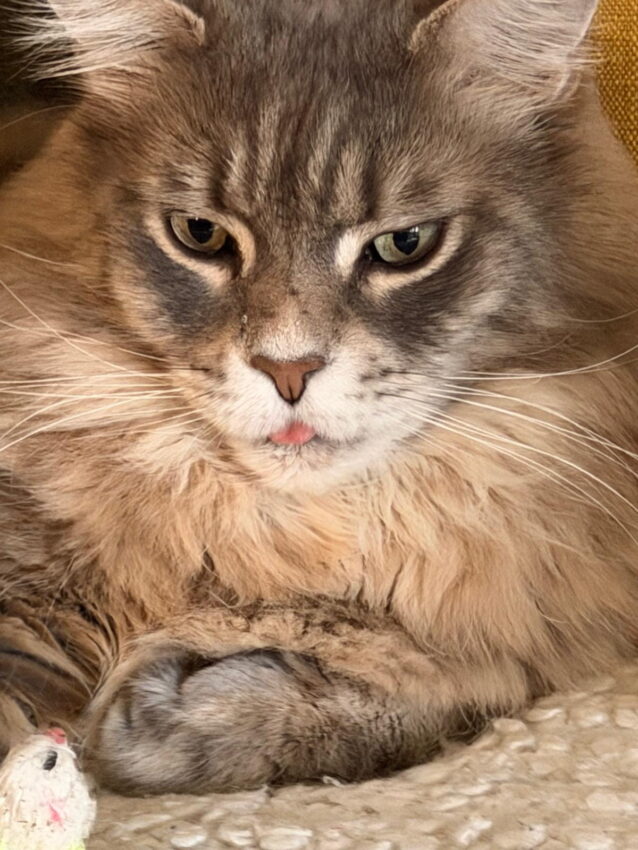
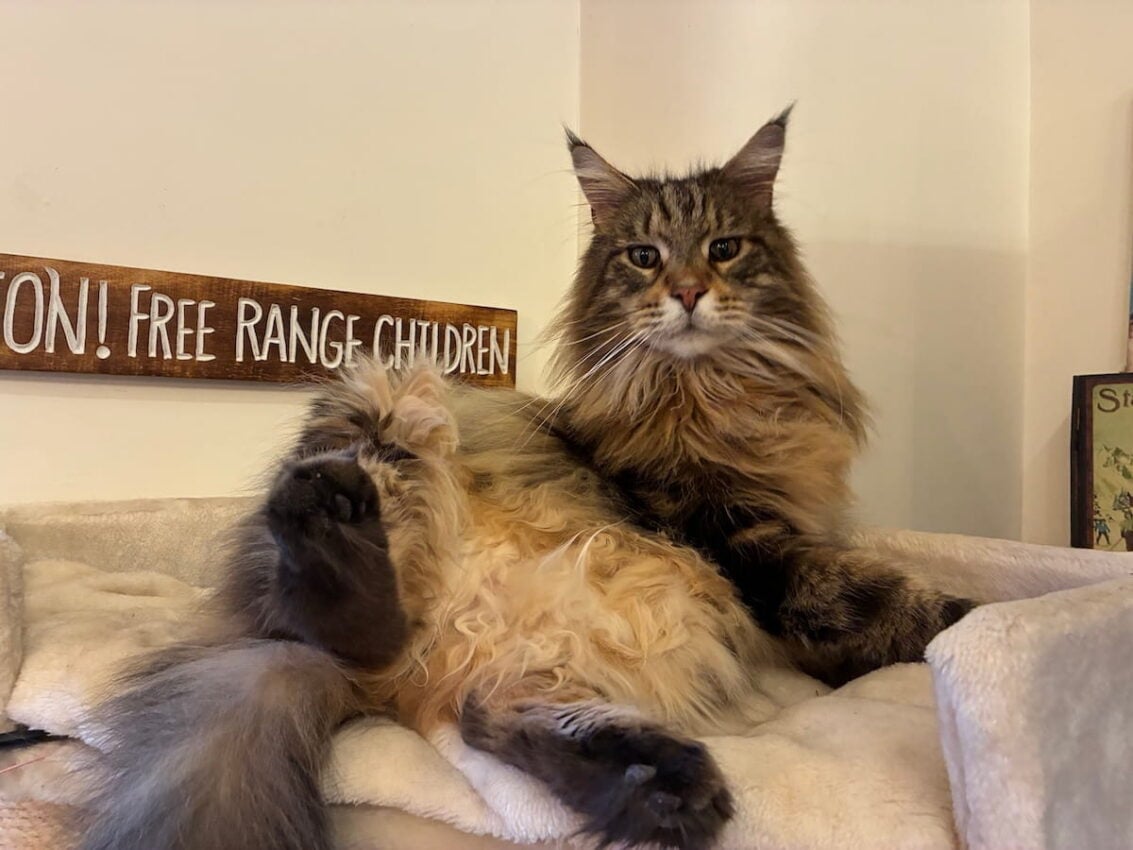
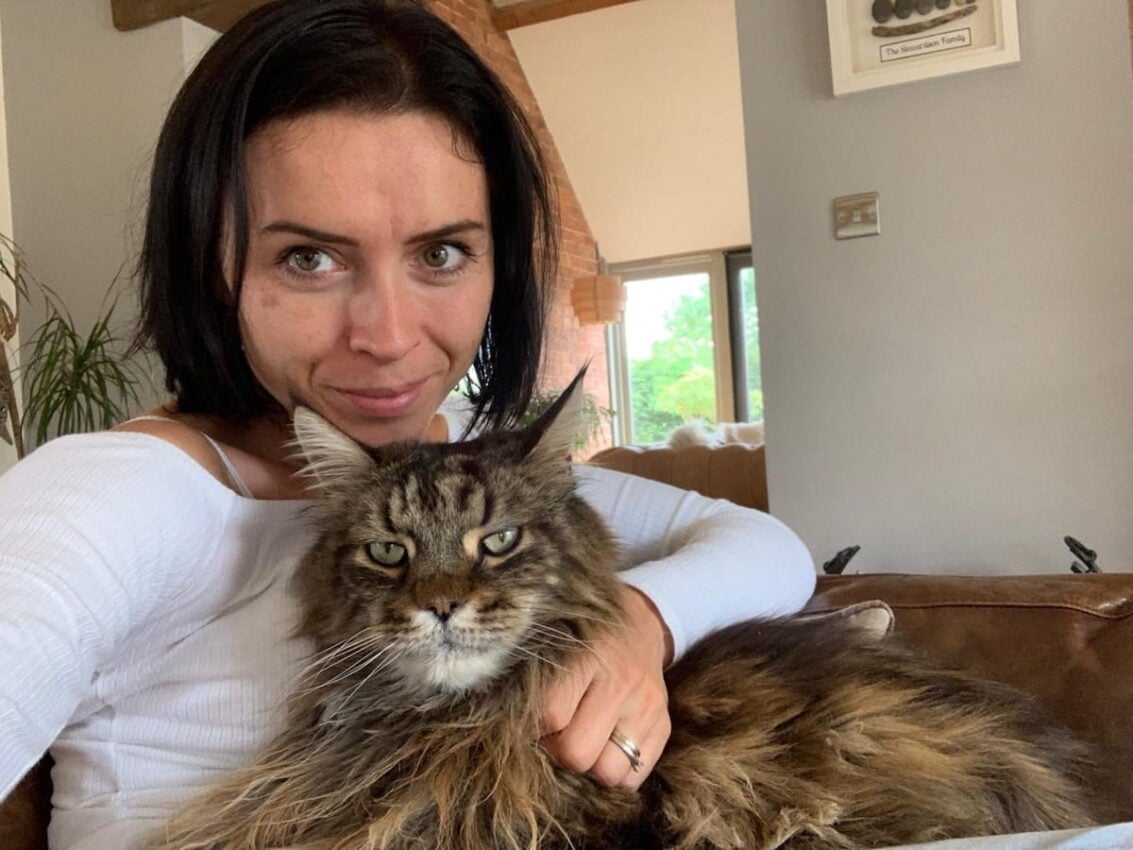
In our own home, we’ve owned three pedigree Maine Coons for more than 14 years – Pippin, Mika, and Bali. Each one came with full registration papers, verified breeders, and traceable bloodlines.
Interestingly, even though all three were purebred, they didn’t look identical:
- Pippin grew into a large, 20-lb male with oversized paws and ears from kittenhood. He had a medium fluffy coat
- Bali is a more delicate 18lbs and has a softer, silkier coat and a slightly more petite body frame than his brother Mika.
- Mika is a huge 22lbs and has an angular, classic European-style face. He’s muscular and super fluffy!
This shows why appearance alone is unreliable. Even genuine Maine Coons can look very different depending on their bloodline, diet, and development.
Without pedigree papers, it would have been impossible to “prove” they were purebred just by looking at them.
How To Confirm If Your Cat Is A Purebred Maine Coon
The only reliable way to confirm whether your cat is a true Maine Coon is through documentation or genetic testing. Physical traits alone are not enough to prove pedigree.
There are three main ways to confirm the breed:
1. Pedigree papers
- Issued by registered breeding organizations
- Show your cat’s ancestry for multiple generations
- The most reliable proof of breed status
2. Breeder documentation
- Reputable breeders provide registration details
- Cats are usually registered with bodies such as TICA or CFA
- This confirms the cat comes from verified Maine Coon bloodlines
3. DNA testing
- Pet DNA kits can identify breed ancestry
- Results may show Maine Coon genetic markers
- These tests are helpful for mixed-breed cats
If your cat does not have pedigree papers, it is more accurate to describe them as a domestic long-haired cat or Maine Coon mix, even if they share many physical traits.
Bottom Line: Proof Always Beats Appearance
If your cat has verified pedigree papers from a recognised registry, you can be confident they are a purebred Maine Coon.
If there are no papers, no verifiable breeder, and no traceable lineage, the most honest conclusion is that your cat is likely a domestic longhair or a Maine Coon mix.
Appearance, personality, and DNA tests can provide helpful clues, but they cannot replace official pedigree documentation. In the world of purebred cats, paperwork is not just a formality; it is the only reliable proof of breed status.
The Simple Rule Most Owners Need To Hear
If you remember only one thing from this guide, it should be this:
A cat is only a purebred Maine Coon if it has official pedigree papers.
Without paperwork, the cat may still look like a Maine Coon or share some of the breed’s traits, but it cannot be confirmed as purebred.
FAQ
How can I tell if my cat is a Maine Coon?
You can look for common Maine Coon traits such as a long rectangular body, large paws, broad chest, bushy tail, shaggy coat, square muzzle, and ear tufts. However, these features only suggest Maine Coon ancestry or resemblance and do not prove the cat is purebred.
Can a normal cat look like a Maine Coon?
Yes, many domestic long-haired cats can look similar to Maine Coons. Coat length, tail fluff, ear tufts, and body size can appear in non-pedigree cats, too, which is why appearance alone is not enough to confirm breed.
What is the most obvious Maine Coon feature?
One of the most obvious Maine Coon features is the breed’s square muzzle, combined with a long body, large frame, and bushy tail. Many people also notice the ear tufts and shaggy coat first.
Do all big fluffy cats have Maine Coon in them?
No, not all big fluffy cats have Maine Coon ancestry. Many cats are naturally large or longhaired without being related to the breed. Size and fluff alone are not reliable indicators.
Can a vet tell if my cat is a Maine Coon?
A vet can point out Maine Coon-like features, but they usually cannot confirm that a cat is a purebred Maine Coon without pedigree papers. Vets identify health and body traits, but formal breed proof usually comes from registration documents.
How do I know if my cat is a purebred Maine Coon?
The only reliable way to know if your cat is a purebred Maine Coon is through pedigree papers, breeder records, or official registration documents. Physical appearance alone cannot prove purity.
What does a Maine Coon face look like?
A Maine Coon typically has a broad face with a square muzzle, strong chin, large ears set high on the head, and often visible ear tufts. The expression is usually more rugged and structured than that of many other cats.
Do Maine Coon kittens look different from normal kittens?
Yes, some do. Maine Coon kittens often have larger paws, taller ears, longer bodies, and a more rugged facial shape than many other kittens. But young kittens can be hard to identify accurately because they are still developing.
Can my cat be part Maine Coon?
Yes, a cat can be part Maine Coon, but it can be difficult to prove without breeder history or genetic background. Cats with mixed ancestry may show some Maine Coon traits without having the full breed appearance.
Are ear tufts a sign of a Maine Coon?
Ear tufts can be a sign of a Maine Coon, but they are not proof. Other breeds and mixed-breed cats can have tufted ears too, so ear tufts should only be judged alongside other body traits.
Is a bushy tail a sign of a Maine Coon?
A bushy tail is common in Maine Coons, but it is not unique to the breed. Many longhaired cats have thick, fluffy tails, so this trait alone is not enough for identification.
Can DNA tests prove my cat is a Maine Coon?
DNA tests may suggest breed similarities, but they are not always definitive for proving a cat is a purebred Maine Coon. Pedigree paperwork is usually more reliable than appearance-based or consumer DNA guesses.