Is My Cat Part Maine Coon? Signs, DNA Tests, And Proof

Large paws, tufted ears, long fur, and a bushy tail can make almost any fluffy cat look like a Maine Coon. However, appearance alone cannot confirm ancestry. A cat may genuinely have a Maine Coon parent or ancestor. It may also be a domestic longhair that happens to share some of the same physical characteristics.
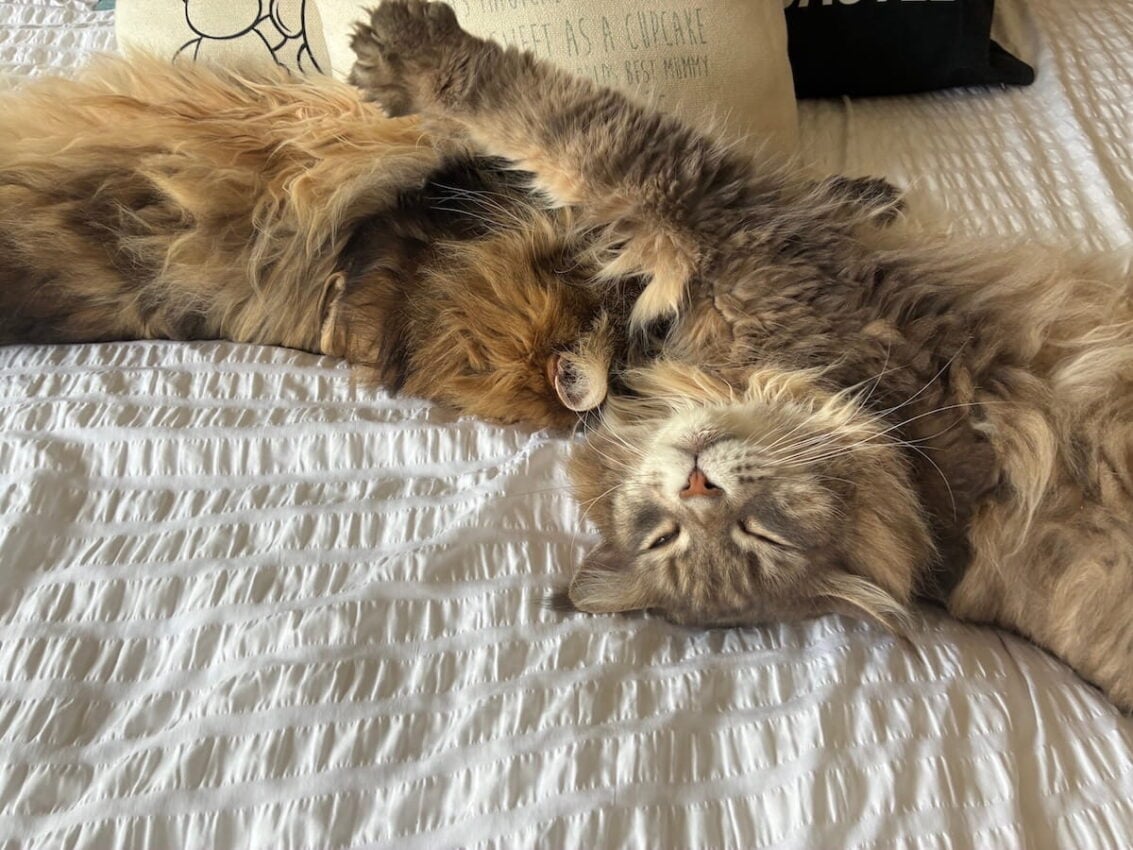
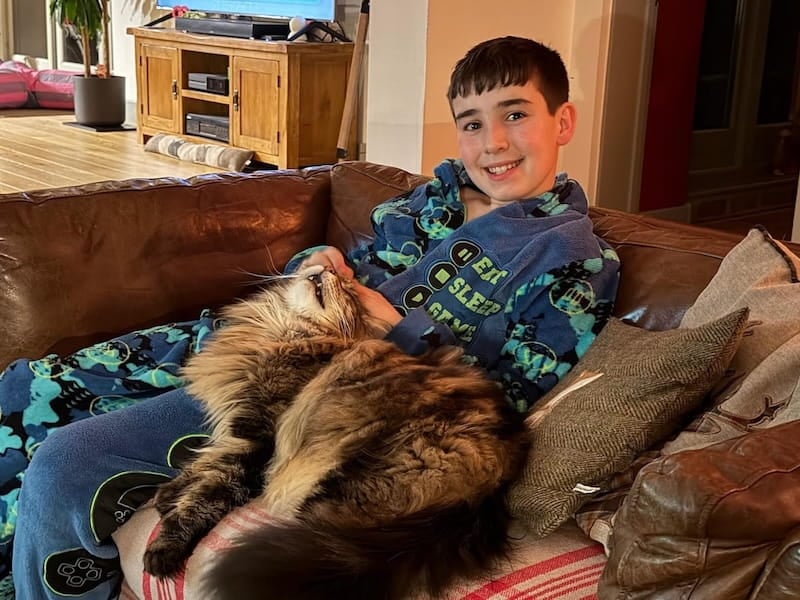
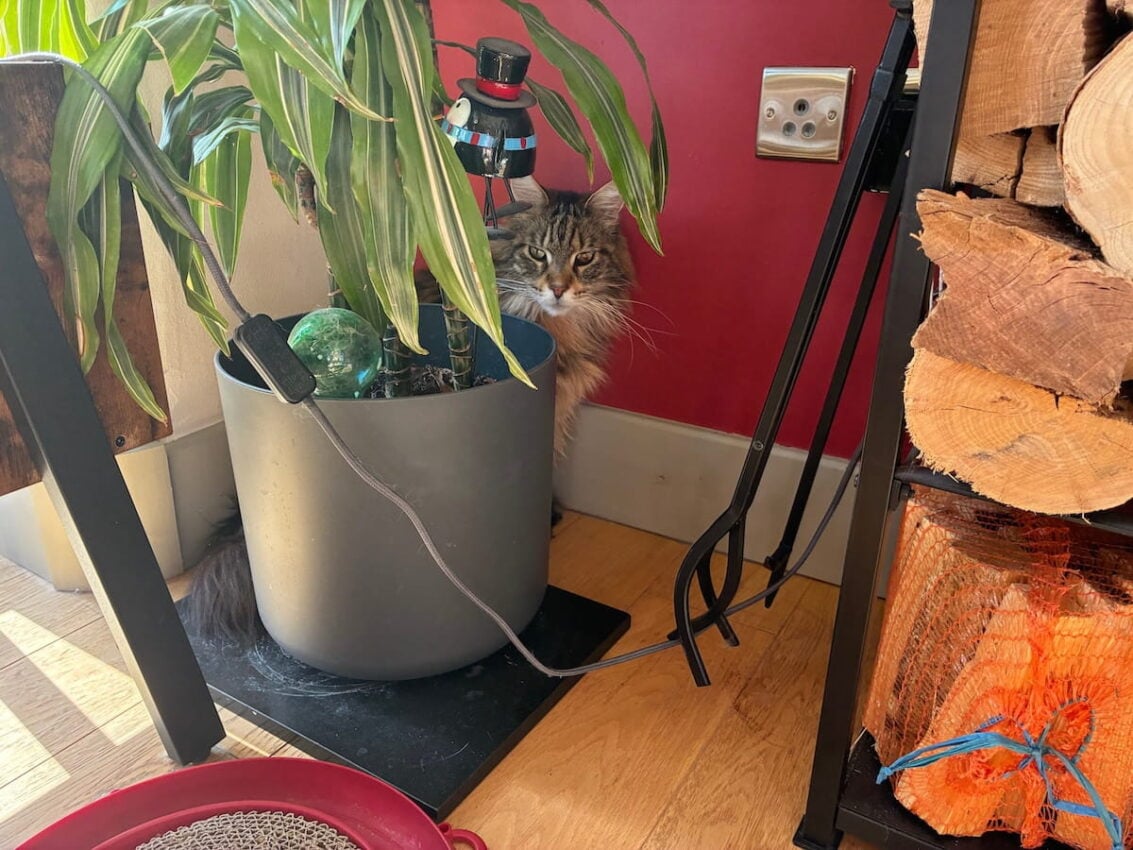
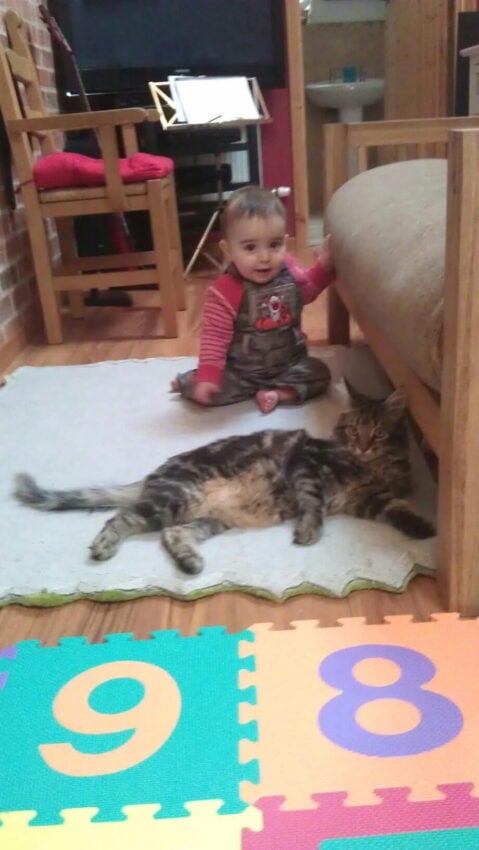
After living with three Maine Coons – Pippin, Mika, and Bali – I have seen how much cats of the same breed can differ in size, coat texture, confidence, and personality. The most reliable approach is therefore to examine the whole cat, consider any trustworthy background information, and understand what pedigrees and DNA tests can actually establish.
For a general introduction to the breed before comparing individual traits, read our guide explaining what a Maine Coon is.
Quick Answer
Your cat may have Maine Coon ancestry if it displays several of these characteristics:
* A long, rectangular body
* A broad chest and substantial frame
* A square muzzle and strong chin
* Large, well-furnished ears
* An uneven, shaggy coat
* A long, flowing tail
* Large, tufted paws
* Slow physical maturation
The official TICA Maine Coon breed standard describes this combination of a rectangular body, substantial bone structure, square muzzle, furnished ears, uneven coat, long tail, and large tufted paws. It also emphasizes that overall balance matters and that no single feature should dominate the cat’s appearance. However, physical features can suggest that a cat resembles a Maine Coon, but they cannot prove Maine Coon ancestry.
The strongest evidence is documented parentage showing that a parent or recent ancestor was a registered Maine Coon.
What Does “Part Maine Coon” Mean?
A part Maine Coon is a cat with both Maine Coon and non-Maine-Coon ancestry. Examples include:
- A kitten with one registered Maine Coon parent
- A cat with a documented Maine Coon grandparent
- A rescue with reliable records identifying a Maine Coon parent
- A cat whose relationship to a known Maine Coon has been verified through parentage testing
A Maine Coon mix is not a separate pedigree breed.
The current TICA standard lists no permissible outcrosses for registered Maine Coons. A deliberate cross between a Maine Coon and another breed or domestic cat would not qualify as a pedigree Maine Coon under that standard, even when its Maine Coon ancestry was genuine.
The distinction is important:
- Pedigree Maine Coon: Documented ancestry meeting a registry’s requirements
- Maine Coon mix: Known Maine Coon and non-Maine-Coon ancestry
- Possible Maine Coon mix: Ancestry is reported or suspected but unverified
- Maine Coon lookalike: Resembles the breed but has no known Maine Coon ancestry
For a separate explanation of pedigree proof, registration documents, and breeder paperwork, read how to know if your cat is a purebred Maine Coon.
Which Evidence Is Most Reliable?
Not every clue carries the same weight.
| Evidence | Reliability | What it shows |
|---|---|---|
| Records identifying a registered Maine Coon parent | Strongest | Supports genuine recent Maine Coon ancestry |
| Parentage testing involving the alleged parent | Strong | Can verify a biological relationship |
| Detailed breeder, surrender, rescue, or veterinary records | Useful | May support the cat’s reported history |
| Verified photographs and records of the parents | Supportive | Add context when identities are known |
| Commercial breed-similarity DNA result | Limited | Estimates similarity to a reference population |
| Several Maine Coon-like physical traits | Suggestive | Demonstrates resemblance, not ancestry |
| One feature such as ear tips or an M marking | Weak | Common in many unrelated cats |
TICA’s current registration guidance shows why paperwork carries more weight than appearance. Registration through an individual pedigree requires three generations of named ancestors, including registration numbers, colors, and patterns.
Can You Identify A Maine Coon Mix By Appearance?
You can assess whether a cat has Maine Coon-like characteristics, but you cannot directly determine ancestry. The question is not whether the cat has one dramatic feature. It is whether the cat displays a balanced combination of structural, facial, and coat characteristics associated with the breed.
The following signs are most useful when considered together.
1. Long, Rectangular Body
A Maine Coon’s body is typically long and rectangular rather than short, round, or compact.
Look for:
- A relatively long torso
- A broad, deep chest
- Similar width through the shoulders and hips
- Substantial legs
- A muscular, balanced appearance
The TICA breed standard describes the torso as large, substantial, muscular, and rectangular, with equal width from the shoulders to the hips. It also states that proportion is as important as overall size.
A cat that is overweight may look large without having an underlying Maine Coon-like frame. Assess the torso, chest, leg structure, and proportions rather than judging by weight alone.
Our detailed Maine Coon body-shape guide explains what the breed’s rectangular build looks like from different angles.
2. Substantial Frame And Broad Chest
Maine Coons should feel solid beneath their fur. Typical structural characteristics include:
- Substantial bone structure
- Strong shoulders
- A broad chest
- Firm musculature
- Legs and paws proportionate to the body
This does not mean the cat should be fat. TICA distinguishes firm musculature from excess body weight and states that correct breed type should not be sacrificed simply for size. A mixed cat may inherit a substantial frame without becoming as large as a pedigree Maine Coon. Conversely, an unrelated domestic cat may grow unusually tall, long, or heavy. Body structure is therefore more informative than weight by itself.
For typical development, proportions, and the difference between size and obesity, see our Maine Coon size and growth guide.
3. Square Muzzle And Strong Chin
The muzzle is one of the most useful Maine Coon characteristics. A typical Maine Coon head has:
- High, broad cheekbones
- A clearly defined square muzzle
- Parallel muzzle edges when viewed from above
- A wide, deep chin
- A head that is slightly longer than it is wide
- A gently curved profile
TICA describes the muzzle as well-defined, square, and box-like, with a wide chin completing the square appearance. A suspected mix may inherit a softer or less pronounced version of this structure. Look at the relationship between the cheekbones, muzzle, chin, and nose rather than expecting a perfect show-standard head. A narrow, pointed, or distinctly rounded muzzle is less typical of a Maine Coon.
4. Large, Well-Furnished Ears
Maine Coon ears are generally:
- Large
- Wide at the base
- Taller than they are wide
- Well furnished internally
- Tapered toward the tips
- Balanced with the size of the head
The longer hairs extending from inside the ear are called ear furnishings. Longer hairs rising from the tips are commonly called lynx tips. The official standard includes large, furnished ears and lynx tips in its description of the breed. However, ear tufts do not prove Maine Coon ancestry. Many domestic longhairs and other long-coated breeds also have them.
Ear shape becomes meaningful only when it accompanies characteristics such as a rectangular body, substantial frame, square muzzle, and uneven coat.
Our guide to Maine Coon lynx tips and ear furnishings explains why some Maine Coons have more dramatic ear tufts than others.
5. Uneven, Shaggy Coat
A Maine Coon coat is not simply long and fluffy. TICA describes an uneven coat that is:
- Shorter over the shoulders
- Gradually longer down the back and sides
- Shaggy around the abdomen
- Longer around the hind legs
- Full and flowing on the tail
- Often silky rather than woolly
- Supported by a light undercoat
The frontal ruff, belly shag, and furry hind-leg “britches” may become more noticeable as the cat matures.
A possible mix may inherit:
- The complete shaggy coat
- A smaller neck ruff
- A fluffy tail but less body fur
- Medium-length fur
- Seasonal furnishings that become fuller in winter
Domestic longhairs can also have spectacular coats. Coat length alone is therefore weak evidence.
6. Long, Flowing Tail
A Maine Coon’s tail should balance its long body. The TICA standard describes the tail as approximately as long as the body when measured from the tail base to the shoulder blades. It should be wide at the base, taper gradually, and carry long, flowing fur.
Look for a tail that is:
- Long in relation to the torso
- Broad at the base
- Fully furnished
- Gradually tapered
- Flowing rather than tightly plume-shaped
Many unrelated longhaired cats have beautiful bushy tails. The clue becomes more useful when the tail length matches a rectangular body and substantial frame.
For a direct breed comparison, our Maine Coon versus regular cat guide examines differences in body shape, coat, size, and development.
7. Large, Tufted Paws
Maine Coon paws are generally large, rounded, and well furnished. The official breed standard states that the paw tufts begin between the toes and remain visible beneath the pads.
A kitten’s paws may appear particularly large compared with the rest of its body. In an adult cat, consider whether the paws remain proportionate to a substantial frame.
Large paws are only supporting evidence because:
- Domestic cats can naturally have broad feet.
- Many longhaired cats have toe tufts.
- Adolescent cats sometimes look temporarily “all paws.”
- Males and females may differ considerably in size.
8. Overall Balance
The most useful visual clue is not one dramatic feature. It is how the entire cat fits together. A strongly Maine Coon-like cat may combine:
- A long rectangular torso
- A broad chest
- Substantial legs and paws
- A square muzzle
- High cheekbones
- Large furnished ears
- An uneven shaggy coat
- A long proportional tail
TICA explicitly states that balance and proportion are essential and that no single characteristic should dominate the cat’s appearance. Even a convincing combination demonstrates resemblance rather than proving ancestry.
Other Supporting Clues
Some suspected Maine Coon mixes also display:
- Slow physical maturation
- Unusually large size
- Large oval eyes
- Extra toes
The TICA standard states that Maine Coons can take four to five years to reach full maturity and recognizes the Maine Coon Polydactyl alongside the regular Maine Coon. However, these clues remain inconclusive.
Large and slow-growing domestic cats exist, while polydactyly also occurs outside the Maine Coon breed. Eye shape is shared by many unrelated cats. Use these characteristics only as supporting details when they accompany stronger structural signs.
For a young cat, our guide to identifying a Maine Coon kitten explains which features may be visible early and which develop gradually.
What Is A Maine Coon Tabby Mix?
The phrase Maine Coon tabby mix is commonly misunderstood. Tabby is not a breed. It is a coat pattern consisting of stripes, swirls, spots, or banded hairs.
A Maine Coon tabby mix might mean:
- A known cross between a Maine Coon and a tabby-patterned domestic cat
- A rescue believed to have Maine Coon ancestry and a tabby coat
- A large domestic tabby that resembles a Maine Coon
- A pedigree tabby Maine Coon incorrectly described as mixed
A pedigree Maine Coon can be tabby without being a mix. The TICA standard accepts classic, mackerel, spotted, and ticked tabby patterns in the breed.
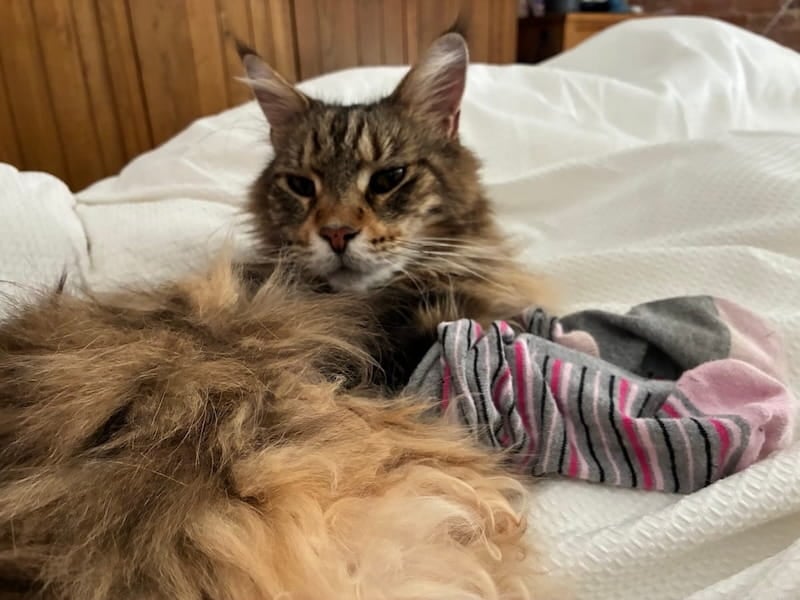
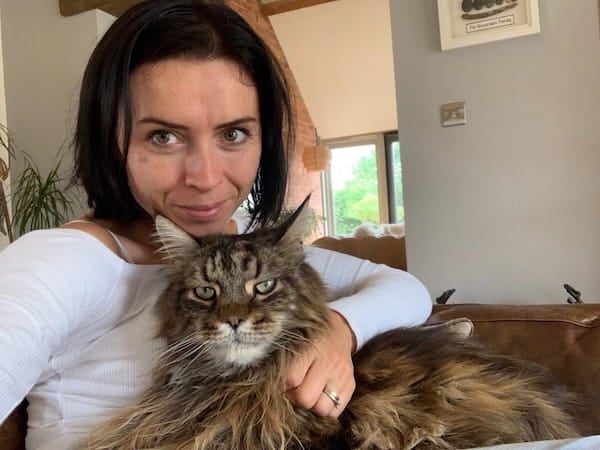
Our Maine Coons Pippin, Mika, and Bali are or were tabbies. All three displayed the familiar M-shaped marking on the forehead, but that marking came from their tabby pattern – not from being Maine Coons.
Our complete tabby Maine Coon guide explains the different tabby patterns and colors.

Does An M On The Forehead Mean Maine Coon?
The M-shaped forehead marking occurs in tabby-patterned cats of many breeds and in ordinary domestic cats.
It may appear on:
- Brown tabbies
- Blue tabbies
- Silver tabbies
- Red tabbies
- Classic tabbies
- Mackerel tabbies
- Spotted tabbies
A cat can have a prominent M marking without any known Maine Coon ancestry. Conversely, a solid-colored Maine Coon may not display an obvious forehead M.
Our article explaining why Maine Coons have an M on their forehead examines this common misconception in more detail.
Can Personality Reveal Maine Coon Ancestry?
Personality is a poor ancestry test. The TICA Maine Coon profile describes the breed generally as gentle, social, playful, and interested in family activities. Nevertheless, those broad breed tendencies cannot determine the ancestry of one individual cat.
Mika and Bali demonstrate this clearly. They are brothers, yet their reactions to people have been very different. Bali was described as openly affectionate, while Mika arrived extremely anxious and timid after reportedly spending much of his time hiding.
A cat that follows people, chirps, plays fetch, or investigates water may behave like the popular image of a Maine Coon. Ordinary domestic cats can display the same behaviors. Use personality as interesting context, not evidence of parentage.
Our Maine Coon personality guide explains common breed tendencies while recognizing how strongly individual cats can differ.
Can A DNA Test Confirm Maine Coon Ancestry?
The answer depends on the type of test.
Direct Parentage Testing
Parentage testing compares a cat’s DNA directly with the alleged parent or parents. The UC Davis Veterinary Genetics Laboratory offers feline parentage testing that compares an offspring’s DNA profile with the profiles of possible parents. UC Davis specifically notes that this test does not determine a cat’s breed.
Parentage testing can answer: Is this particular cat the biological parent of this kitten?
However, it does not independently prove that the parent is a registered Maine Coon. You would still need the alleged parent’s pedigree or registration records.
Commercial Breed-Ancestry Testing
Consumer ancestry tests normally compare a cat’s DNA with reference samples associated with certain breeds or breed groups. A result may suggest that your cat is genetically similar to cats in the company’s Maine Coon reference population. That is not the same as confirming a recent Maine Coon parent or proving that the cat is a particular percentage Maine Coon.
The Cat Fanciers’ Association overview of feline genetic testing shows that commercial services differ in the breeds, markers, traits, and reference populations included in their databases. In practice, a breed-similarity result should therefore be treated as an estimate rather than the equivalent of pedigree documentation or direct parentage testing.
Results may be influenced by:
- The number of cats in the reference database
- Which Maine Coon lines have been sampled
- Similarities between related breeds and regional cat populations
- The company’s matching algorithm
- Future database updates
- How distant the suspected ancestry is
A commercial DNA result may add useful context, but it should not be described as foolproof proof of Maine Coon ancestry.
Health And Trait Testing
A test for coat color, hair length, blood type, or a disease-associated variant answers a different question.
For example, finding a longhair variant associated with Maine Coons does not establish breed ancestry, because some hair-length variants also occur in other breeds and crossbred cats. UC Davis notes that longhair variants may be shared between breeds and the wider longhaired cat population. Similarly, carrying a health variant found in Maine Coons does not prove that a cat belongs to the breed.
Health results should be interpreted according to the particular test and discussed with a veterinarian where appropriate.
Why Pedigree And Parent Records Matter
A pedigree documents named ancestors rather than estimating resemblance.
TICA currently permits registration through routes including a breeder slip, a certified pedigree from an approved registry, or a qualifying individual pedigree. Its individual-registration process requires three generations of ancestors, including names, registration numbers, colors, and patterns.
Useful evidence for a suspected mix may include:
- A registered Maine Coon parent
- The parent’s registration number
- Litter or breeder records
- Veterinary or microchip records connecting the kitten to the litter
- Signed transfer or surrender documents
- Direct parentage testing involving the documented parent
A statement that “the father was a huge Maine Coon” is not equivalent to verified parentage.
When purchasing a kitten, our guide to buying a Maine Coon explains how to check registration, health records, breeder claims, and common scams.
Can A Veterinarian Confirm The Breed?
A veterinarian may recognize that a cat has features consistent with a Maine Coon, but a physical examination usually cannot confirm ancestry. A veterinarian can assess:
- Body structure
- Muscle and body condition
- Coat and skin health
- Growth and development
- Joint mobility
- Heart health
- Other medical concerns
A breed label in veterinary or rescue records may simply repeat information originally supplied by an owner, breeder, or shelter.
Ask how the breed description was established before treating it as verified ancestry.
How To Assess Your Cat More Accurately
Examine the cat in clear, natural light and use several views:
- A standing side profile showing the body
- A front-facing photograph showing the muzzle and chest
- A view from above showing the head and torso
- A clear view of the ears
- The paws and toe furnishings
- The tail shown alongside the body
Also record:
- Age
- Sex
- Weight and body condition
- Growth history
- Whether the cat is neutered
- Known information about parents or littermates
- Previous photographs
- Adoption, surrender, or breeder records
Do not try to determine ancestry from one close-up photograph, winter fluff, body weight, or an unsupported shelter label.
How Should You Describe Your Cat?
Use wording that matches the evidence available.
Documented Maine Coon Parentage
Use: Maine Coon mix
You may also name the other breed when both sides of the cat’s ancestry are documented.
Reported Ancestry Without Supporting Records
Use: Reported Maine Coon mix
or:
Possible Maine Coon mix
Maine Coon-Like Appearance But No Known History
Use: Domestic longhair with Maine Coon-like features
This describes what you can observe without presenting uncertain ancestry as fact.
Registered Pedigree Documentation
Use: Pedigree Maine Coon
The correct description does not change how valuable or loved the cat is. It simply separates what is known from what is suspected.
Does Suspected Maine Coon Ancestry Change A Cat’s Care?
Care should be based on the individual cat rather than an uncertain breed label. A large, longhaired cat may need:
- Regular brushing and mat checks
- Appropriately sized litter boxes
- Sturdy cat trees and carriers
- Weight and body-condition monitoring
- Exercise and environmental enrichment
- Routine veterinary and dental care
Known family history is more useful for health planning than visual resemblance.
Our Maine Coon health and wellness guide explains the principal health considerations associated with the breed, including heart, joint, dental, urinary, and weight-related concerns.
Frequently Asked Questions
What Is the Strongest Physical Sign That a Cat May Be Part Maine Coon?
There is no single definitive sign. The strongest visual impression comes from a combination of a rectangular body, broad chest, substantial frame, square muzzle, uneven coat, long tail, and large tufted paws.
Does an M on the Forehead Mean My Cat Is Part Maine Coon?
No. The M on the forehead is associated with tabby patterning and occurs in many cats without Maine Coon ancestry.
Do Ear Tufts Prove Maine Coon Ancestry?
No. Ear furnishings and lynx tips contribute to a Maine Coon-like appearance, but they also occur in unrelated longhaired cats.
Are All Tabby Maine Coons Mixed?
No. Many registered pedigree Maine Coons have tabby coats. Tabby describes a coat pattern, not mixed ancestry.
Can a Small Cat Be Part Maine Coon?
Yes. A mixed cat may not inherit the Maine Coon’s full adult size. Sex, age, health, nutrition, and the other parent’s genetics also influence growth.
Can a Shorthaired Cat Be Part Maine Coon?
Potentially, yes. A mixed cat does not necessarily inherit every visible Maine Coon characteristic, including the breed’s coat length.
Can a DNA Test Prove That My Cat Is Part Maine Coon?
A direct parentage test can verify a relationship with a particular alleged parent. A commercial breed-similarity test provides an estimate based on its reference database and is not equivalent to documented parentage.
Can My Veterinarian Confirm That My Cat Is Part Maine Coon?
A veterinarian can assess physical characteristics and health but generally cannot confirm ancestry from appearance alone.
Is a Rescue’s Maine Coon Label Reliable?
It depends on the evidence. Some labels are based on surrender records or known parentage. Others are visual estimates based on long fur, large size, or ear tufts. Ask what information was used before treating the label as confirmed.
Is a Maine Coon Tabby Mix a Recognized Breed?
No. It is an informal description. Tabby is a coat pattern. A genuine mix must have both Maine Coon and non-Maine-Coon ancestry.
Final Thoughts
A cat may genuinely be part Maine Coon, but appearance alone cannot establish ancestry. The strongest physical clues are:
- A long rectangular body
- A broad chest and substantial frame
- A square muzzle
- Large furnished ears
- An uneven shaggy coat
- A long flowing tail
- Large tufted paws
- Balanced proportions
An M marking, large size, dramatic ear tips, extra toes, chirping, or an interest in water does not prove Maine Coon ancestry.
Documented parentage provides the clearest evidence. Direct parentage testing can verify a biological relationship when the alleged parent is available, while commercial breed-similarity reports should be treated as estimates rather than definitive proof.
Most importantly, care for the cat in front of you. Its coat, body condition, health, behavior, and emotional needs matter far more than an uncertain breed label.