Can You Shave A Maine Coon? Risks, Lion Cuts And Safer Options

Shaving a Maine Coon might seem like a quick solution for shedding, overheating, or matted fur, but in most cases, it is not recommended.
Maine Coons have a thick, semi-longhaired coat that helps protect their skin and supports natural temperature regulation. Removing too much of this coat can leave the skin more exposed and may create new problems, especially if shaving is done for convenience rather than for a genuine medical, hygiene, or welfare reason.
That does not mean shaving is always wrong. If a Maine Coon has severe mats, infected skin, wound-care needs, surgery preparation, diagnostic testing, or serious hygiene problems, clipping or shaving part of the coat may be the safest and kindest option.
The key is knowing when shaving is genuinely necessary and when safer grooming alternatives should be tried first.
For a complete coat-care routine, read my Maine Coon grooming and care guide.
Quick Answer
Most Maine Coons should not be shaved for shedding, summer heat, or convenience. Shaving may be necessary for severe matting, medical treatment, wound care, hygiene problems, or veterinary procedures, but it should usually be done by a vet or experienced cat groomer.
In most cases, regular brushing, targeted detangling, sanitary trims, and professional grooming are safer than a full shave or lion cut.
Can You Shave A Maine Coon?
Technically, yes, you can shave a Maine Coon, but that does not mean you should.
A Maine Coon’s coat is not just decorative. It provides a protective barrier over the skin, helps repel moisture, and gives some insulation from environmental changes. When this coat is shaved too short, the skin is more exposed to sunlight, irritation, temperature changes, and accidental injury.
Shaving should therefore be treated as a last-resort grooming or medical solution, not a routine part of Maine Coon care.
For most healthy Maine Coons, the better approach is to keep the coat clean, brushed, and free from mats rather than removing it completely.
Why Maine Coons Usually Should Not Be Shaved
Maine Coons are large, long-haired cats with coats designed to protect them through changing seasons.
Their fur usually includes:
- Guard hairs: Longer outer hairs that help protect the coat and skin.
- Undercoat: A softer layer that adds insulation and can become dense, especially in winter.
Together, these layers help protect against moisture, cold, heat, friction, and direct sun exposure. This is why shaving a Maine Coon for cosmetic reasons, convenience, or summer heat is usually not the best answer.
What Can Happen After Shaving?
Shaving removes much of the coat’s natural protection.
Depending on the cat, the clip length, and the reason for shaving, this can lead to:
- Poorer natural temperature regulation
- Greater sun exposure, especially on pale or thinly covered skin
- Skin sensitivity or irritation
- Accidental clipper burns, nicks, or cuts
- Patchy or uneven regrowth
- A different coat texture during regrowth
- Stress if the cat finds clipping frightening
Some cats cope well after a necessary shave, especially when mats have been painful or a medical problem needs treating. Others may hide, feel vulnerable, or seem unsettled until the coat begins to regrow.
When Shaving A Maine Coon Is Necessary
Although routine shaving is not recommended, there are situations where clipping part or all of the coat may be the safest option.
1. Severe Matting
Severe mats are one of the most common reasons a Maine Coon may need to be shaved.
Shaving may be needed when mats:
- Sit tightly against the skin
- Cover large areas of the body
- Cause pain when touched
- Pull the skin when the cat moves
- Hide sore, red, broken, or infected skin underneath
Trying to brush out severe mats can be painful and may damage the skin. In these cases, carefully clipping the affected areas can be kinder than forcing a comb through tangled fur.
For mat-specific help, read my guide on how to remove matted fur from a Maine Coon.
2. Medical Treatment Or Veterinary Procedures
Veterinarians may shave small areas of fur for medical reasons. This is very different from shaving the entire coat for convenience.
A vet may clip fur for:
- Surgery preparation
- Blood tests
- Cannula placement
- Ultrasound scans
- Wound cleaning
- Skin treatment
- Hot spots, infection, or abscess care
- Urine testing, bladder treatment, or emergency care
This happened with my Maine Coon, Pippin, when he suffered from a serious urinary tract infection. He did not have a full-body shave, but the fur on part of his leg had to be shaved by the vet as part of his treatment.
That kind of shaving is completely different from a cosmetic lion cut or a summer shave. It is targeted, necessary, and done for medical access rather than appearance.
3. Serious Hygiene Problems
Some Maine Coons develop hygiene problems around the backend, especially if they have very long trousers, diarrhoea, arthritis, obesity, or reduced mobility.
In these cases, a sanitary trim may be recommended. This means trimming the fur around the rear end, not shaving the whole body.
A sanitary trim can help if your cat regularly gets faeces, urine, or litter stuck in the backend fur. It can also make cleaning easier for older cats who struggle to groom themselves properly.
Should You Shave A Maine Coon In Summer?
Many owners consider shaving their Maine Coon in summer because they worry their cat is too hot under all that fur.
This is understandable, especially during heatwaves, but shaving is usually not the safest or most effective way to keep a Maine Coon cool.
A well-maintained coat helps provide a barrier between your cat’s skin and the outside environment. If the coat is shaved very short, the skin is more exposed to direct sunlight, heat, and irritation.
Instead of shaving, focus on cooling your cat’s environment and keeping the coat free from packed undercoat and mats.
Better Ways To Keep A Maine Coon Cool
In hot weather, safer cooling methods include:
- Keeping your cat indoors during the hottest part of the day
- Providing shaded resting places
- Offering constant access to fresh water
- Using fans safely to improve airflow
- Closing curtains or blinds in very sunny rooms
- Providing cool tile floors or cooling mats
- Grooming regularly to remove loose undercoat
- Checking for mats, especially under the armpits, belly, and backend
If your Maine Coon is panting, drooling, weak, restless, vomiting, collapsing, or acting confused in hot weather, contact a vet urgently.
What Is A Maine Coon Lion Cut?
A lion cut is a style of cat shave where the body is clipped short while leaving fur around the head, mane, lower legs, and tail tip. This creates a lion-like appearance.
Some Maine Coons look striking in a lion cut because their natural mane is already impressive, but a lion cut is still a form of body shaving. It should not be treated as a harmless fashion choice.
Is A Lion Cut Ever A Good Idea?
A lion cut may be appropriate if a Maine Coon has widespread matting, cannot be safely brushed, or needs clipping for medical or hygiene reasons. In these cases, the aim is comfort and welfare, not appearance.
However, a lion cut is usually not recommended for:
- Reducing normal shedding
- Keeping a Maine Coon cool in summer
- Making grooming easier for the owner
- Creating a cute or funny appearance
- Avoiding regular brushing
If a lion cut is being considered because the coat has become unmanageable, it is worth asking why the coat reached that stage.
Often, the real solution is a better grooming routine, a different brush, shorter grooming sessions, or help from a cat groomer.
Possible Problems With Lion Cuts
Even when performed professionally, lion cuts can have downsides.
Possible problems include:
- Skin exposure
- Sun sensitivity
- Stress during grooming
- Uneven regrowth
- Temporary changes in coat texture
- The coat matting again as it grows back
- The cat feels more vulnerable after clipping
Some cats also dislike the sensation of clippers, restraint, or being handled for long periods. If a Maine Coon is already anxious, elderly, painful, or aggressive during grooming, shaving can become stressful unless handled carefully by a professional.
Does Shaving Stop Maine Coon Shedding?
Shaving does not stop shedding. It only changes the length of the hair that falls out.
Maine Coons shed because their coat naturally renews itself. Seasonal changes, indoor heating, diet, age, hormones, stress, and health can all affect how much fur they lose.
If shedding is the problem, shaving is rarely the best fix. A better approach is to remove loose undercoat before it ends up around your home.
Useful shedding solutions include:
- Brushing several times per week
- Daily grooming during heavy shedding seasons
- Using a comb or brush suited to a Maine Coon coat
- Checking for mats before they tighten
- Supporting skin and coat health with a balanced diet
- Asking a vet about sudden or excessive hair loss
Normal shedding is not a reason to shave a Maine Coon.
Does Maine Coon Fur Grow Back After Shaving?
In many cases, Maine Coon fur does grow back after shaving, but it may take months, and it does not always return evenly straight away.
Regrowth can depend on:
- The cat’s age
- Coat type
- Season
- Health
- Nutrition
- Hormonal factors
- How short the coat was clipped
- Whether the skin or follicles were damaged
Some Maine Coons regrow their coats normally. Others may have temporary patchiness, uneven texture, or slower regrowth in certain areas.
This is another reason shaving should not be done casually. If shaving is necessary, it should be done carefully and with a clear purpose.
Better Alternatives To Shaving
In most cases, shaving can be avoided by improving the grooming routine.
1. Regular Brushing
Most Maine Coons need brushing several times per week, and some need daily attention during shedding seasons.
Regular brushing helps remove loose undercoat before it compacts into mats. It also lets you spot small tangles before they become painful.
These are my favorite Maine Coon cat brushes.
2. Targeted Grooming
You do not need to brush every inch of your Maine Coon for ages every day. In fact, many cats tolerate short, targeted grooming sessions better.
Focus on the areas most likely to mat:
- Behind the ears
- Under the armpits
- Chest
- Belly
- Tail base
- Back legs
- Trousers
- Around the rear end
These areas are more prone to friction, oiliness, tangling, and hidden mats.
3. Sanitary Trims
A sanitary trim can be a useful compromise for Maine Coons with backend hygiene problems.
Instead of shaving the whole coat, only the fur around the rear end is carefully trimmed. This helps reduce mess while keeping most of the coat intact.
Sanitary trims can be especially helpful for:
- Older Maine Coons
- Cats with mobility problems
- Cats with very long trousers
- Cats prone to faeces sticking in the fur
- Cats who struggle to clean themselves properly
4. Professional Grooming
A professional cat groomer may be able to remove small mats, reduce coat bulk, tidy problem areas, or perform a sanitary trim without needing a full-body shave.
Professional help is especially useful if:
- Mats are close to the skin
- Your cat reacts badly to grooming
- You are unsure which tools to use
- The coat has become too dense to manage at home
- You are worried about cutting the skin
Never use scissors to cut out tight mats unless you have professional training. Cat skin is very thin and can be pulled up inside the mat, making accidental cuts more likely.
Veterinary guidance warns that scissors should not be used to remove hair mats because mats often sit very close to the skin, making accidental cuts more likely.
When To Choose A Groomer Or Vet
Use this guide to decide what level of help your Maine Coon may need:
| Problem | Best Next Step |
|---|---|
| Small loose tangle | Gently separate with fingers or a suitable comb |
| Loose surface mat | Try careful detangling if your cat is comfortable |
| Mat close to the skin | Ask a professional cat groomer |
| Large, tight, painful mats | Contact a groomer or vet; shaving may be needed |
| Red, sore, smelly, broken, or infected skin | Contact a vet |
| Faeces stuck in the backend fur | Consider a sanitary trim, not a full-body shave |
| Older cat unable to groom properly | Discuss a grooming plan with your vet or groomer |
| Sudden coat change or excessive hair loss | Book a vet check |
Source: mainecooncentral.com
Should You Shave A Maine Coon At Home?
You should not shave a Maine Coon at home unless you have proper training and your cat is calm, cooperative, and only needs a very minor trim in a safe area. Cat skin is thin, loose, and easy to cut, especially when mats sit close to the body.
If the coat is badly matted, your cat is distressed, the skin looks sore, or the mats are near the armpits, belly, genitals, tail base, or back legs, use a professional cat groomer or vet instead.
My Experience With Maine Coon Coat Care
I have not personally had to shave any of my Maine Coons because of matting, shedding, or summer heat. However, I have experienced veterinary shaving with Pippin.
When he suffered from a serious UTI, the vet had to shave fur from part of his leg during treatment. That was not cosmetic, and it was not done to make grooming easier. It was a targeted medical shave, done because the vet needed access.
Seeing Pippin’s leg shaved for treatment also showed me how quickly fur removal can expose the skin, which is why I would always separate necessary veterinary clipping from cosmetic or convenience shaving.
That experience reinforced the difference between necessary shaving and avoidable shaving.
Medical shaving has a purpose. It helps the vet treat the cat. A full-body shave for convenience is completely different and should be considered much more carefully.
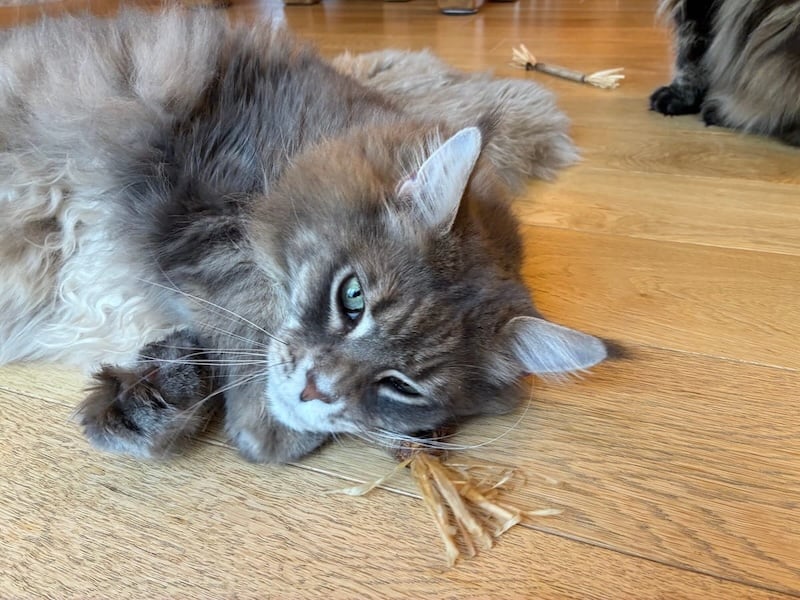
With Pippin, Mika, and Bali, I’ve found that coat type also makes a big difference. Some Maine Coons are much more prone to matting than others.
Pippin had a dense coat that could become oily around the tail base. Mika tends to need checks around his backend because that area can tangle more easily. Bali has a silkier coat that seems to resist tangles better.
This is why I do not think shaving advice should be one-size-fits-all. A Maine Coon with a thick, oily, easily matted coat may need more frequent grooming than one with a silkier coat. But that still does not mean a full-body shave should be the first answer.


How To Prevent A Maine Coon From Needing To Be Shaved
The best way to avoid shaving is to prevent mats from becoming severe in the first place.
Helpful habits include:
- Brush little and often
- Focus on mat-prone areas
- Use the right brush and comb for a Maine Coon coat
- Check behind the ears, armpits, belly, trousers, and tail base
- Keep grooming sessions short if your cat gets annoyed
- Reward calm behaviour
- Deal with small tangles immediately
- Ask a groomer for help before the coat becomes unmanageable
Most severe grooming problems start as small tangles that are missed for too long. Once mats tighten against the skin, brushing becomes painful, and shaving may become the only humane option.
Related Grooming Guides
For more help with Maine Coon coat care, read:
- Maine Coon Grooming And Care
- Best Brushes For Maine Coons
- How To Remove Matted Fur From A Maine Coon
- Does Maine Coon Fur Grow Back?
Conclusion: Should You Shave A Maine Coon?
Most Maine Coons should not be shaved unless there is a clear medical, hygiene, or welfare reason.
Shaving is sometimes necessary for severe matting, veterinary treatment, wound care, surgery, diagnostic procedures, or backend hygiene problems. In those cases, clipping may be the kindest and safest option.
However, shaving should not be used as a routine fix for shedding, summer heat, or owner convenience. A Maine Coon’s coat protects the skin, supports natural temperature regulation, and helps shield the body from the environment.
For most cats, the better solution is regular brushing, early mat removal, targeted grooming, sanitary trims, and professional help when needed.
The simplest rule is this:
If shaving helps your Maine Coon’s health, comfort, or veterinary care, it may be necessary. If it is only being considered for convenience, appearance, shedding, or summer heat, there is almost always a safer option.