Maine Coon Vs Russian Blue: Differences & Mix Traits
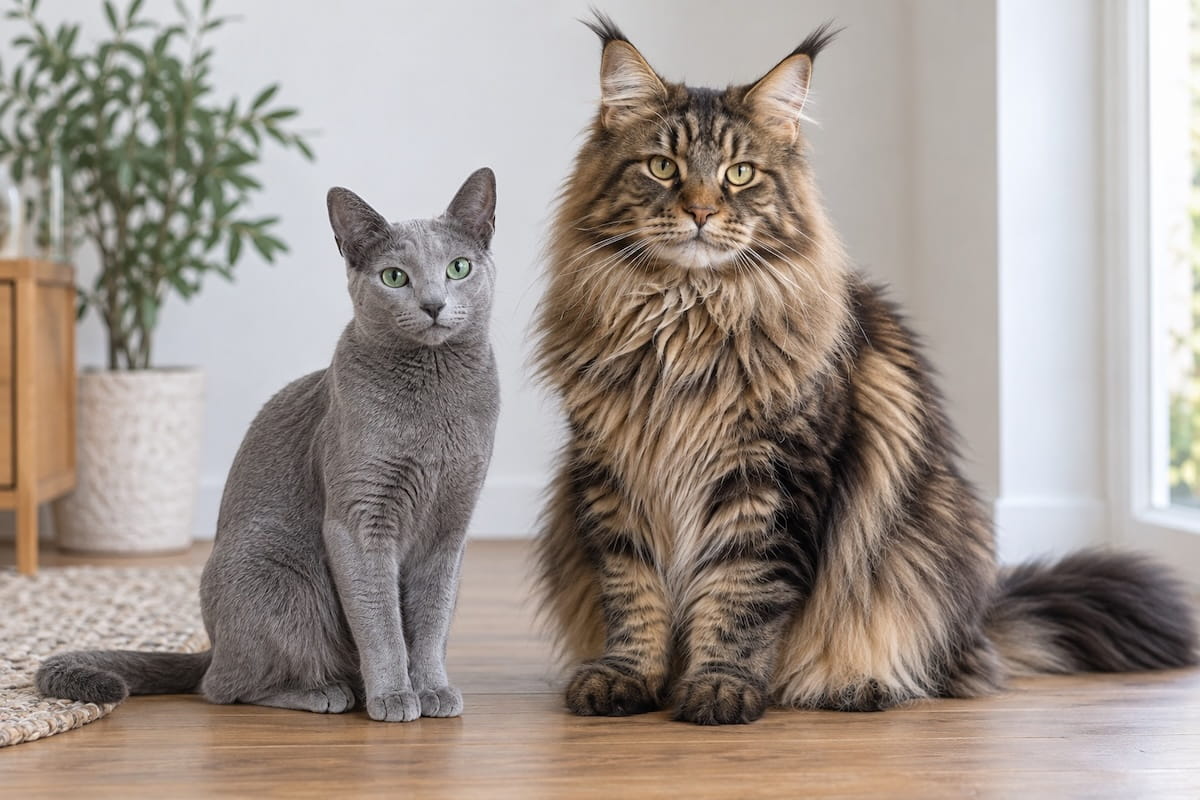
The Maine Coon and Russian Blue are both intelligent, affectionate cats, but they are very different breeds. Maine Coons are large, substantial cats with shaggy coats, rectangular bodies, and famously sociable personalities. Russian Blues are medium-sized cats with a short, dense blue coat, fine-boned build, and striking green eyes.
I have owned Maine Coons for more than 14 years, including Pippin, Mika, and Bali. I haven’t personally owned a Russian Blue, although my husband had a Russian Blue when he was growing up, so the breed has been part of his family life. For the breed-specific Russian Blue characteristics in this comparison, I have therefore relied on established breed information from organizations including TICA and the Cat Fanciers’ Association rather than presenting his childhood experience as representative of every Russian Blue.
If you are new to Maine Coons, my What Is A Maine Coon? guide explains the breed in much greater depth.
Quick Answer
The biggest differences between a Maine Coon and Russian Blue are their size, coat, build, and typical approach to people.
Maine Coons are much larger and have medium-long shaggy coats. They tend to be outgoing, curious cats that like being involved in whatever their owners are doing. Russian Blues are medium-sized, shorthaired cats. They can be extremely affectionate with their families but are often more reserved when meeting unfamiliar people.
Neither is automatically the better pet. The right breed depends on how much space you have, how much grooming you want to do, and the type of personality you prefer.
Maine Coon Vs Russian Blue At A Glance
| Feature | Maine Coon | Russian Blue |
|---|---|---|
| Size | Large | Medium |
| Male weight | Commonly around 18–22 lbs | Medium-sized breed |
| Body | Long, rectangular, substantial | Fine-boned, muscular, elegant |
| Coat | Medium-long and shaggy | Short, extremely dense |
| Color | Many colors and patterns | Blue |
| Eyes | Green, gold, copper, and other accepted variations | Vivid green |
| Personality | Sociable, curious, friendly | Affectionate, observant, often initially reserved |
| Intelligence | High | High |
| Activity | Playful and active | Playful, agile, and intelligent |
| Grooming | Regular grooming needed | Relatively low maintenance |
| Vocality | Famous for chirps and trills | Often quiet but can be conversational |
| Children and pets | Usually well suited | Can also live happily with both |
| Apartment living | Possible with enough space and enrichment | Often well suited |
1. Maine Coon Vs Russian Blue Size
Size is one of the clearest differences. Maine Coons are large cats with substantial bodies, broad chests, big paws, and long tails. According to The International Cat Association’s Maine Coon breed profile, adult males commonly weigh around 18-22 pounds, while females are typically smaller. Maine Coons are also slow to mature, often continuing to develop for several years.
If you’re wondering how that compares with a normal Maine Coon at different ages, my Maine Coon Size And Growth guide covers their development in much more detail.
Russian Blues are considerably smaller. TICA’s Russian Blue breed profile classifies them as medium-sized cats with fine boning and a muscular but elegant build. Their incredibly dense coat can also make them look more substantial than they really are.
So if you specifically want a very large cat, the Maine Coon is the clear winner.
2. Body And Face Shape
A Maine Coon should look powerful and substantial rather than delicate.
Typical features include:
- A long rectangular body
- Broad chest
- Large paws
- Prominent cheekbones
- A strong, square-looking muzzle
- Large ears
- A long bushy tail
The Russian Blue has a much more refined silhouette. The Cat Fanciers’ Association Russian Blue standard describes the breed as having a smooth, medium wedge-shaped head, relatively fine body structure, large ears, and characteristic emerald-green eyes. Russian Blues are also known for an expression sometimes called the Russian Blue smile, created partly by the shape of the muzzle and mouth.
Put the breeds beside one another, and their overall shapes are really quite different.
3. Coat Length And Texture
The coat is another easy way to distinguish them.
Maine Coon Coat
Maine Coons have a shaggy, weather-resistant coat that varies in length across the body. The fur is generally longer around the stomach, britches, ruff, and tail. This beautiful coat does require maintenance. My Maine Coon Grooming Guide explains how I manage the coat and deal with knots and mats.
Russian Blue Coat
Russian Blues are shorthairs. Their coat is unusually dense and stands away from the body, while silver tipping on the hairs gives it the distinctive shimmering appearance associated with the breed.
According to TICA’s Russian Blue breed information, the breed has one coat color: blue, and one coat length: short. TICA also recommends brushing or combing the dense coat around once or twice a week.
If you want a lower-maintenance coat, the Russian Blue has a definite advantage.
4. Maine Coon Vs Russian Blue Colors
Maine Coons come in a huge range of colors and patterns. These include:
- Brown tabby
- Black
- Blue
- Red
- Cream
- Silver
- White
- Tortoiseshell
- Numerous combinations with white
You can see the wider range in my Maine Coon Colors And Patterns Guide.
The Russian Blue is much more specific. Both TICA and CFA describe the recognized Russian Blue as a shorthaired blue cat with silver tipping. This also clears up an important source of confusion: A blue Maine Coon is not automatically part Russian Blue.
Blue is a perfectly normal Maine Coon color in its own right. Mika is a blue tabby Maine Coon, for example, and you can see more examples in my Blue Maine Coon guide.
5. Personality And Temperament
This is where the comparison becomes more interesting because both breeds are affectionate, but they often express it differently.
Maine Coon Personality
Maine Coons tend to be very involved with family life. My own cats have followed us around the house, waited outside doors, chattered for attention, played fetch, investigated whatever we were doing, and generally made themselves part of everyday family life.
TICA similarly describes Maine Coons as gentle, friendly cats that often want to “help” their owners with whatever they are doing.
My Maine Coon Personality guide goes into far more detail about the breed’s behavior based on my experience with Pippin, Mika, and Bali.
Russian Blue Personality
Russian Blues should not simply be described as shy or antisocial. TICA describes Russian Blues as affectionate and very close to their families while being somewhat reserved around strangers. They often watch a new person or situation before deciding whether to become involved. That distinction is useful. A Russian Blue may love its family deeply while still taking longer to warm up to somebody unfamiliar.
If I had to simplify the broad breed tendencies:
- Maine Coon: “What are we doing?”
- Russian Blue: “I’ll watch first, then decide whether I’m joining you.”
Individual personality and socialization still matter enormously.

6. Intelligence And Play
I would not describe Russian Blues as only moderately intelligent. Both breeds are clever. TICA describes Russian Blues as highly intelligent, noting that they can learn tricks, retrieve toys, open doors and drawers, and enjoy puzzle-based activities. That gives them more in common with Maine Coons than you might expect. Maine Coons are also famously playful. Bali loves retrieving his toy mouse, while Mika is particularly good at harder food puzzles.
Both breeds can benefit from:
- Puzzle feeders
- Interactive toys
- Fetch games
- Climbing opportunities
- Regular play
- Mental stimulation
The main practical difference is that Maine Coon equipment often needs to be much larger and sturdier.
7. Are Maine Coons Or Russian Blues More Vocal?
Maine Coons are famous for their unusual voices. Many chirp, trill, squeak, and chatter rather than relying exclusively on an ordinary meow. TICA specifically highlights chirping and trilling as characteristic Maine Coon communication.
Russian Blues are often described as quieter, but that doesn’t mean they are silent. TICA notes that Russian Blues can develop quite a vocabulary and may respond when their owners talk to them.
So I wouldn’t reduce the comparison to:
Maine Coon = vocal
Russian Blue = silent
Both can be communicative cats.
8. Which Is Better With Children And Other Pets?
Maine Coons have a strong reputation as family cats, and my own experience has certainly supported that. They are generally tolerant, sociable cats, although any interaction with young children should still be respectful and supervised.
Russian Blues should not be written off as unsuitable for families. TICA specifically states that Russian Blues can get along well with children and other pets and describes them as loving, playful companions.
The cat’s own temperament, previous experience, socialization, and the way introductions are handled are likely to matter more than a simplistic breed label.

9. Grooming And Maintenance
The Russian Blue wins easily if low-maintenance grooming is a priority. A Russian Blue’s short, dense coat typically needs only occasional brushing. Maine Coons require considerably more attention because their longer fur can tangle and form mats, particularly around areas such as the stomach and armpits.
Individual cats can also make grooming easier or considerably harder. Mika is a perfect example. He is incredibly affectionate on his terms, but once he decides grooming time is finished, grooming time is most definitely finished!
10. Health Considerations
No pedigree breed should be chosen on appearance and personality alone.
Maine Coons have recognized inherited health concerns, including hypertrophic cardiomyopathy, hip dysplasia, spinal muscular atrophy, and pyruvate kinase deficiency. TICA’s Maine Coon health information discusses screening for these conditions, while my Maine Coon Health And Wellness Guide explains the major issues owners should understand in more detail.
Russian Blues can still develop ordinary feline health problems, even though they do not share the same breed-specific risk profile.
Whichever breed you choose, I would want to see appropriate health information about the actual cat and its family line rather than assuming a breed is automatically healthy.
Maine Coon Vs Russian Blue: Which Should You Choose?
Neither breed is universally better. A Maine Coon may suit you better if you:
- Specifically want a large cat
- Like a sociable, involved personality
- Don’t mind regular grooming
- Have room for larger cat furniture and equipment
- Want an interactive family companion
A Russian Blue may suit you better if you:
- Prefer a medium-sized cat
- Want a short coat
- Prefer less grooming
- Like an intelligent but somewhat more reserved personality
- Want a cat that may cope well with periods alone
- Live in a smaller home or apartment
TICA specifically describes Russian Blues as well suited to apartment living because they can enjoy their own company while also interacting enthusiastically when their owners return. But breed descriptions only tell you tendencies. The personality of the individual cat still matters enormously.

Russian Blue Maine Coon Mix
A surprisingly large number of people also search for the Russian Blue Maine Coon mix, so it is worth covering separately.
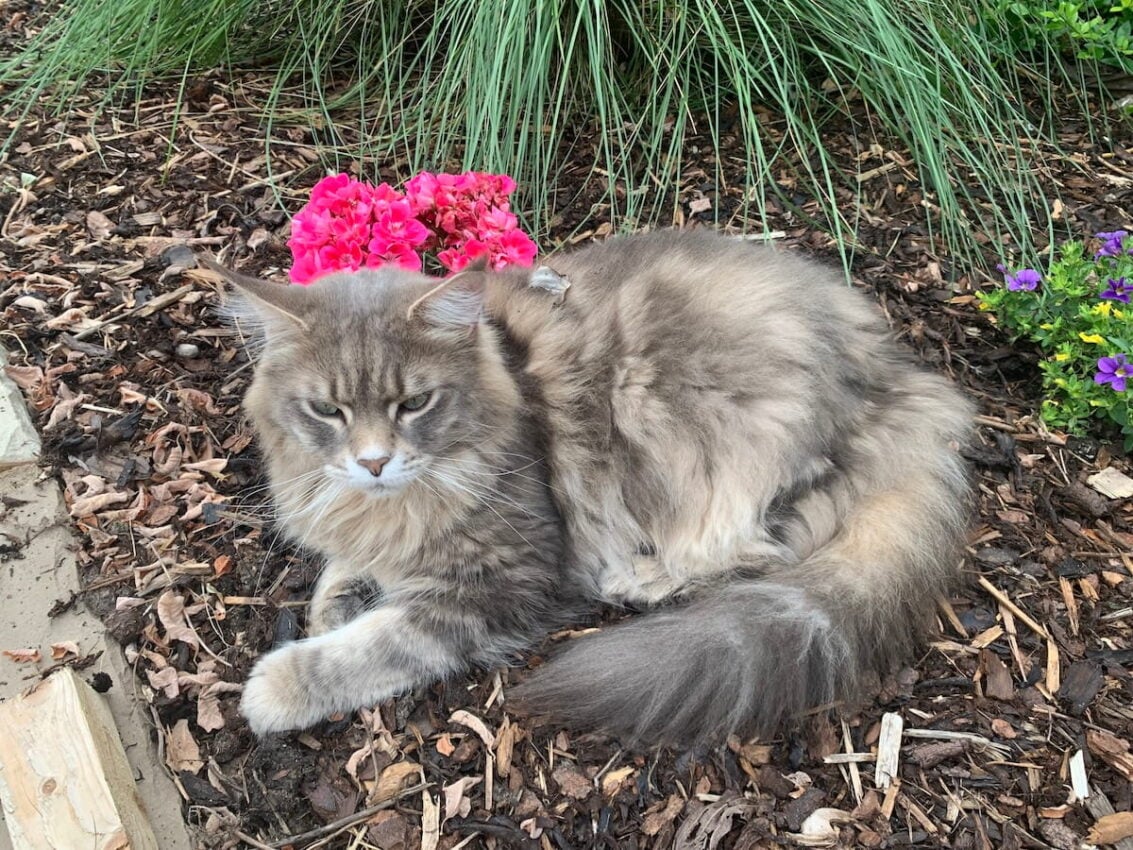
First, this is not a recognized pedigree breed. It simply describes a cat whose parents or ancestry genuinely include both a Russian Blue and Maine Coon. And that creates an important problem when people try to identify one online: A large fluffy gray cat is not automatically a Russian Blue Maine Coon mix.
What Does A Russian Blue Maine Coon Mix Look Like?
There is no breed standard, so there is no single correct appearance. A mixed kitten could inherit characteristics such as:
- A larger or more moderate body
- Large ears
- A long tail
- Green eyes
- A blue or other colored coat
- Short, medium, or potentially longer fur
- A mixture of the facial features of either parent
It won’t necessarily look like somebody has simply blended an exact Maine Coon and Russian Blue 50/50.
Will A Russian Blue Maine Coon Mix Be Blue?
Not necessarily. The blue-gray coloring seen in cats is produced by dilution of pigment. The UC Davis Veterinary Genetics Laboratory’s feline dilute guidance explains that dilute is an autosomal recessive trait, meaning a cat needs two copies of the dilute variant to display diluted coloring.
A genetically blue Russian Blue therefore passes a dilute copy to its kittens, but the Maine Coon parent would also need to contribute a compatible dilute copy for that kitten to display dilute coloring.
So even with a Russian Blue parent, a blue coat is not guaranteed.
Will A Russian Blue Maine Coon Mix Have Long Hair?
Again, not necessarily. UC Davis’s feline long-hair genetics guidance explains that long hair is recessive and identifies several FGF5 variants associated with long coats, including variants found in Maine Coons. A Maine Coon parent can therefore pass longhair genetics to its kittens without every kitten necessarily developing a long coat.
This means a genuine first-generation Russian Blue Maine Coon cross could actually be shorthaired. That is worth remembering when looking at photographs online.
How Big Will The Mix Get?
There is no reliable standard weight. The Maine Coon parent comes from a large breed, while the Russian Blue is medium-sized and more finely built. A kitten could eventually fall somewhere between those parental types, but you cannot simply average two breed weights and predict the adult result.
The size of the actual parents and their family lines would be much more informative.
What Is A Russian Blue Maine Coon Mix Personality Like?
Possible inherited tendencies include:
- Intelligence
- Playfulness
- Affection
- Curiosity
- Fetching behavior
- Strong attachment to family
- Some reserve around unfamiliar people
But nobody can promise a particular combination. Temperament also depends on socialization, environment, experiences, and the individual kitten.
How Can I Tell If My Cat Is A Russian Blue Maine Coon Mix?
You cannot reliably prove this from appearance. A domestic cat can naturally have the following without belonging to either pedigree breed:
- Blue-gray fur
- Green eyes
- A bushy tail
- Large ears
- A substantial body
Likewise, a genuine cross could inherit short fur and look far less Maine Coon-like than expected. Documented parentage is much stronger evidence than appearance.
If you’re trying to work out whether an unknown cat has Maine Coon characteristics, my How To Tell If Your Cat Is Part Maine Coon guide explains what physical traits can and cannot tell you.
Should You Buy A Deliberately Bred Russian Blue Maine Coon Mix?
I would be cautious about anybody selling these kittens at a premium simply because they are marketed as a special “designer” mix. Crossbreeding does not automatically create a healthier cat or guarantee the best characteristics of both breeds.
I would want to know:
- Who are the parents?
- Can their identity and pedigree be verified?
- What health screening has been carried out?
- Why was this particular cross produced?
- How have the kittens been raised and socialized?
- What support does the breeder provide after purchase?
My How To Find A Reputable Maine Coon Breeder guide covers the kinds of checks I would make before paying for any deliberately bred kitten.
Frequently Asked Questions
Are Maine Coons Bigger Than Russian Blues?
Yes. Maine Coons are a large, substantial breed, whereas Russian Blues are classed as medium-sized cats.
Is A Blue Maine Coon Part Russian Blue?
No. Blue is an established Maine Coon color, so a blue Maine Coon does not need any Russian Blue ancestry.
Are Russian Blues Friendlier Than Maine Coons?
Neither breed is universally friendlier. Maine Coons often have a more immediately sociable reputation, while Russian Blues can be reserved with unfamiliar people but very affectionate with their families.
Which Breed Needs More Grooming?
The Maine Coon. Its longer coat is much more prone to tangles and mats than the Russian Blue’s short coat.
Can Maine Coons And Russian Blues Live With Children?
Yes. Both breeds can live successfully with children when the individual cat has a suitable temperament and interactions are handled respectfully.
Can A Maine Coon And Russian Blue Breed?
Yes. Both are domestic cats. Their kittens would be mixed cats rather than a newly recognized pedigree breed.
Is A Russian Blue Maine Coon Mix Always Gray?
No. Coat color depends on the genes inherited from both parents, so Russian Blue ancestry alone does not guarantee blue-gray coloring.
Is A Russian Blue Maine Coon Mix Longhaired?
Not necessarily. Long hair is recessive, so a genuine cross may be shorthaired.
Conclusion
The Maine Coon and Russian Blue are both intelligent and affectionate breeds, but the similarities largely end there. Maine Coons are much larger, have long shaggy coats, and tend to throw themselves into family life. Russian Blues are medium-sized shorthairs with elegant proportions, silver-tipped blue coats, green eyes, and a personality that can be affectionate yet more measured around unfamiliar people.
My husband grew up with a Russian Blue, while my own direct ownership experience is with Maine Coons. That distinction matters to me: breed standards and reputable sources are far more useful than pretending one family’s cat can tell us how every Russian Blue will behave.
And if you are researching a Russian Blue Maine Coon mix, remember that there is no standard appearance, size, coat, or temperament for the cross. A fluffy gray cat is not automatically part Russian Blue and part Maine Coon.
When ancestry genuinely matters, known parentage tells you far more than appearance alone.