Best Maine Coon Cat Trees: 6 Large, Stable Trees For Big Cats

Choosing the best Maine Coon cat tree is very different from buying a standard cat tree.
Maine Coons are large, muscular cats with long bodies, big paws, and powerful jumping ability, so many ordinary cat trees are too small, too lightweight, or too unstable for long-term use. A cat tree that looks big online can still feel cramped once a fully grown Maine Coon tries to stretch, climb, turn around, or sleep on it.
The best cat trees for Maine Coons have a heavy base, wide platforms, thick scratching posts, strong materials, and enough height for a full-body stretch. A good tree should let your cat climb, scratch, perch, rest, and play safely without wobbling under their weight.
After living with three male Maine Coons, Pippin, Mika, and Bali, I would never buy a small, flimsy cat tree for this breed. When Pippin developed arthritis, hip dysplasia, and spinal/muscle wastage as he got older, I also learned that accessibility matters just as much as height. Large cats need sturdy climbing furniture, but senior or less agile Maine Coons also need lower platforms, wide steps, and comfortable resting spots they can reach safely.
In this guide, I’ll show you the best Maine Coon cat trees, what features actually matter, and how to choose a large, stable model that suits your cat’s size, age, mobility, and personality.
Quick Answer
The best Maine Coon cat trees are large, heavy-duty models with a stable base, wide platforms, thick scratching posts, strong materials, and enough height for a full-body stretch. Maine Coons need bigger, stronger cat trees than average cats because they are heavier, longer-bodied, and powerful jumpers.
My top choice for buyers is the RHR Quality Kilimandjaro de Luxe, because this type of tree has been ideal for my own large Maine Coons and has enough space for multiple big cats. You could also look for extra-large towers from large-cat-focused brands or heavy-duty models such as Cat Tree King, Globlazer, and Hey-brother trees.
A suitable Maine Coon cat tree should have:
* Enough space for your cat’s full adult body length
* A heavy, wide base
* Tall scratching posts
* Strong sisal
* Wide platforms
* Large resting areas
* Roomy condos
* Multiple levels
* Safe access routes
* Anti-tip support
* Durable fabric around landing points
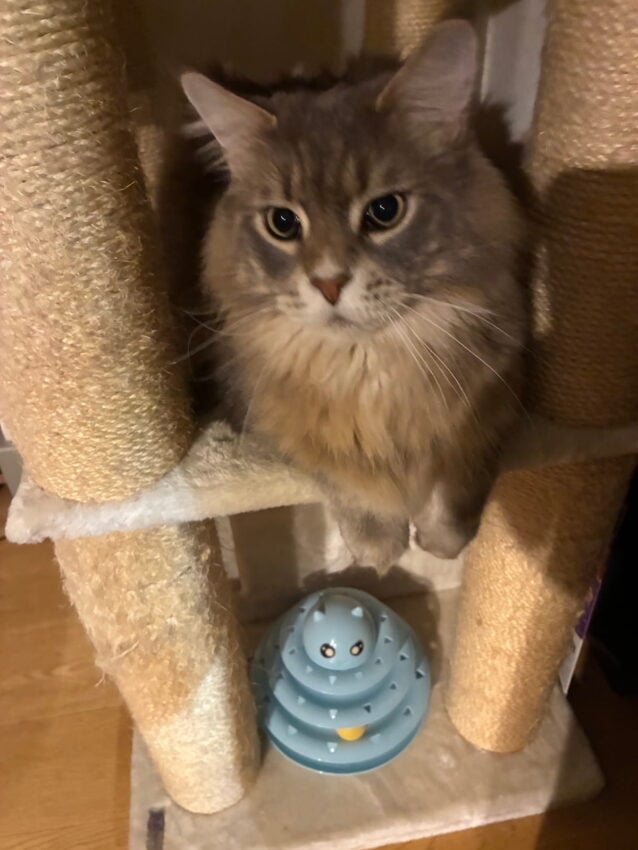
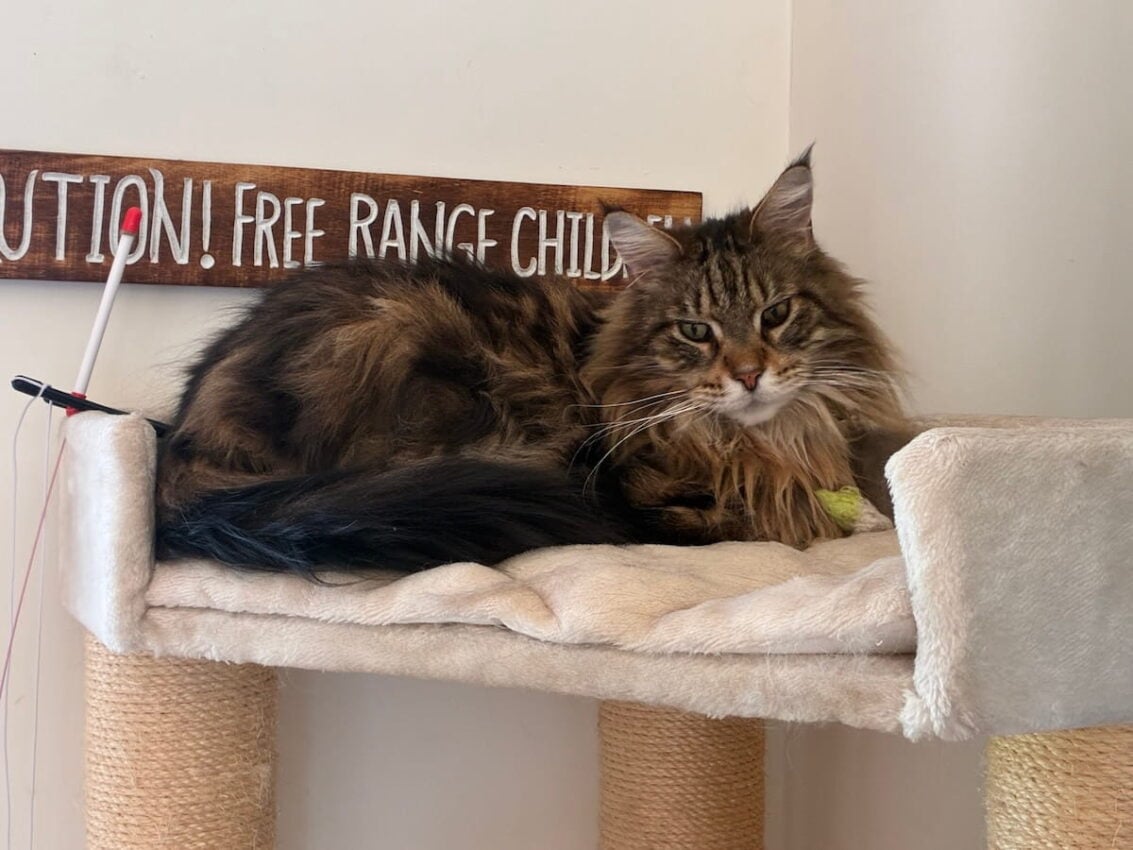
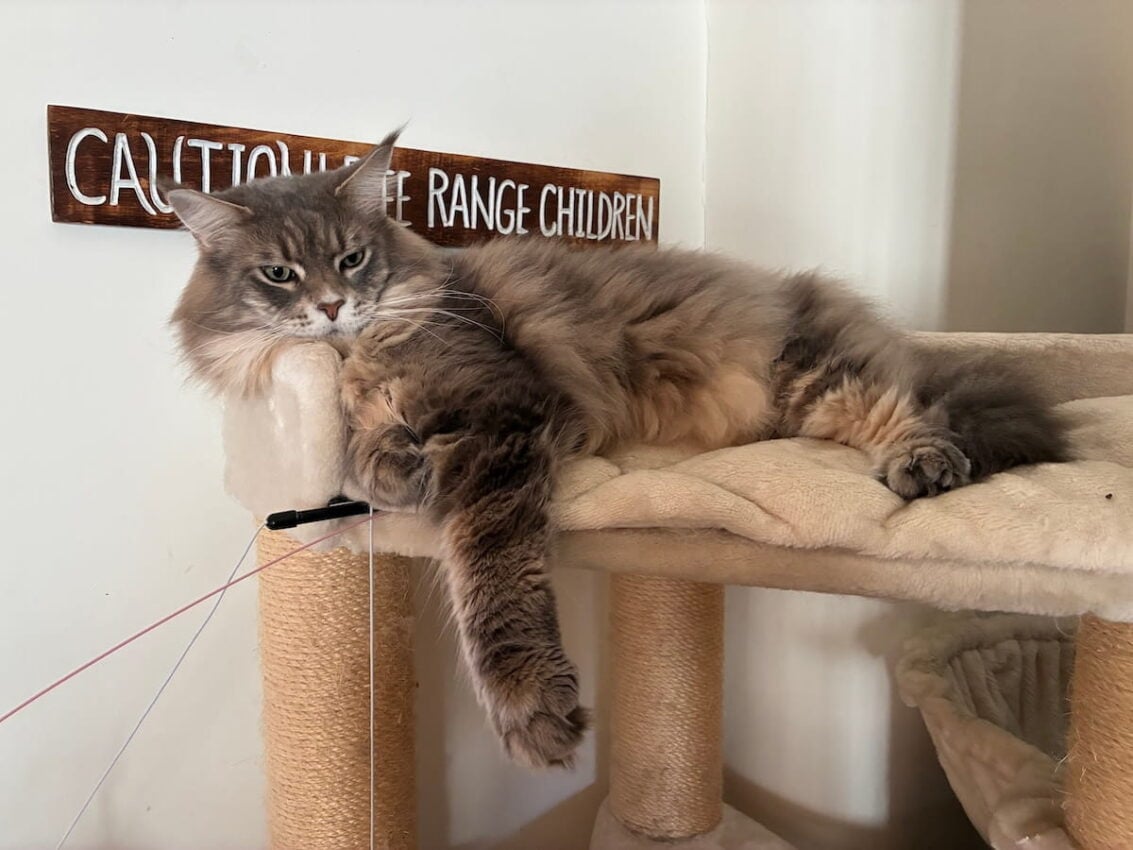
Here are some pictures of our three furry friends using our RHR Quality Extra-Large Maine Coon cat tree. We bought this tree from cattreeking.com:

JUMP TO THE BEST MAINE COON CAT TREES
Our Maine Coon Cat Tree Experience
Above are pictures of Bali, Mika, and Pippin using our extra-large Maine Coon cat tree. We bought this tree after searching for something strong enough for three large male Maine Coons, including Pippin, who needed easier access because of arthritis and hip dysplasia.
We bought our RHR Quality Extra Large cat tree from Cat Tree King, and it has been an excellent cat tree for big Maine Coons. It has given all three boys enough room, with wide platforms, tall scratching posts, and sturdy areas for climbing and lounging. However, long-term use has also taught me what owners need to check before buying.
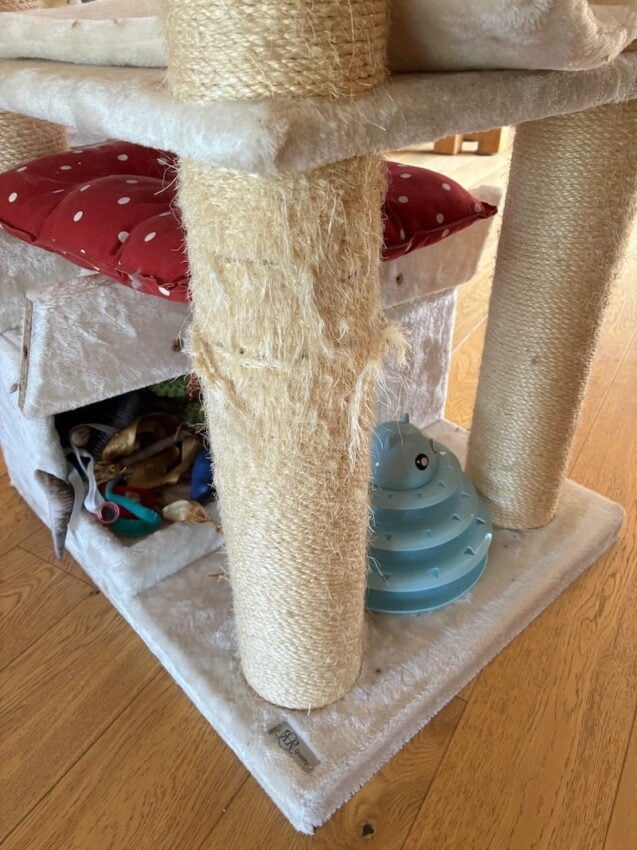
All three of my Maine Coons have loved scratching the tall posts. Over the years, they have worn down the sisal on the front posts, but this is not a major problem because sisal can usually be replaced. In fact, heavy scratching is a sign that the tree is being used properly!
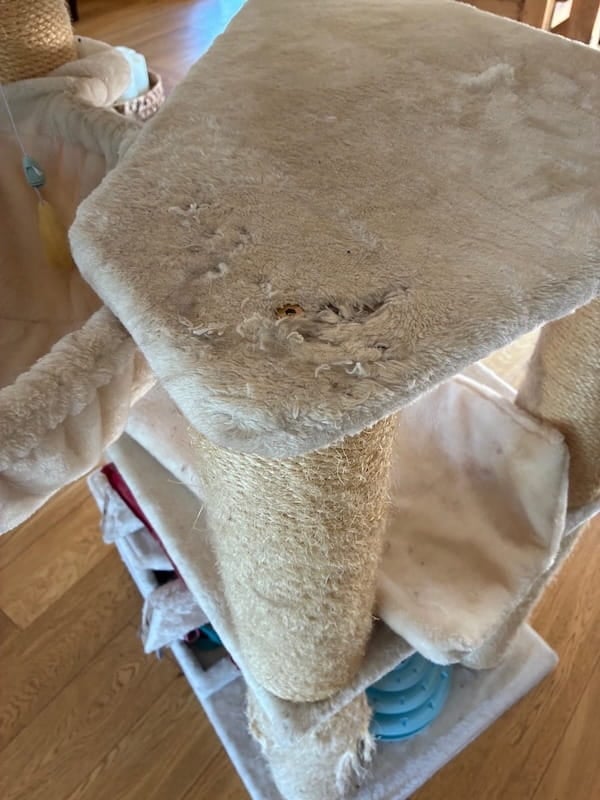
The bigger issue has been wear on the main landing areas. With our RHR Quality cat tree, the material on the main landing level has worn away over time, and there is now a tear in the fabric where the screw attaches to the vertical joints. This makes sense because large Maine Coons repeatedly jump onto the same points, so the highest-impact landing areas take the most strain.
This does not mean the tree was a bad buy. It has been ideal for our large Maine Coons and has had room for all of them. But it does mean buyers should look carefully at the surfaces where their cat will land, launch, scratch, and turn. The parts that take repeated weight and friction will wear first.
One surprising thing I have noticed is that since Bali and Mika reached around eight years old, they seem to choose benches, sofas, and beds more often than the cat tree. This may be partly age, comfort, or habit, but it may also be boredom. Something similar happened when they were younger, and simply moving the cat tree to a new location helped regain their interest.
That is an important lesson: if your Maine Coon stops using a cat tree, it does not always mean the tree is wrong. Sometimes the location has become stale.
Pippin was different. He tended not to venture onto the cat tree much around age nine to ten, which made sense because he had arthritis, hip dysplasia, and spinal/muscle wastage. For an older Maine Coon, reduced cat tree use can be a sign that the tree is too hard to access, too high, too slippery, or simply uncomfortable for painful joints.

Maine Coon Cat Tree Buying Checklist
| Feature | Why It Matters For Maine Coons |
|---|---|
| Heavy base | Helps prevent wobbling or tipping when a large cat jumps |
| Wide platforms | Gives long-bodied cats room to sit, turn, and stretch |
| Tall scratching posts | Allows a full-body stretch and protects furniture |
| Strong sisal | Withstands powerful scratching from large paws |
| Large condos | Prevents bigger cats from feeling cramped |
| Multiple levels | Encourages climbing, exercise, and vertical territory |
| Lower access points | Helps kittens, seniors, and cats with joint issues |
| Anti-tip strap | Adds security, especially with tall towers |
| Durable landing areas | Reduces wear where cats jump repeatedly |
| Replaceable posts or parts | Helps extend the lifespan of an expensive tree |
| Easy cleaning | Important for long-haired Maine Coons that shed heavily |
Mainecooncentral.com
Why Maine Coons Need Bigger Cat Trees
Maine Coons are one of the largest domestic cat breeds. Their size changes what a cat tree needs to do.
A standard cat tree may be fine for a smaller cat, but a Maine Coon needs more strength, width, and stability. If the platforms are too narrow, your cat may not be able to turn around comfortably. If the base is too light, the whole tree may wobble when they jump. If the scratching posts are too short, they cannot stretch properly.
A poor-quality tree may lead to:
- Wobbling
- Tipping
- Loose joints
- Torn fabric
- Broken platforms
- Cramped resting areas
- Unused condos
- Scratching posts that wear down quickly
- A cat who avoids the tree altogether
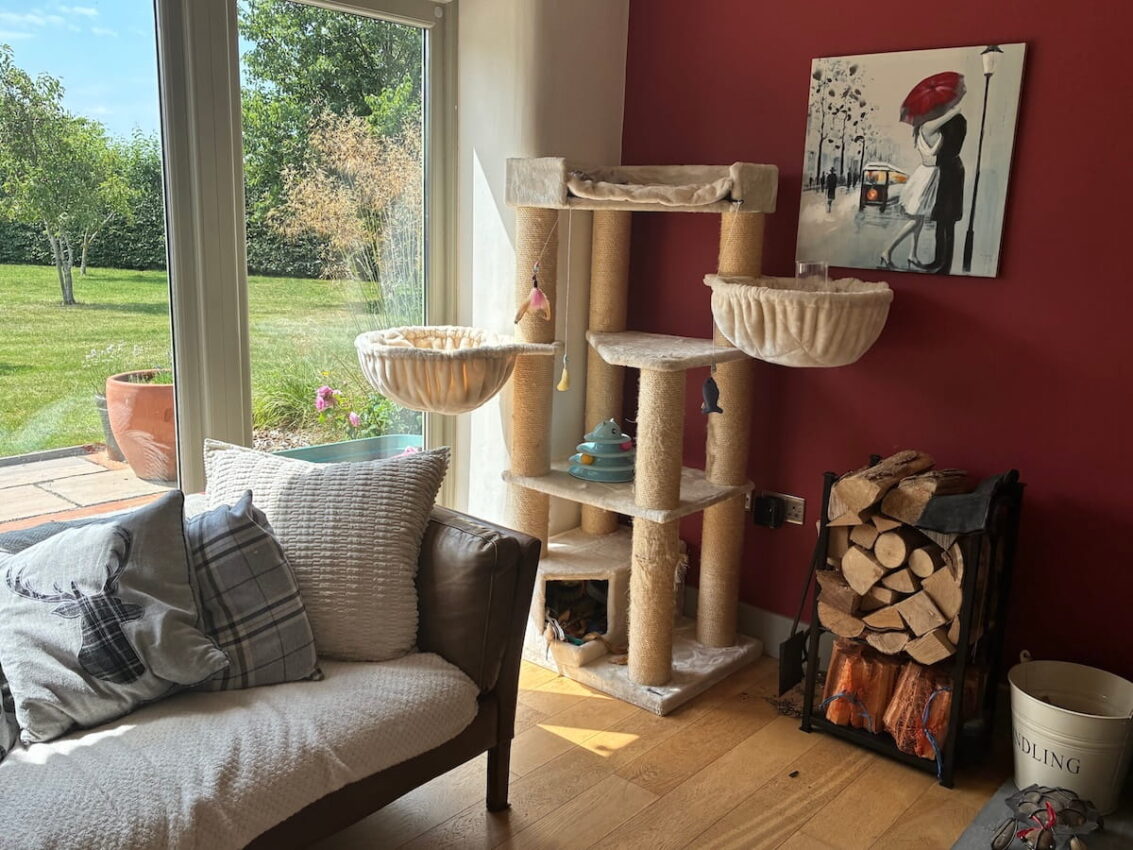
This is why I see a Maine Coon cat tree as an important piece of cat furniture, not just a decorative toy. And, since extra cat trees make quite a statement in your home, make sure you buy one that looks good! Like the tree we use, pictured below … (please note, I’ve detached the stylish steps that usually sit at the side, as when moving the tree to spark new interest in it, I realised the steps took up too much room).
The AAFP/ISFM Feline Environmental Needs Guidelines identify scratching, play, and resting areas as important feline environmental resources.
What To Look For In A Maine Coon Cat Tree
1. Stability
Stability is the most important feature. A Maine Coon cat tree should not wobble when your cat jumps, climbs, or scratches. If the tree feels unstable, your cat may avoid it or use your furniture instead.
Look for:
- A wide base
- Heavy total weight
- Strong joints
- Anti-tip wall straps
- Thick support posts
- Balanced platform layout
- Good owner reviews from large-cat households
A very tall tree with a narrow base is not ideal for a heavy cat unless it can be fixed securely to the wall.
2. Platform Size
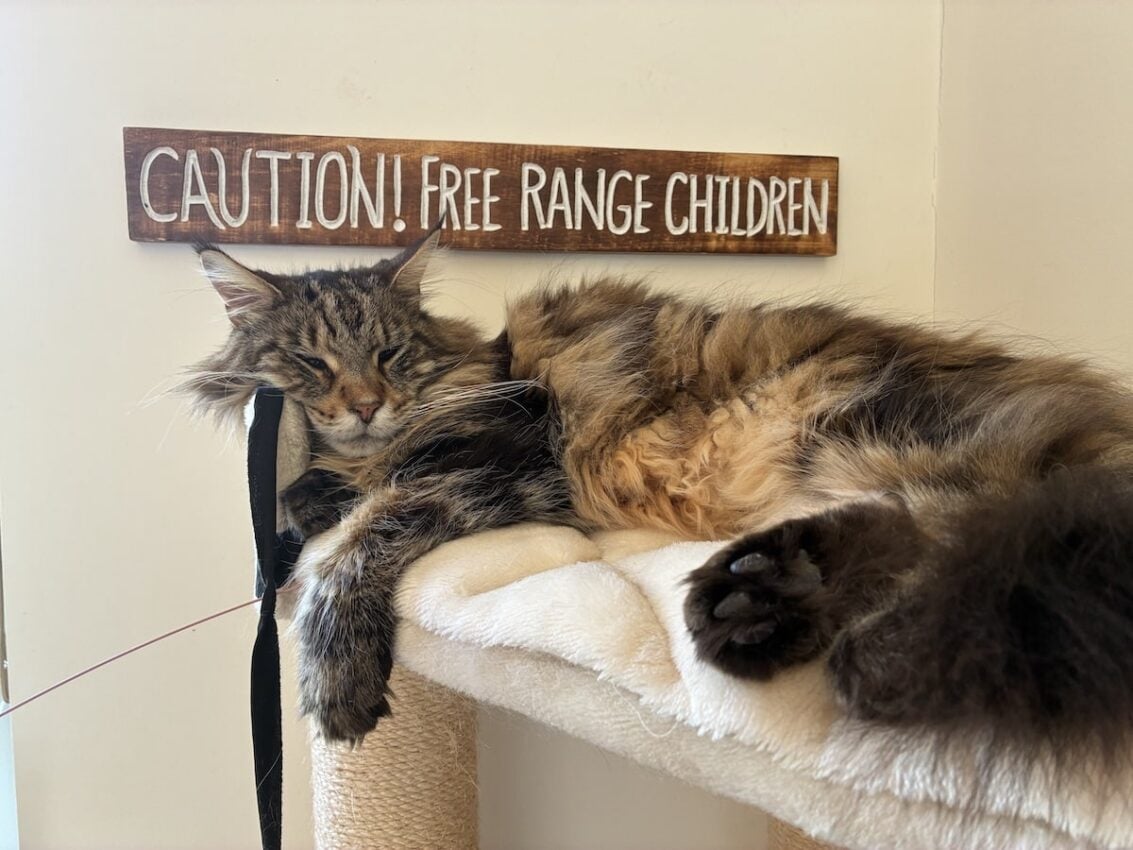
Large cats need large platforms. A platform that looks fine in a product photo may be too small for a Maine Coon to lie on comfortably. Measure your cat from chest to rump, and compare that with the platform measurements before buying.
Wide, flat platforms are usually better than tiny round perches.
A good Maine Coon platform should let your cat:
- Sit comfortably
- Turn around
- Stretch out
- Curl up without hanging off
- Land safely after a jump
3. Scratching Post Height
Cats scratch to stretch, condition their claws, and mark territory. A Maine Coon needs scratching posts tall enough for a proper full-body stretch.
International Cat Care recommends that scratching posts be tall enough for a cat to stretch fully while scratching. This matters because many posts are too short. A Maine Coon may ignore a small post because it does not allow the stretch they need.
For furniture damage, read how to stop a Maine Coon from scratching furniture.

4. Durable Landing Areas
Maine Coons put a lot of pressure on the same landing points. When they leap onto a platform, turn, dig their claws in, or launch onto the next level, the fabric and joints take repeated strain. Over time, these areas may wear faster than the rest of the tree.
Our own RHR Quality tree has remained useful for years, but the main landing area has worn where the joints and screws sit. This is exactly the kind of long-term wear owners should expect from multiple large cats.
Check customer reviews for comments about:
- Torn fabric
- Loose platforms
- Worn landing areas
- Weak screws
- Perches becoming unstable
- Posts loosening over time
5. Accessibility
Do not buy only the tallest tree. A tall tree is brilliant for young, agile cats, but Maine Coons age. Kittens, seniors, overweight cats, and cats with joint issues may struggle if platforms are too far apart.
Pippin’s arthritis, hip dysplasia, and spinal/muscle wastage made me much more aware of this. A good Maine Coon cat tree should have height, but also sensible access.
Look for:
- Low first platforms
- Wide steps
- Multiple routes up
- Large landing areas
- No impossible vertical gaps
- Stable lower resting spots
- Platforms suitable for older cats
A cat tree should not require your cat to make huge jumps every time they want to use it.

6. Room For Multiple Cats
If you have more than one Maine Coon, space matters even more.
A multi-cat tree should have:
- More than one resting spot
- Several scratching posts
- Multiple access points
- Different heights
- Wide platforms
- Strong stability
- Enough distance between resting areas
Our RHR/Cat Tree King tree has worked well because there has been room for all of the boys (60lbs worth of cat weight!). That matters in a multi-cat household because cats may not want to share one cramped platform.

Why Maine Coons Benefit From A Large Cat Tree
A cat tree is not just a luxury item. For a Maine Coon, it can support several important physical and behavioural needs.
Protects Furniture
Cats need to scratch to maintain their claws, stretch their bodies, and mark territory. A large cat tree with sturdy sisal posts gives your Maine Coon a better place to scratch than your sofa or carpet.
All three of my Maine Coons have used our tall scratching posts heavily. The front sisal posts have worn down over time, but that is exactly what I want them to scratch instead of our furniture!
Encourages Exercise
A multi-level cat tree encourages climbing, jumping, stretching, and daily movement. This is especially useful for indoor cats, apartment cats, and cats who do not have safe outdoor access.
Cornell Feline Health Center explains that toys and play encourage exercise and cognitive enrichment, while a lack of stimulation can contribute to obesity and behaviour problems such as destructive scratching.
For more details, read “How much exercise does a Maine Coon need?”
Provides Vertical Territory
Many cats feel safer when they can observe the room from above. A tall, stable cat tree gives a Maine Coon height, control, and a resting place away from busy household traffic. This is especially useful in multi-cat homes, indoor homes, and apartments.
Reduces Boredom
A good cat tree gives your Maine Coon somewhere to climb, scratch, perch, nap, and watch the world.
However, even a good cat tree can become boring if it stays in the same place for years. When Bali and Mika lost interest in our tree as youngsters, moving it to a different location helped them use it again. Now that they are around eight years old, they have started choosing benches, sofas, and beds more often, so I may need to refresh the setup again.
For broader enrichment ideas, read how to keep a Maine Coon entertained.
Supports Indoor And Apartment Cats
Indoor Maine Coons and apartment cats need vertical space because they have fewer natural opportunities to climb and explore. A large cat tree can make a smaller home feel more interesting and give your cat a dedicated territory of their own.
Read are Maine Coons good indoor cats? And can Maine Coons live in apartments?.
Best Maine Coon Cat Trees
Below are six strong large-cat tree options to consider. Availability, prices, and exact measurements can change, so check the latest product listing carefully before buying.
When comparing products, pay close attention to height, base width, total weight, platform size, scratching post strength, and whether the tree is genuinely suitable for large cats.
1. Best Overall Option: RHR Quality Kilimandjaro de Luxe XXL
The RHR Quality Kilimandjaro de Luxe XXL is my top choice because this is the style of tree that has worked best for my own Maine Coons.
It is large, sturdy, spacious, and suitable for multiple big cats. Our tree has had room for Pippin, Mika, and Bali, and the tall scratching posts have been used heavily for years.
Please note that this item cannot be purchased from Amazon. For more information, view the item directly on the RHR company website.
Why I Like It
The biggest benefit is space. Large Maine Coons need wide platforms and strong posts, and this type of tree feels much more suitable than standard pet-shop towers.
It has also been excellent for scratching. My boys have worn the sisal down on the front posts, but that is easy enough to replace and far better than them wearing down my furniture!
The tree has given them height, lounging space, and a dedicated place to climb and observe the room. It has been one of the most useful pieces of Maine Coon furniture we have bought.
What To Watch
Over time, the material on the main landing area has worn where the cats repeatedly jump on and off. There is now a tear in the fabric where the screw/joint section is located. This is to be expected …
This wear and tear is not enough to make me regret buying the tree, because it has been ideal for my large Maine Coons. But it is a useful warning: check the durability of the areas where a heavy cat will repeatedly land.
Also consider age and mobility. Pippin stopped using the higher levels as much when he became older and developed arthritis, hip dysplasia, and spinal/muscle wastage. For senior Maine Coons, you may need ramps, lower platforms, or an easier climbing route.
2. Best Large-Cat Specialist Brand: Cat Tree King
Cat Tree King is a strong option for Maine Coon owners because the brand focuses on large, heavy-duty cat trees. These trees are usually more suitable than standard cat trees because they tend to have larger platforms, thicker posts, and stronger construction.
Why It Suits Maine Coons
Cat Tree King-style towers are a good fit for:
- Large male Maine Coons
- Multi-cat households
- Cats who like to climb high
- Cats who scratch heavily
- Owners who want a long-term investment
- Indoor cats who need vertical territory
The main thing to check is the exact model. Some will be better for young, athletic cats, while others will be better for cats that need lower access points.
What To Watch
Large specialist cat trees can be expensive and may take up a lot of floor space. Measure the room carefully, including the ceiling height and the space your cat needs to jump on and off safely.
3. Best Wide-Platform Option: Globlazer Cat Tree (VIEW On Amazon)
The Globlazer S65 Cat Tree (as seen on Amazon) is a good option for Maine Coon owners who want a medium-tall tree with extra-wide platforms rather than an extremely tall tower.
The listed product dimensions are 36 x 17 x 65 inches, and the tree weighs 34.17 pounds.
Why It Suits Maine Coons
The biggest advantage of this Globlazer model is the platform width. Maine Coons need more room than average cats to sit, turn, stretch and land safely, and the wider platforms make this design more suitable for their long bodies and large frames.
It may suit:
- Maine Coon kittens
- Young Maine Coons
- Smaller adult Maine Coons
- Cats who like wide platforms
- Owners who want a 65-inch tree rather than a giant tower
- Cats who enjoy climbing, scratching, and lounging
The height gives cats vertical space without being as extreme as some very tall towers, which may make it easier to place in normal rooms.
What To Watch
The box hidey-hole near the middle is useful while your Maine Coon is young, and many kittens or growing cats will have great fun climbing into it, hiding, playing, and using it as part of the tree.
However, a full-grown Maine Coon may eventually outgrow that enclosed box. This is common with cat trees because many condos and hidey-holes are designed with average-sized cats in mind. I would treat the hidey-hole as a fun kitten/young-cat feature rather than the main reason to buy the tree.
For an adult Maine Coon, the extra-wide platforms are more important than the box. The platforms are the feature most likely to stay useful as your cat grows.
CLICK HERE TO VIEW ON AMAZON
4. Best Tall Narrow Option: Heybly Cat Tree
The Heybly Cat Tree (as seen on Amazon) is a tall, narrower cat tree that may suit owners who want vertical height without an especially wide footprint.
The listed product dimensions are 39.4 x 15.8 x 72.4 inches, and the tree weighs 41.8 pounds.
Why It Suits Maine Coons
At 72.4 inches tall, this cat tree gives Maine Coons good vertical space for climbing, perching, and observing the room. The overall length is generous at 39.4 inches, which may help provide more usable platform space than many standard cat trees.
It may suit:
- Young adult Maine Coons
- Active Maine Coons that enjoy climbing
- Indoor cats need vertical territory
- Homes where floor space is limited
- Owners wanting a tall tree without a huge footprint
The weight of 41.8 pounds gives it more substance than many lightweight cat trees, but owners should still check stability carefully because Maine Coons are powerful jumpers.
CLICK HERE TO VIEW ON AMAZON
What To Watch
The narrower 15.8-inch depth means this tree may not feel as solid as wider, heavier large-cat models when used by a very large male Maine Coon. For big cats, platform size, base width, and wobble matter just as much as height.
If your Maine Coon is especially large, energetic, or heavy, consider using any supplied anti-tip strap and placing the tree against a wall for extra security.
This may be a good option for a younger or moderately sized Maine Coon, but for very large adult males or multi-Maine Coon homes, I would still prioritise the widest, heaviest and most stable tree you can fit.
5. Best Tall Compact Option: Hey-brother Cat Tree
The Hey-brother Cat Tree is available on Amazon and is a tall, compact cat tree that may suit Maine Coon owners who want height but do not have space for a very wide tower.
The listed product dimensions are 19.7 x 15.7 x 71.7 inches, and the tree weighs 40.87 pounds.
Why It Suits Maine Coons
At 71.7 inches tall, this Hey-brother model gives Maine Coons useful vertical space for climbing, perching, and watching the room. Its height may appeal to active Maine Coons that enjoy being above household activity.
It may suit:
- Maine Coon kittens
- Young adult Maine Coons
- Smaller or moderately sized Maine Coons
- Indoor cats needing more vertical territory
- Homes with limited floor space
- Owners who want a tall tree without a huge footprint
The weight of 40.87 pounds gives it more substance than many lightweight cat trees, which is important for a large breed.
What To Watch
The main concern is the compact footprint. At only 19.7 x 15.7 inches, this tree may be too narrow for very large adult male Maine Coons, especially if they jump onto it with force or like to sprawl across wide platforms.
For a big Maine Coon, height alone is not enough. Check the platform sizes carefully, use any supplied anti-tip strap, and place the tree against a wall if possible.
This may be a good option for younger Maine Coons, smaller adults, or homes where space is limited, but for very large males or multi-Maine Coon households, I would still choose a wider, heavier, more stable tree if you have the room.
CLICK HERE: VIEW ON AMAZON
How To Choose The Right Cat Tree For Your Maine Coon
For A Very Large Male Maine Coon
Choose the heaviest, widest, and most stable tree you can afford.
Prioritise:
- Wide platforms
- Thick posts
- Heavy base
- Large resting areas
- Anti-tip strap
- Strong scratching posts
- Room to turn around
- No tiny hammocks or narrow perches
For A Maine Coon Kitten
A smaller tree can work temporarily, but remember that your kitten will grow quickly.
Look for:
- Safe lower platforms
- Good scratching surfaces
- Stable construction
- Easy climbing routes
- No huge falls
- Room to upgrade later
A kitten tree should not be so high that falls become dangerous.
For A Senior Maine Coon
Senior cats need comfort and access.
Choose:
- Lower platforms
- Wide steps
- Soft resting areas
- Minimal huge jumps
- Stable landing points
- Good grip
- Optional ramps
- Easy access to favourite levels
Pippin’s later years taught me not to judge a tree only by height. A senior Maine Coon may need safe, reachable resting spaces more than a dramatic tower.
For An Apartment Maine Coon
A cat tree is one of the best ways to add territory to a small home.
Choose:
- Tall vertical design
- Good stability
- Compact but heavy base
- Window placement
- Multiple uses: scratching, sleeping, climbing
- Strong posts
- Platforms big enough for full lounging
Read can Maine Coons live in apartments? for more small-space setup ideas.
For Multiple Maine Coons
Do not buy a one-cat tree and expect several large cats to share it easily.
Look for:
- Several platforms
- Multiple sleeping areas
- More than one scratching post
- Enough room between levels
- Heavy-duty structure
- Multiple access routes
- Wide base
- Large-cat reviews
A good multi-cat tree reduces competition by giving each cat their own space.
Where To Put A Maine Coon Cat Tree
Location can decide whether your cat uses the tree or ignores it.
Good places include:
- Near a window
- In a family room
- Beside a sofa
- Near a favourite resting spot
- In a warm, social area
- Near where your cat already scratches
- Somewhere with a good view
Poor places include:
- Hidden spare rooms
- Dark corners
- Noisy utility rooms
- Behind doors
- Places your cat never chooses to rest
- Areas blocked by dogs or other cats
From experience, moving the cat tree can make a big difference. When Bali and Mika lost interest in the tree when they were younger, changing its location encouraged them to use it again. Now that they are older and choosing benches, sofas, and beds more often, location and novelty may again be part of the issue.
Why Your Maine Coon May Stop Using A Cat Tree
A Maine Coon may stop using a cat tree because:
- The location is boring
- The platforms are too small
- The fabric feels worn
- The tree wobbles
- Another pet blocks access
- Your cat prefers a warmer spot
- The tree is too hard to climb
- Your cat is older
- Pain or arthritis makes jumping difficult
- The landing areas are uncomfortable
- The tree no longer offers novelty
If a young or healthy cat stops using the tree, try moving it to a better location before replacing it.
If an older cat stops using it, consider pain, stiffness, or mobility issues. Pippin’s reduced cat tree use around age nine to ten made sense because of his arthritis, hip dysplasia, and spinal/muscle issues.
A sudden change in jumping, climbing, or confidence should be discussed with a vet, especially in senior Maine Coons.
How To Make An Old Cat Tree Interesting Again
Try:
- Moving it near a window
- Rotating its position
- Adding a washable blanket
- Replacing worn sisal
- Adding catnip or silvervine
- Playing with a wand toy around it
- Hiding treats on platforms
- Tightening loose screws
- Cleaning fur and scent build-up
- Adding a nearby tunnel or cardboard box
- Making the access route easier
Do not assume disinterest means failure. Sometimes a cat tree just needs to feel new again.
For broader enrichment ideas, read how to keep a Maine Coon entertained.
How Long Should A Maine Coon Cat Tree Last?
A high-quality Maine Coon cat tree should last years, but heavy use will show.
Expect wear on:
- Front scratching posts
- Landing platforms
- Fabric around screw/joint areas
- Top perches
- Hammocks
- Edges where claws catch
- Favourite sleeping spots
My RHR Quality Extra Large tree has lasted well, but the sisal has worn on the front posts, and one main landing area has developed fabric damage around the screws. This is after years of use by large Maine Coons, so I still consider it a successful purchase.
The best cat tree is not one that looks perfect forever. It is one your cats actually use.
Can You Replace Cat Tree Sisal?
Yes, in many cases, worn sisal can be replaced. This is useful because Maine Coons can wear through scratching posts faster than smaller cats. Replacing sisal is often cheaper than buying a whole new tree.
You may need:
- Natural sisal rope
- Scissors
- Staple gun or strong adhesive
- Gloves
- Patience
- Replacement posts if the brand sells parts
Always check that the tree is structurally sound first. If the post itself is loose, cracked, or unstable, sisal replacement alone may not be enough.
Cat Tree Safety Tips For Maine Coons
Before letting your Maine Coon use a new tree, check:
- All screws are tight
- Platforms do not wobble
- The base sits flat
- The tree does not rock when pushed
- Anti-tip strap is fitted if supplied
- No staples, nails, or sharp edges are exposed
- Hanging toys cannot be swallowed
- Fabric is secure
- Perches can support your cat’s weight
- Access routes are safe
Recheck the tree regularly because large cats put more strain on joints and posts.
FAQs About Maine Coon Cat Trees
What Is The Best Cat Tree For A Maine Coon?
The best cat tree for a Maine Coon is large, heavy, stable, and spacious, with wide platforms, strong scratching posts, a heavy base, and enough height for a full-body stretch. For UK buyers, the RHR Quality Kilimandjaro de Luxe XXL is a strong option based on my own experience.
Do Maine Coons Need A Cat Tree?
Yes, most Maine Coons benefit from a cat tree because it gives them a place to climb, scratch, rest, observe, and exercise. It is especially useful for indoor cats, apartment cats, and multi-cat homes.
How Tall Should A Maine Coon Cat Tree Be?
A Maine Coon cat tree should be tall enough to allow climbing and full-body scratching, but stability matters more than height alone. A tall, wobbly tree is not safe.
What Size Cat Tree Does A Maine Coon Need?
A Maine Coon needs a cat tree with wide platforms, large resting areas, and strong posts. Check product measurements carefully rather than relying on photos.
Are Normal Cat Trees Too Small For Maine Coons?
Many standard cat trees are too small for adult Maine Coons. Platforms, hammocks, and condos are often designed for average-sized cats and may feel cramped or unstable.
Are Cat Trees Good For Indoor Maine Coons?
Yes, cat trees are excellent for indoor Maine Coons because they add climbing, scratching, vertical territory, and environmental enrichment.
Why Has My Maine Coon Stopped Using The Cat Tree?
Your Maine Coon may have stopped using the cat tree because the location is boring, the tree is worn, another resting place is more comfortable, or your cat is older and less willing to jump. Moving the tree helped regain interest with Bali and Mika when they were younger.
Do Senior Maine Coons Need A Different Cat Tree?
Often, yes. Senior Maine Coons may need lower platforms, easier access, softer resting areas, and fewer large jumps. Reduced climbing can also indicate pain or arthritis.
Can A Maine Coon Cat Tree Protect Furniture?
Yes, if it has tall, sturdy scratching posts and is placed where your cat wants to scratch. All three of my Maine Coons have used the tall posts heavily, which has helped direct scratching away from furniture.
How Many Cat Trees Do Multiple Maine Coons Need?
Multiple Maine Coons may need one very large tree or more than one climbing/scratching area. Each cat should have enough room to rest, scratch, and move without competing for the same small platform.
Related Maine Coon Central Guides
How To Stop A Maine Coon Scratching Furniture
Useful if your cat is choosing the sofa instead of the cat tree.
How To Keep A Maine Coon Entertained
Gives boredom-busting ideas for intelligent, playful Maine Coons.
How Much Exercise Does A Maine Coon Need?
Explains daily activity needs for kittens, adults, and senior Maine Coons.
Are Maine Coons Good Indoor Cats?
Helpful for owners building an indoor enrichment setup.
Can Maine Coons Live In Apartments?
Explains how vertical space helps Maine Coons in smaller homes.
Maine Coon Arthritis
Important for older cats who avoid jumping, climbing, or using high platforms.
Maine Coon Hip Dysplasia Facts
Useful if your Maine Coon struggles with mobility or rear-end discomfort.
Final Verdict
The best Maine Coon cat tree is not simply the tallest or most expensive one. It is the tree your cat can use safely, comfortably, and repeatedly.
For young, active Maine Coons, height, scratching posts, and climbing routes matter. For large adult males, platform size and stability are essential. For senior cats like Pippin, access and comfort become just as important as height. For cats like Bali and Mika, location and novelty can affect whether the tree stays interesting over time.
Our own large RHR/Cat Tree King-style cat tree has been ideal for big Maine Coons. It has had room for all three cats, provided tall scratching posts they genuinely use, and given them a sturdy place to climb and rest. It has worn over the years, especially on the front sisal posts and main landing area, but that is exactly what I would expect from a well-used tree in a multi-Maine Coon home.
My advice is simple: buy bigger, stronger, and sturdier than you think you need. Then place the cat tree somewhere your Maine Coon actually wants to be.
A great Maine Coon cat tree should protect your furniture, support exercise, offer vertical territory, provide safe resting spots, and make your cat’s home more interesting. When it does all of that, it is worth the investment.