How To Tell A Maine Coon From A Tabby (Key Differences Explained)
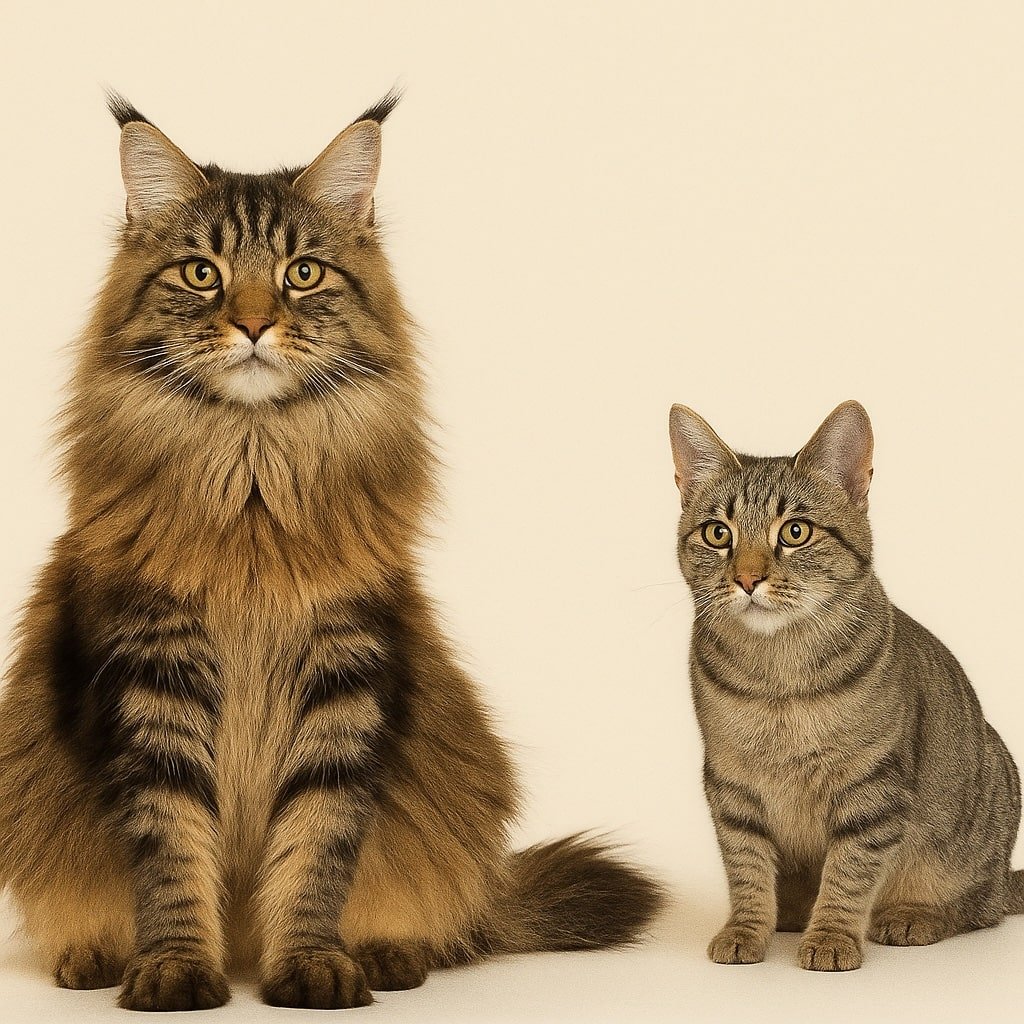
Many people confuse Maine Coons with tabby cats – especially when they see a large, fluffy cat with striped markings. The confusion happens because tabby is not a breed at all, but a coat pattern that can appear in many different types of cats, including Maine Coons.
Maine Coons, on the other hand, are a specific pedigree breed with distinct physical features, size, and structure. This means a cat can actually be both a Maine Coon and a tabby at the same time, depending on its coat pattern.
Understanding the difference comes down to recognising breed traits vs coat patterns, rather than relying on colour or markings alone.
Quick Answer
You can tell a Maine Coon from a tabby by understanding that a Maine Coon is a breed, while tabby is just a coat pattern. Maine Coons are typically much larger with tufted ears, long bodies, and thick fur, while tabby cats can be any size or breed and are identified by their striped or patterned coat.
How To Tell A Maine Coon From A Tabby
1. Breed vs. Pattern: A Fundamental Distinction
A Maine Coon is a unique breed characterized by specific genetic traits, known for its:
- Large size
- Tufted ears
- Silky double coat
In contrast, a tabby refers to a coat pattern (striped, swirled, spotted), not a breed.
Thus, tabby-patterned cats can belong to any breed or mix, including, yes, Maine Coons.
Important: Because tabby describes a coat pattern rather than a breed, there is no standard “tabby” size, body shape, tail, coat length, ear shape, paw structure, or personality. In the comparisons below, I use a typical non-pedigree domestic tabby as a practical reference point, but tabby markings alone cannot tell you a cat’s breed.
2. Size And Body Proportions
Purebred Maine Coon males typically weigh 18-22 pounds, while females weigh 12-15 pounds.
They possess a long, rectangular body shape and grow slowly, reaching full size between 3 and 5 years old.
A typical non-pedigree domestic tabby is often smaller than a Maine Coon, but tabby markings themselves tell you nothing about adult size. A tabby-patterned cat can be small, medium, or large depending on its genetics and breed, and a purebred Maine Coon can also have a tabby coat.
3. Tail Size And Fur
A hallmark of the Maine Coon is its plush, raccoon-like tail that can be as long as its body and is densely furred. This tail helps in maintaining balance and keeping off the snow.
Tabby markings do not determine tail length, shape, or fur density. However, a very long, full, bushy tail can be one useful Maine Coon clue when it appears alongside other breed characteristics such as a rectangular body, large paws, substantial bone structure, and a shaggy coat.
4. Coat Architecture
Maine Coons wear a weatherproof double coat: a dense undercoat for insulation and long, silkier guard hairs on top, along with a pronounced ruff around the neck and tufted lower legs.
Maine Coons can have several tabby patterns, including classic, mackerel, spotted, and ticked. They can also have many non-tabby coat colors and patterns, including solid, smoke, and shaded coats.
Tabby describes the pattern of the coat, not its length or texture. A tabby-patterned cat may be shorthaired or longhaired. Maine Coons, including tabby Maine Coons, have the breed’s characteristic shaggy coat, typically with longer fur around the neck, belly, and hind legs.
For a closer look at Maine Coon tabby colors and markings, see my guide to Tabby Maine Coon Cats.
5. Facial Structure And Ear Features
A Maine Coon’s head is slightly wedge-shaped, with high cheekbones and a square muzzle. Its ears are typically large and well-furnished, and some Maine Coons also have prominent lynx-tip ear tufts.
A tabby pattern does not determine head shape or ear structure. Tabby-patterned cats can have many different facial features depending on their breed and genetics. Therefore, features such as a square muzzle, high cheekbones, large ears, and prominent ear furnishings are more useful when assessing Maine Coon characteristics than the tabby markings themselves.
6. Paw Structure And Polydactyly
Maine Coons have large, tufted paws, often with extra toe fur to protect against snow. These paws act as built-in snowshoes.
Some Maine Coons are also polydactyl, meaning they have extra toes. However, polydactyly is not exclusive to Maine Coons and should not be used on its own to identify the breed.
Tabby markings do not determine paw size, toe number, or the amount of fur between the toes. Large, well-tufted paws can support Maine Coon identification when seen alongside several other breed traits, but paw size or extra toes alone cannot prove that a cat is a Maine Coon.
7. Temperament And Communication
Maine Coons are often described as “gentle giants” – laid-back, intelligent, affectionate, and known for vocalizations like:
- Chirps
- Trills
- Soft meows
They may follow you around like a canine companion.
Tabby behavior varies wildly, as it depends on individual breed and upbringing rather than pattern.
Maine Coon Vs Tabby: Side-By-Side Comparison
| Feature | Maine Coon | What “Tabby” Tells You |
|---|---|---|
| Category | A recognized cat breed | A coat pattern, not a breed |
| Adult Size | A large, substantial breed | Nothing about size; this depends on breed and genetics |
| Body Shape | Long, rectangular, and muscular | Nothing about body shape |
| Tail | Typically long, broad, and heavily furred | Nothing about tail length or thickness |
| Coat | Shaggy, uneven-length coat with longer fur around the neck, belly, and hindquarters | Describes markings, not coat length or texture |
| Head And Muzzle | Broad head with prominent cheekbones and a square muzzle | No standard head or muzzle shape |
| Ears | Large ears with substantial inner furnishings; ear-tip tufts may be present | No standard ear size or shape |
| Paws | Large paws that may have prominent toe tufts | No standard paw size or structure |
| Temperament | Often social, intelligent, playful, and people-oriented | Tabby pattern does not determine personality |
| Growth | Slow-maturing breed that may continue developing for several years | Tabby pattern does not determine growth rate |
| Markings | A Maine Coon may have a tabby pattern or another accepted coat color/pattern | Tabby describes patterns such as stripes, swirls, spots, and distinctive facial markings |
The most important difference is therefore not “Maine Coon features versus tabby features”. Tabby cats do not have a single set of physical features. Instead, you are comparing the established characteristics of the Maine Coon breed with a coat pattern that can occur in many different cats.
How To Know If A Tabby Cat Is A Maine Coon
If your cat has tabby markings and you are trying to determine whether it is a Maine Coon, do not use the coat pattern as evidence of breed ancestry.
For a purebred Maine Coon purchased from a breeder, pedigree and registration records provide much stronger evidence than appearance alone. A reputable breeder should be able to provide information about the kitten’s parents, pedigree, and relevant health testing.
For rescue cats and cats with unknown ancestry, physical characteristics can provide clues, but they cannot definitively prove that a cat is part Maine Coon.
Look at the combination of traits, including:
- Large, rectangular body
- Substantial bone structure
- Square muzzle
- Large, well-furnished ears
- Long, bushy tail
- Large, tufted paws
- Shaggy coat with longer fur around the neck and hindquarters
- Slow physical maturation
Also remember that the familiar “M” marking on the forehead is a tabby marking, not a Maine Coon identifier.
If you are specifically trying to determine whether a cat of unknown ancestry could be a Maine Coon mix, read my dedicated guide: How To Tell If Your Cat Is Part Maine Coon.
Conclusion
The difference between a Maine Coon and a tabby is simple once you understand the terminology.
A Maine Coon is a specific breed with recognizable physical traits, while tabby refers only to a coat pattern that appears across many cats. This is why so many cats are mistakenly labeled as Maine Coons – their markings may look similar, but their structure, size, and overall build tell a very different story.
The key takeaway is simple:
- Maine Coon = breed ✔️
- Tabby = pattern ✔️
- A cat can be both ✔️
Once you focus on body shape and features rather than coat markings, it becomes much easier to tell the difference.
Maine Coon vs Tabby FAQ
Is a tabby cat a Maine Coon?
No, a tabby is not a breed. It is a coat pattern that can appear in many cats, including Maine Coons and mixed-breed cats.
Can a Maine Coon be a tabby?
Yes, many Maine Coons have tabby patterns. This is one of the most common coat types in the breed.
What is the main difference between a Maine Coon and a tabby?
A Maine Coon is a specific breed with consistent traits, while a tabby describes a coat pattern that can occur in any cat.
How can I tell if my cat is a Maine Coon?
Look at the cat’s overall structure rather than its coat markings. Maine Coon characteristics can include a long rectangular body, square muzzle, large well-furnished ears, substantial paws, a long bushy tail, and a shaggy coat. However, appearance alone cannot confirm Maine Coon ancestry, particularly in a rescue or mixed-breed cat.
If that is what you are trying to establish, see How To Tell If Your Cat Is Part Maine Coon.
Do tabby cats have the “M” on their forehead?
Yes, most tabby cats have a distinctive “M” marking on their forehead, regardless of breed.
Are Maine Coons bigger than tabby cats?
Maine Coons are typically larger than the average domestic cat, but tabby markings do not determine a cat’s size. A tabby-patterned cat can be small or large depending on its breed and genetics, and Maine Coons themselves commonly have tabby coats.
Can you confirm a Maine Coon by appearance alone?
No. Physical characteristics can strongly resemble a Maine Coon, but appearance alone cannot prove that a cat is purebred or has Maine Coon ancestry. For a purebred cat, documented pedigree and registration records provide the clearest evidence of breed identity. Cats with unknown ancestry should be described cautiously as having Maine Coon-like traits unless their background is known.