Savannah Cat Vs Maine Coon: Size, Personality & Differences
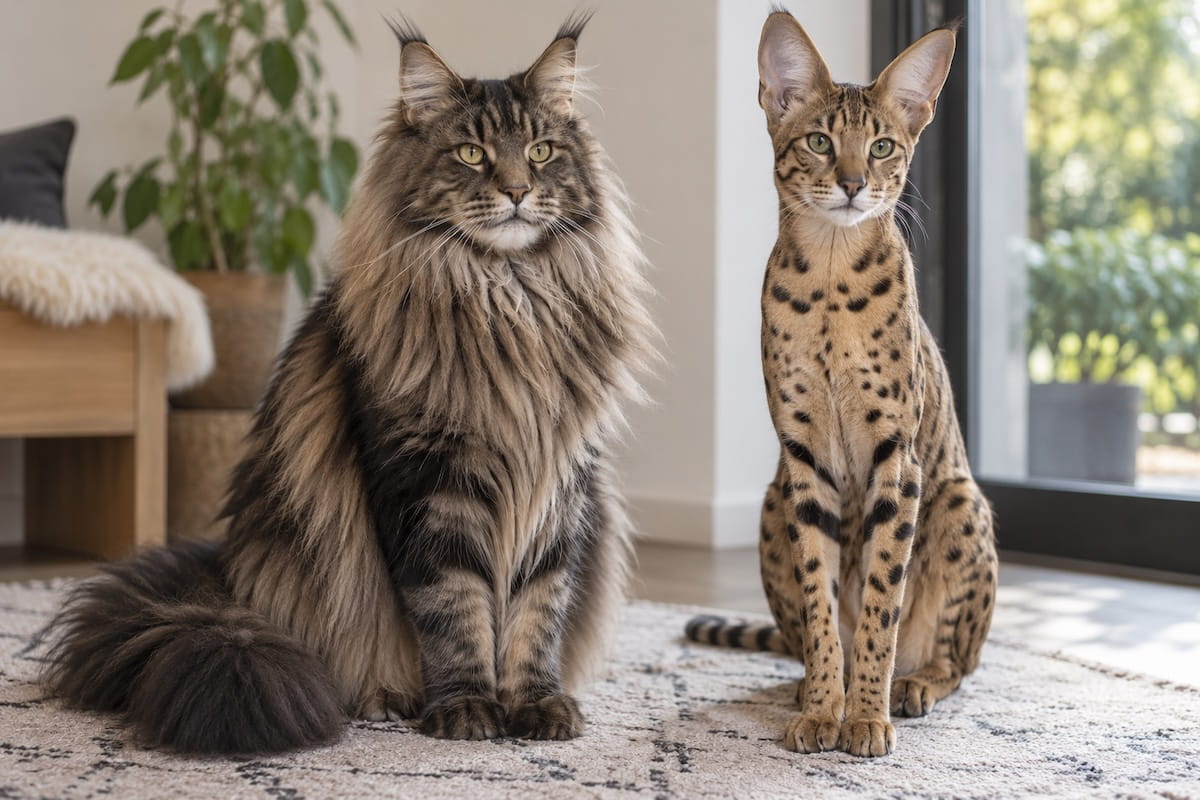
Savannah cats and Maine Coons are both large-looking, intelligent, and highly interactive cats, but they offer very different ownership experiences. The Maine Coon is a large, fully domestic breed with a substantial rectangular body, shaggy coat, and famously gentle temperament. The Savannah is a domestic breed with African serval ancestry. It is typically taller, leaner, shorter-coated, and considerably more energetic.
So which is bigger, and which makes the better pet?
Maine Coons are generally heavier and more substantial, while Savannah cats often appear taller because of their exceptionally long legs and neck. For most family homes, the Maine Coon is also the easier breed to accommodate.
Quick Answer
Choose a Maine Coon if you want a large, sociable cat with a long coat, playful personality, and relatively adaptable nature. Consider a Savannah if you specifically want a highly active, athletic cat that needs considerable interaction, climbing space, and enrichment.
The biggest differences are:
Savannahs have serval ancestry; Maine Coons are fully domestic.
Savannahs are taller and leaner.
Maine Coons are generally heavier and more substantial.
Savannahs have short coats, usually with the breed’s distinctive spotted appearance.
Maine Coons have shaggy semi-long coats.
Savannahs typically have much higher activity needs.
Savannah ownership can be restricted in some locations.
Savannah Cat Vs Maine Coon At A Glance
| Trait | Savannah Cat | Maine Coon |
|---|---|---|
| Ancestry | Domestic breed with serval ancestry | Fully domestic breed |
| Build | Tall, lean, long-legged | Long, broad, substantial |
| Size | Medium-large, very tall-looking | Large and generally heavier |
| Coat | Short; usually boldly patterned/spotted | Semi-long and shaggy |
| Grooming | Low | Moderate |
| Activity | Very high | Moderate to high |
| Personality | Curious, assertive, interactive | Gentle, social, playful |
| Training | Highly trainable | Intelligent and trainable |
| Family suitability | Best for active, prepared homes | Suits a wider range of households |
| Ownership restrictions | Possible | No hybrid-specific restrictions |
If you are unfamiliar with the breed, my guide explaining what a Maine Coon is covers its appearance, history, and temperament in greater detail.
1. Ancestry: Domestic Breed Vs Serval Heritage
The biggest difference starts with their ancestry. Maine Coons developed as domestic cats in North America and are regarded as one of the oldest natural breeds on the continent.
The International Cat Association’s Maine Coon profile describes the breed as America’s native longhair, developed as a hardy working cat capable of coping with the harsh New England climate. Savannahs have a completely different origin. According to TICA’s Savannah breed history, the first known Savannah was born in 1986 after a domestic cat produced a kitten sired by an African serval. TICA calls this kitten an F1, or first-generation hybrid.
Modern Savannahs can be further removed from that original serval cross, so it is important not to talk about every Savannah as though it were an F1. The individual cat, its breeding, and its generation all matter.
2. Savannah Vs Maine Coon Size
This is one of the most searched comparisons, but simply asking which is “bigger” can be misleading.
Maine Coon
Maine Coons are genuinely heavy, substantial cats. TICA currently lists typical adult weights of approximately:
- Males: 18-22 pounds
- Females: 12-15 pounds
They have broad chests, substantial bones, large paws, and long rectangular bodies. They also mature unusually slowly. My Maine Coon size and growth guide explains how their size changes during their first several years.
Savannah
TICA describes Savannahs as medium-to-large, tall and lanky cats whose long legs can make them appear heavier than they actually are.
Their distinctive proportions include unusually long:
- Legs
- Neck
- Body
- Ears
This creates the illusion of an extremely heavy cat. In reality, TICA specifically notes that many Savannahs are closer in weight to a large domestic cat than their height suggests.
Which Is Bigger?
Savannah cats often look taller, while Maine Coons are generally heavier and bulkier.
Think:
- Savannah = height and athleticism
- Maine Coon = mass and substance
3. Appearance
Put these breeds next to each other, and the difference is obvious.
Savannah cats have:
- Long slender legs
- A lean torso
- Very tall ears
- A long neck
- Hooded-looking eyes
- A relatively short coat
- Bold spots
Maine Coons have:
- A broad chest
- Heavy bone structure
- Large tufted paws
- A strong square muzzle
- Furnished ears
- A shaggy coat
- A huge flowing tail
The Savannah has an elegant, upright silhouette. The Maine Coon looks broader, heavier, and considerably fluffier.
4. Coat And Grooming
If you want the easier coat, the Savannah wins. Savannahs have short coats without the heavy undercoat associated with many long-haired breeds. TICA recommends occasional brushing, with additional grooming during shedding periods. Maine Coons have a mature two-layered coat with longer fur around the chest, belly, and hindquarters.
Their coats vary surprisingly widely. My Maine Coon Bali has relatively silky, manageable fur, while Mika’s much fluffier coat requires considerably more attention. Regular mat checks are particularly important around the:
- Armpits
- Chest
- Belly
- Behind the ears
- Hind legs
My Maine Coon grooming guide explains how I manage those different coat types.
5. Personality And Intelligence
Both breeds are intelligent and closely involved with their owners. However, the intensity is different.
Savannah Personality
TICA describes Savannahs as active, curious, and playful cats that can become bored without sufficient interaction and enrichment. They can learn to:
- Play fetch
- Walk on a harness
- Solve puzzles
- Open doors
- Investigate taps and cupboards
- Play in water
They often form strong bonds with their owners and may follow them around the house, although TICA notes that they are not generally traditional lap cats.
Maine Coon Personality
Maine Coons are also intelligent and people-oriented, but they tend to be more relaxed. They frequently:
- Follow their owners
- Investigate household activity
- Play fetch
- Solve food puzzles
- Chirp and trill
- Remain playful well into adulthood
You can read more about these traits in my Maine Coon personality guide.
I would not describe the Savannah as “intelligent” and the Maine Coon as merely “friendly.” Both are clever cats; the Savannah is generally the more intense and energetic of the two.
6. Activity And Enrichment
This may be the most important practical difference. TICA describes Savannahs as high-energy cats that need a great deal of daily interaction.
Expect to provide:
- Tall climbing areas
- Active play
- Puzzle feeders
- Training
- Interactive toys
- Vertical territory
- Plenty of mental stimulation
Savannahs are also impressive jumpers and may explore places an ordinary cat would never consider. Maine Coons still need enrichment, but their needs are usually easier to accommodate. Mine enjoy fetch, food puzzles, cat trees, chasing toys, and investigating whatever we happen to be doing.
For an owner who wants an intelligent, playful cat without quite the same intensity, the Maine Coon is likely to be the easier fit.
7. Which Is Better For Families?
For the broadest range of households, I would choose the Maine Coon. TICA describes Maine Coons as gentle, friendly, and generally good with children, dogs, and other cats. That matches my own experience of the breed over more than 14 years.
Savannahs can also form extremely strong relationships with their families, but their high activity and interaction requirements make matching the cat to the household particularly important. A busy home that actively wants to train, play with, and enrich its cat may love a Savannah.
A family wanting a more easygoing large companion is likely to find the Maine Coon more straightforward.
8. Health
Neither breed should be assumed to be automatically healthier than the other. Responsible breeding matters. TICA recommends Savannah screening for pyruvate kinase deficiency and progressive retinal atrophy, and also notes a history of hypertrophic cardiomyopathy (HCM) within the breed.
For Maine Coons, breeding programs commonly consider:
- Hypertrophic cardiomyopathy (HCM)
- Hip dysplasia
- Spinal muscular atrophy (SMA)
- Pyruvate kinase deficiency
My Maine Coon health and wellness guide explains the Maine Coon-associated conditions in greater depth.
The important thing when choosing either breed is not simply whether a breeder says their cats are “healthy,” but what health screening has actually been carried out.
9. Savannah Ownership Can Be Restricted
This is one major difference that should not be overlooked. TICA’s Savannah ownership information warns that the breed is prohibited or restricted in some states and countries because of its serval ancestry. Rules may also vary according to location and Savannah generation. Before paying a deposit, check the regulations that currently apply where you live.
Maine Coons do not have this hybrid-ancestry issue.
My Experience: Would I Choose A Savannah Or Maine Coon?
I have owned three pedigree Maine Coons over more than 14 years: Pippin, Mika, and Bali. I have not owned a Savannah, so I rely on current breed-registry information rather than pretending to have firsthand Savannah experience.
What my own cats have shown me, though, is that Maine Coons already provide much of what attracts people to exotic, highly interactive breeds. Bali loves playing fetch with his toy mouse. Mika is exceptionally good at difficult food puzzles and investigates practically everything around him. All three have followed us around, interacted heavily with family life, and retained playful personalities as adults.
So if someone is considering a Savannah because they want a large, intelligent, dog-like cat, I would not automatically assume they need a Savannah. The Maine Coon already offers many of those qualities with a generally easier activity level.
My Maine Coon pros and cons guide gives a much more candid account of what actually living with the breed involves.
Savannah Or Maine Coon: Which Should You Choose?
Choose A Maine Coon If You Want:
- A large, substantial cat
- A gentle, sociable personality
- An intelligent, playful companion
- A cat suited to a wider range of family homes
- A spectacular long coat
- Interactive behavior without extreme energy
- No hybrid-specific ownership restrictions
Consider A Savannah If You Want:
- A tall, athletic cat
- A striking spotted appearance
- Very high activity levels
- A cat you actively want to train
- Extensive interactive play
- Minimal coat grooming
- A particularly unusual companion
The Savannah should not be chosen simply because it looks exotic. Likewise, the Maine Coon should not be chosen simply because it is huge and fluffy. Choose the cat whose energy level and everyday care requirements fit the life you actually lead.
If the Maine Coon sounds like the better fit, my guide to finding a reputable Maine Coon breeder explains what documentation, health testing, and breeder practices to look for.
Frequently Asked Questions
Is A Savannah Bigger Than A Maine Coon?
Savannahs often appear taller because of their exceptionally long legs and neck. Maine Coons are generally heavier, broader, and more substantially built.
Which Is More Active?
The Savannah. Both breeds are playful and intelligent, but Savannahs generally require much more daily activity, climbing, and mental stimulation.
Are Savannah Cats Part Wild Cat?
Savannah cats have African serval ancestry. The first recorded Savannah was an F1 kitten produced from a serval and a domestic cat.
Which Is Easier To Groom?
The Savannah. Its short coat requires considerably less grooming than the Maine Coon’s shaggy semi-long coat.
Which Makes The Better Family Pet?
For most family homes, I would choose the Maine Coon because of its gentle temperament and more moderate activity level. Savannahs can be excellent companions for owners prepared for their considerably greater enrichment needs.
Are Savannah Cats Legal Everywhere?
No. Savannah ownership is restricted in some locations because of the breed’s serval ancestry. Always check current local rules before buying one.
Conclusion
Savannah cats and Maine Coons are both impressive, intelligent breeds, but they are very different cats to live with. The Savannah is taller, leaner, shorter-coated, and generally much more energetic. The Maine Coon is heavier, fluffier, more substantial, and usually easier to integrate into an ordinary family home. Both can form strong relationships with their owners, and both need regular interaction and enrichment.
The better choice is not the biggest or most exotic-looking cat. It is the one whose personality, activity level, and care requirements genuinely suit your household.