Maine Coon Stressed? Signs, Causes And How To Calm Them

Maine Coons are usually described as confident, sociable, and laid-back, but they can still experience fear, anxiety, and chronic stress. Some react obviously by growling, fleeing, or hissing (like Mika). Others become unusually quiet, hide away, stop playing, eat less, or avoid being touched.
I have seen stress present very differently in my three male Maine Coons. Pippin hid when pain made him feel vulnerable, yet several house moves never caused him obvious distress. Mika growls when a delivery van drives over our driveway pebbles, then runs away! Both Mika and Bali are frightened by the robot hoover, handheld hoover, and even the sound of my trainers on our wooden kitchen floor, whereas Pippin was completely unconcerned by those noises.
Those differences taught me an important lesson: there is no single “Maine Coon stress personality”. The trigger may be pain, an unfamiliar sound, another cat, a visitor’s scent, poor early socialisation, boredom or a loss of control.
Quick Answer
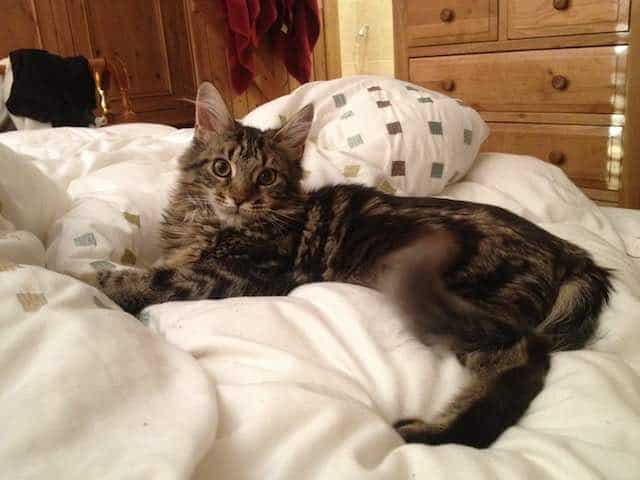
A stressed Maine Coon may hide, crouch, flatten their ears, develop wide pupils, growl, hiss, overgroom, eat less, avoid people, toilet outside the litter tray or become unusually clingy or aggressive.
Remove the immediate trigger where possible, provide a quiet, safe place, keep resources and routines predictable, and do not force physical contact. Sudden changes in behaviour should be treated as a possible medical problem, especially when accompanied by pain, loss of appetite, or changes in litter tray use.
Any cat that repeatedly strains to urinate, cries in the litter tray, or produces little or no urine needs urgent veterinary attention. A complete urinary blockage is an emergency and is particularly common in male cats.

Normal Behaviour Vs Signs Of Stress
| Relaxed Maine Coon | Possible Stress Sign |
|---|---|
| Rests in familiar, open places | Suddenly hides in unusual or inaccessible places |
| Eats and drinks normally | Eats less or refuses food |
| Plays in their usual way | Stops playing or becomes unusually restless |
| Approaches familiar people | Avoids contact, freezes, or runs away |
| Uses the litter tray normally | Toilets elsewhere or repeatedly visits the tray |
| Accepts their usual handling | Flinches, growls, or swats when touched |
| Ears and whiskers look relaxed | Ears flatten, pupils widen, and body crouches |
| Vocalises normally | Starts growling, hissing, or calling unusually |
Mainecooncentral.com
The Cats Protection guide to feline stress explains that stressed cats may hide or seek height, flatten their ears, and show wide pupils. Changes from your cat’s normal behaviour matter more than any isolated gesture.
How Long Should Stress Last?
A brief reaction after a loud noise may settle within minutes or hours. After a vet visit, guests or building work, a cat may need a day or two to return completely to normal.
- Minutes to hours: Usually reasonable after a brief fright if your cat begins relaxing when the trigger ends.
- One to three days: Continue providing quiet, routine, and choice. Behaviour should gradually improve.
- More than a week: Look for a repeating trigger and seek veterinary advice if the behaviour is unusual.
- Two weeks or longer: Chronic stress, pain, or illness becomes more likely.
- Sudden severe signs: Contact a vet immediately rather than waiting.
Stress Or Pain? Pippin Taught Me To Check Both
Stress and pain can look almost identical in cats.
Pippin was normally an exceptionally confident Maine Coon. He approached strangers, coped with household activity, and was not bothered by the hoover. However, when he damaged his tail canal during a bad jump, the pain changed his behaviour dramatically. He hid away from us as much as possible.
We made sure he could not get outside because we worried that, while frightened and in pain, he might disappear somewhere and not return. His hiding was not a personality change. Pain made him feel unsafe.
Pippin also hid when he developed a urinary tract infection. That reinforced the same lesson: sudden hiding can be a medical clue.
Watch for a:
- Sudden change in temperament
- Protecting one body area
- Reluctance to jump
- Reduced appetite
- Altered toileting
- Poor grooming
- Aggression when touched
If these signs are new, consult your vet before assuming the problem is purely emotional. My guides to Maine Coon health issues, joint problems, and hip dysplasia explain other conditions that can change behaviour.
Common Causes Of Maine Coon Stress
1. Loud Or Unfamiliar Sounds
Vacuum cleaners, fireworks, thunderstorms, building work, delivery vehicles, and unfamiliar footsteps can all trigger fear.
Mika reacts as soon as a delivery van drives onto our gravel driveway. He growls at the vehicle and then runs away. Both Mika and Bali are also frightened by the robot and handheld hoovers. Even the sound of my trainers moving across the wooden kitchen floor can make them tense or flee.
Pippin never reacted that way. He was raised by us from kittenhood, whereas Mika and Bali were adopted as adults. Their responses may reflect less calm exposure to ordinary household sounds during early socialisation, although we cannot know exactly what they experienced before being adopted.
Do not trap a frightened cat beside a noise to make them “get used to it”. Let them leave, provide a safe room, and introduce distant sounds gradually only while they remain relaxed.
2. Visitors And Unfamiliar Scents
Cats assess visitors through posture, movement, voice, and scent. A person can behave perfectly around cats and still smell unfamiliar or alarming.
When a house valuer visited us, Bali took the time to approach him. The gentleman was good with cats and calmly offered his hand. Bali eventually moved forward to smell it, but then ran away faster than we had ever seen him run. Something about the man’s scent appeared to frighten him.
The visitor may have carried the smell of another animal, strong products, or an environment Bali associated with danger. Ask guests not to stare, reach over the cat, or pursue them. Let the cat decide whether to approach.
3. New Cats And Social Pressure
Ironically, several house moves never caused visible stress to Pippin, but adopting Mika and Bali did.
We introduced them slowly, yet Pippin still became stressed while adapting to two unfamiliar cats entering his established home. For him, social change mattered more than a change of building.
Inter-cat tension is not always a fight. It can involve staring, blocking a doorway, taking preferred resting places, or making another cat hesitate before approaching food, water, or litter trays. The 2024 AAFP Intercat Tension Guidelines explain how these quieter forms of pressure can affect cats.
Provide separate feeding stations, several water points, multiple resting areas, and vertical escape routes. Aim for one litter tray per cat, plus one extra. A large, stable Maine Coon cat tree can also create valuable vertical territory and give each cat more choice over where to rest.
4. Moving Home And Environmental Change
Moving house commonly unsettles cats, but individual reactions vary.
Pippin moved house several times without showing obvious distress. He explored and adapted remarkably well. That does not mean moves are harmless to every cat; it shows that temperament, socialisation and management matter.
When moving, begin with one secure room containing familiar bedding, food, water, litter, and scratching options. Expand access gradually and keep feeding and play routines consistent.
5. Loneliness, Boredom, And Routine Disruption
Maine Coons are intelligent and often strongly bonded to their families. Too little stimulation or a sudden change in companionship can result in excessive calling, destructive behaviour, overgrooming, restlessness, or withdrawal.
My guides to Maine Coon separation anxiety, leaving Maine Coons alone, and keeping a Maine Coon entertained explain how to distinguish boredom from deeper anxiety.
Provide short daily hunting-style play, puzzle feeding, climbing spaces, and predictable interaction. Mika particularly enjoys puzzle challenges because successfully solving them appears to build his confidence.

6. Poor Litter-Tray Conditions
A tray that is dirty, too small, scented, covered, noisy, or guarded by another pet can create stress. Maine Coons also need genuinely large trays; many standard products are too cramped.
Never punish toileting accidents. They can reflect illness, pain, fear, or an unsuitable setup.
Repeated trips, straining, crying, blood, or little urine are different from a simple tray preference. Cornell’s guide to feline lower urinary tract disease explains that urethral obstruction is potentially life-threatening and occurs more often in male cats because their urethra is longer and narrower.

How To Calm A Stressed Maine Coon
What To Do In The First 30 Minutes
- Remove or reduce the trigger. Turn off the hoover, move other animals away, close curtains, or ask visitors to give the cat space.
- Provide a safe retreat. Use a quiet room with water, a litter tray, bedding, and a covered hiding option.
- Stop physical pressure. Do not pick the cat up, pull them from hiding, or repeatedly stroke them.
- Lower noise and movement. Keep children, visitors, and other pets away until the cat begins relaxing.
- Offer, but do not force, food or play. A treat or short wand-toy session may help once the cat is receptive.
- Check for medical warning signs. Look at appetite, movement, urination, breathing, and response to touch.
The AAFP/ISFM Environmental Needs Guidelines organise a healthy feline environment around five essentials: a safe place; separated resources; opportunities for play and predatory behaviour; positive, predictable human contact; and respect for the cat’s senses.
Our Honest Experience With Feliway
We used Feliway pheromone plug-in diffusers while slowly introducing Mika and Bali to Pippin.
I cannot honestly say they made a significant visible difference in our house. However, our main living area has vaulted, almost double-height ceilings, so a standard diffuser had an enormous volume of air to cover. Providing enough units throughout the property would have been extremely expensive.
That does not prove pheromone products never work. It shows that room size, layout, placement, and the actual source of stress matter. Cats Protection notes that pheromone diffusers may help some cats but should be used alongside medical or behavioural advice rather than as the only solution.
A diffuser cannot compensate for blocked access to litter trays, painful illness, frightening handling, or unresolved conflict between cats.
What Not To Do
Avoid:
- Dragging a cat from hiding
- Punishing hissing, growling, or toileting accidents
- Holding a frightened cat tightly
- Blocking escape routes
- Repeated full-intensity exposure to the trigger
- Changing several things at once
- Assuming sudden withdrawal is “just their mood”
- Using essential oils around cats
Hiding and fleeing are coping behaviours. Removing those options can turn fear into defensive aggression.
Building Long-Term Confidence
Confidence develops through safety, predictability, and successful experiences.
- Keep meals and play within consistent time windows.
- Let your cat initiate and end physical contact.
- Provide high and low hiding places.
- Spread resources around the home.
- Use puzzle feeders and manageable challenges.
- End play with a successful catch.
- Prepare a safe room before predictable noise or visitors.
- Introduce new pets slowly.
- Reward calm investigation without luring the cat too close to danger.
For indoor cats, combine mental enrichment with suitable physical activity. See how much exercise a Maine Coon needs and the best Maine Coon toys.
When To Contact A Vet
Arrange veterinary advice when:
- Stress signs are sudden or out of character
- Hiding persists without a clear, harmless trigger
- Your cat eats substantially less or stops eating
- There is vomiting, diarrhoea, weight loss, or lethargy
- Touching one area causes pain or aggression
- Jumping, climbing, or walking changes
- Overgrooming causes bald or sore skin
- Toileting behaviour changes
- Home adjustments have not helped within one to two weeks
Seek emergency help for inability to urinate, repeated straining, collapse, severe breathing difficulty, repeated vomiting, or profound weakness.
Frequently Asked Questions
Why Is My Maine Coon Suddenly Hiding?
A short-term fright may be responsible, but sudden hiding can also indicate pain or illness. Pippin hid after his tail injury and during a urinary infection, despite normally being confident. Check appetite, movement, toileting, and sensitivity to touch.
Why Does My Maine Coon Growl At Vehicles?
The sound, vibration, smell, or sudden appearance of a vehicle may trigger fear. Mika growls when delivery vans cross our driveway pebbles, then retreats. Give your cat access to a quiet interior area rather than punishing the warning signal.
Why Is My Maine Coon Scared Of The Hoover?
Hoovers are loud, mobile, and unpredictable. Cats with limited early exposure may find them particularly frightening. Bali and Mika flee from several types of hoover, while Pippin was never concerned.
Can Stress Cause Urinary Problems?
Stress is associated with some feline lower urinary tract problems, but urinary signs can have other causes. A male cat that strains or cannot urinate requires emergency treatment.
Should I Comfort My Stressed Maine Coon?
Offer calm company, but do not force cuddles. Sit nearby and let your cat choose whether to approach. Some cats find touch reassuring; others need distance.
Do Pheromone Diffusers Work?
They may help some cats, but results vary. Ours produced no obvious benefit during cat introductions, possibly because our large, double-height living space was difficult to cover. Use them as one part of a wider plan.
Can A Maine Coon Recover From Poor Socialisation?
Confidence can improve greatly with predictable routines, choice-based handling, safe hiding places, play, and positive associations. Some sensitivities may remain, so success means reduced panic rather than expecting complete fearlessness.
Final Thoughts
A stressed Maine Coon is communicating that something feels unsafe, painful, or beyond their control.
Pippin showed me that pain can make a normally confident cat hide. He also demonstrated that cats do not always react to the events owners expect: several house moves caused no visible distress, yet introducing Mika and Bali did. Mika and Bali show how footsteps, hoovers, vehicles and even a visitor’s scent can frighten cats that may have had less early socialisation.
Do not punish the response. Identify the trigger, rule out pain, protect key resources, and give your cat genuine choice.
The goal is not to force a Maine Coon to tolerate everything. It is to create a home in which they can retreat, recover, and gradually feel safe again.