Maine Coon Size & Growth Guide: Height, Weight, Length & Development Stages

Maine Coons are one of the largest domestic cat breeds, known for their long bodies, powerful bone structure, and slow growth rate. Adult males typically weigh 18-22 lbs, females usually weigh 12-15 lbs, and many continue developing until 3-5 years of age.
This guide explains what a healthy Maine Coon size really looks like, how growth changes with age, how to tell whether your cat is developing normally, and when a size or weight issue may need veterinary attention.
Weight is only one part of the picture. Maine Coons are also defined by their long rectangular body, broad chests, strong bone structure, and distinctive head shape, so body proportions often reveal more than the number on the scale.
If you’re here because you just want quick expectations (without an in-depth dive), start with: Maine Coon Cat Size.
Quick Answer: How Big Do Maine Coons Get?
Adult male Maine Coons typically weigh 18-22 lbs (8.2-10 kg), while adult females usually weigh 12-15 lbs (5.4-6.8 kg). Many continue growing until 3-5 years of age, especially males, who often fill out later through the chest, shoulders, and muscle mass. Healthy size depends on sex, genetics, frame, muscle tone, and body condition – not just the number on the scale.
Official Maine Coon Size Range (Height, Length, Weight)
Maine Coons are one of the largest non-hybrid domestic cat breeds, but their adult size varies widely. A healthy Maine Coon can be large without being overweight – the key is muscle tone and body condition, not chasing a single number on the scale.
As a realistic guide, most adult Maine Coons fall into these ranges:
- Typical adult male: 18-22 lbs (8.2-10 kg), around 10-16 in (25-40 cm) at the shoulder, and up to roughly 40 in (101 cm) nose-to-tail, including the tail.
- Typical adult female: 12-15 lb (5.4-6.8 kg), around 8-14 in (20-36 cm) at the shoulder, and up to roughly 38 in (97 cm) nose-to-tail, including the tail.
Numbers on their own do not always help owners picture just how big this breed is. In real life, a full-grown Maine Coon can weigh more than a 1-year-old child, stretch to a length similar to a 3 to 4-year-old child’s height, and reach roughly knee to hip level on an adult when standing or stretching up. This is why the breed feels so striking in person, even when the cat’s weight is still within a healthy normal range.
These are healthy, normal ranges – not goals. Some Maine Coons sit outside them due to genetics, frame size, & bloodline.
Final adult weight is influenced by more than sex alone. Genetics, overall frame size, diet quality, activity level, and even neuter timing can all shift where an individual Maine Coon settles within the normal range, which is why two healthy cats do not always finish at the same number on the scales. Males also carry more muscle mass, while females tend to be lighter and slimmer.
Breed organisations such as The International Cat Association (TICA) describe the Maine Coon as one of the largest natural domestic cat breeds, and also note that the breed develops slowly and may not reach full size until 3-5 years of age. That slow maturity helps explain why young Maine Coons often look lanky long before they look broad or powerful.
Maintaining a healthy weight is essential for preventing joint strain, heart issues, and mobility limitations. Owners should monitor monthly weight during kittenhood, then quarterly during adulthood, watching for sudden increases or drops that may indicate underlying health issues.
If you’re looking specifically for the typical adult range, see our detailed guide on What is the average weight of a Maine Coon cat, which breaks down male vs female size and what’s considered healthy.
How To Measure Your Maine Coon’s Size At Home
If you want to track your Maine Coon’s growth accurately, consistency matters more than precision. Measuring the same way each time gives a far clearer picture than comparing random photos or online examples.
Weight should be checked monthly during kittenhood and every few months once your cat reaches adulthood. Height is best measured from the floor to the top of the shoulder blades while your cat is standing naturally. Length should be measured from the tip of the nose to the base of the tail, with the tail measured separately if desired.
Body condition is just as important as numbers. A healthy Maine Coon should feel muscular and solid rather than soft or bony. Thick fur and posture can make cats look larger or smaller than they really are, so physical checks are often more reliable than visual comparison alone.
Real-Life Maine Coon Sizes: My Own Cats
I’ve owned three male Maine Coons in total, all raised in the same household, yet all very different in size and build.
🐾 My Maine Coon Size Comparison
| Cat Name | Weight (Adult) | Build | Notes |
|---|---|---|---|
| Mika | 21.7 lbs | Large, muscular | Broad chest, thick limbs, very solid |
| Pippin | 20.3 lbs | Medium frame | Athletic, less bulky |
| Bali | 18 lbs | Petite frame | Lighter bone structure, elegant build |
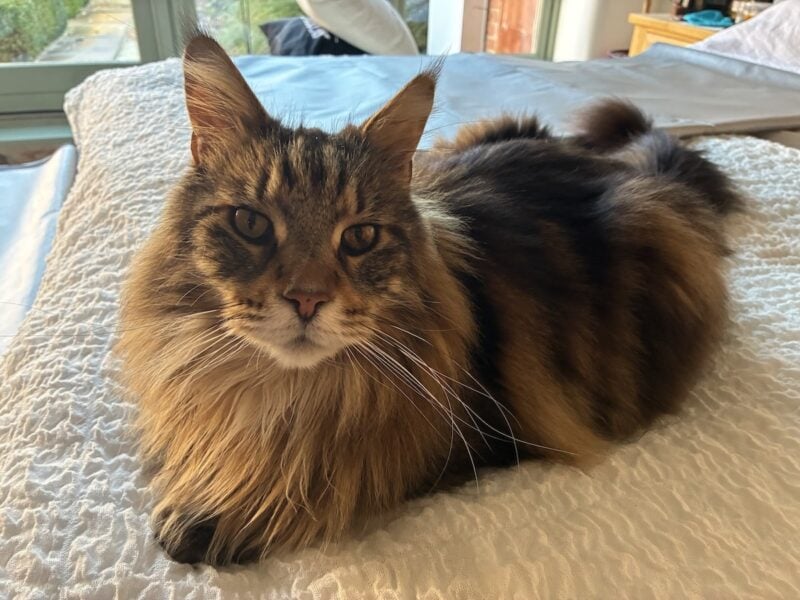
Below are pictures of my three Maine Coons:


💡 Key Insight:
Bali and Mika are brothers, yet their adult size and physical build are completely different. This highlights how genetics and frame type matter more than litter or upbringing alone.
That real-life difference is one of the most important things owners should understand. Two healthy Maine Coons can live in the same home, eat similar diets, and still mature into very different adult cats. One may become broad and heavily muscled, while another stays lighter, taller, or more refined.
This is why comparison with online photos or record-holding cats can create unnecessary worry.
Even among healthy purebred males raised in the same home, adult size and shape can vary a lot. One cat may end up broad, muscular, and heavy-boned, while another stays taller, lighter-framed, and more elegant despite being fully grown.
Male vs Female Maine Coon Size Differences
Male and female Maine Coons often look quite different in build, and that difference is normal. Males typically develop heavier bone structure, broader chests, and more visible muscle, while females are usually more compact and athletic.
As a realistic expectation:
- Adult males commonly reach: 18-22 lbs (8.2-10 kg) (sometimes higher in large-framed lines)
- Adult females commonly reach: 12-15 lb (5.4-6.8 kg)
Males also tend to fill out later. Many reach their near-adult length earlier, but continue adding muscle and “bulk” gradually through years 3–5. Females often reach their mature frame earlier and stay more consistent in body shape.
If you’re comparing your cat to social media “giants,” remember most viral examples are very large adult males — so it’s common for owners of female Maine Coons to worry unnecessarily.

Adult size can vary significantly by sex, which we explain in our comparison of male vs female Maine Coon size and growth.
For a shorter, reader-friendly overview, see our guide to Maine Coon cat size.
Maine Coon Weight By Age (Typical Ranges)
Use this as a general guide. Individual growth varies a lot by genetics and frame size.
- 1 month: Roughly 1.2-1.8 lb (0.55-0.82 kg)
- 3 months: Roughly 3.3-5.3 lb (1.5-2.4 kg)
- 6 months: Roughly 6.8-13.2 lb (3.1-6.0 kg)
- 12 months: Often around 10-20 lb (4.5-9.0 kg), depending on sex and frame
- Adult (3-5 years): Females commonly 12-15 lb (5.4-6.8 kg); males commonly 18-22 lb (8.2-10 kg)
If you’re tracking growth at home, monthly weights are usually enough. Sudden plateaus early in kittenhood, repeated weight loss, or poor appetite should be discussed with a vet.
For a deeper breakdown of healthy adult size ranges, read our full guide to average Maine Coon weight.
For a full timeline of slow maturity in this breed, see when Maine Coon cats stop growing.
By 12 months, many Maine Coons have reached a large share of their final size, and some sources put this at roughly 70-80% of adult weight. What usually comes later is not dramatic extra height, but the slower “fill out” phase that gives the breed its broad, powerful adult look.
How Big Is A Maine Coon Kitten?
Maine Coon kittens are usually larger, longer, and heavier than standard domestic kittens, but they do not all grow at the same speed. Some look obviously large by 12 weeks old, while others go through a long, lanky stage before filling out later.
As a rough guide, many Maine Coon kittens look noticeably bigger than average kittens by 4-6 months old, especially in body length, paw size, tail length, and bone structure. However, size alone is not enough to confirm whether a kitten is a purebred Maine Coon.
Growth depends on several factors, including:
- Genetics and bloodline
- Sex
- Nutrition
- Birth size
- Litter size
- Health
- Individual growth rate
Male Maine Coon kittens often become heavier, broader, and more muscular than females as they mature, but this difference may not be obvious in early kittenhood. A female Maine Coon kitten can look large at 12 weeks, while a male from a slower-developing line may look lankier for longer.
The most reliable signs of healthy kitten growth are steady weight gain, good body condition, strong muscle development, normal energy levels, and a gradual increase in length and height.
Avoid trying to make a Maine Coon kitten grow faster. Overfeeding does not create a bigger cat; it increases the risk of excess fat and unnecessary strain on developing joints.
Size Is A Range, Not A Target
Maine Coons are naturally large, but “average size” is a range, not a target.
A healthy Maine Coon can be big because they’re long, muscular, and heavy-boned – not because they’re overweight. The best way to judge whether your cat is the “right” size is to track growth trends over time and check body condition (muscle vs fat), rather than chasing a single number.
If your Maine Coon’s size worries you, read these next:
For a visual breakdown of how Maine Coons develop over time, see our detailed Maine Coon growth chart.
Typical Maine Coon Growth Milestones
Maine Coon growth usually happens in stages rather than at a steady, predictable pace. During the first few months, kittens grow rapidly in both length and weight. Between about four and eight months, many start to look long, leggy, and slightly awkward because the skeleton often develops faster than the muscles.
Many Maine Coons gain quickly during the first year, continue adding size through adolescence, and then keep filling out in chest width and muscle into early adulthood, which is why a lean 12-month-old can still have plenty of development left to do.
From roughly nine to eighteen months, the chest begins to widen, the body becomes more solid, and muscle development becomes easier to see. Even then, many Maine Coons still look young and unfinished compared with their eventual adult shape.
Most reach close to their adult height and length between two and three years, but full body depth, broadness, and muscular “fill-out” often continue until four or even five years old, especially in males. This slow development is a normal breed trait, not a sign that something is wrong.
This slower development is one of the biggest reasons new owners worry unnecessarily. Most ordinary domestic cats reach adult size by about 10 to 12 months, but Maine Coons often stay in a lanky, unfinished-looking “teenage” phase for much longer before the chest broadens, the muscles develop, and the final frame fills out.
If you are raising a kitten, use the section above on how big a Maine Coon kitten should be alongside the full Maine Coon growth chart for a more detailed month-by-month breakdown.
Maine Coon Body Shape & Proportions
Maine Coons have a unique, unmistakable body structure: a long, rectangular torso, broad chest, strong bone density, high cheekbones, and a square, well-defined muzzle. Their ruff, ear tufts, and bushy tail add to the overall impression of size.
Looking at body proportions helps owners judge whether their cat is developing the typical Maine Coon shape, rather than relying on weight alone.
Maine Coon size is not just about weight. The breed’s rectangular body, broad chest, square muzzle, large paws, and long plumed tail all create the impression of a much larger cat. For a deeper visual breakdown, read my full guide to Maine Coon body shape.
Weight alone never tells the full story with this breed. A Maine Coon may not look especially heavy on the scales, yet still take up far more physical space than an average cat because of its length, height, chest width, and tail size.
Higher numbers are not automatically a problem in this breed. A 22-pound Maine Coon may be perfectly healthy if the cat has a large frame, strong musculature, a visible waist, and ribs that can still be felt under light pressure. The question is not “Is this number too high?” but “Is this cat carrying muscle or excess fat?”
Even 25 lbs is not an automatic sign of obesity in a very large male, but once cats sit above the usual range, body-condition checks become even more important than the number on the scale alone.
Do Maine Coons Have Short Legs?
Maine Coons do not usually have short legs. A purebred Maine Coon should have medium-length legs that are proportionate to their long, muscular body.
This breed is known for its rectangular frame, broad chest, strong bone structure, large paws, long tail, and substantial overall size. Their legs should support that body shape rather than look unusually short or out of balance.
However, Maine Coons can sometimes appear to have shorter legs than they really do because of:
- Their long, thick coat
- Fur that extends down toward the paws
- A large, heavy-looking body
- A broad chest and deep torso
- The way they sit, crouch, or stretch
- Immature kitten proportions during growth
A young Maine Coon kitten may temporarily look as though their legs are short because they have not yet grown into their adult proportions. As the cat matures, the body usually lengthens, the legs look more balanced, and the full Maine Coon frame becomes clearer.
If a Maine Coon genuinely has noticeably short or disproportionate legs, possible explanations include mixed ancestry, selective breeding, dwarfism, or another health-related skeletal issue. A Maine Coon crossed with a short-legged breed, such as a Munchkin, may inherit shorter limbs.
Short legs are not a normal breed feature, so any cat with very short limbs, lameness, pain, stiffness, or difficulty jumping should be assessed by a veterinarian.
Are Maine Coon Back Legs Longer Than The Front Legs?
Maine Coons can sometimes look as though their back legs are longer than their front legs because they have strong, muscular hindquarters. This gives them power when jumping, climbing, running, and pushing off from the ground.
In a healthy Maine Coon, the legs should still look balanced overall. The hindquarters may appear slightly more powerful, but the cat should not look awkward, unstable, or visibly disproportionate.
When To Worry About A Maine Coon’s Legs
Most apparent “short leg” concerns are caused by coat length, posture, or normal body proportions. However, speak to your vet if your Maine Coon shows:
- Limping
- Pain when jumping
- Stiffness after rest
- Reluctance to climb
- Dragging a leg
- Sudden weakness
- A hunched posture
- Uneven leg movement
- Loss of muscle in the back legs
- Difficulty getting in or out of the litter tray
Large cats can be more vulnerable to mobility strain, especially if they are overweight or have underlying joint issues. Early vet advice is important if your Maine Coon’s movement changes suddenly.
Size Compared To Other Breeds
Owners often want to know how Maine Coons compare to breeds such as the Norwegian Forest Cat, Ragdoll, Siberian, and regular domestic cats.
These comparisons help set realistic size expectations and clarify common misconceptions (e.g., “all Maine Coons are 30 lbs” is not true).
See full comparison guides:
- Maine Coon Vs. Norwegian Forest Cat
- Maine Coon Vs. Siberian Cats
- Maine Coon Vs. Ragdoll
- Maine Coon vs Regular Cat
Maine Coon Size Compared To A Typical House Cat
Maine Coons are noticeably larger than the average domestic cat, but the difference is not just about weight. Most typical house cats weigh around 8-12 pounds and stand roughly 8-10 inches tall at the shoulder. By comparison, adult Maine Coons often weigh between 12 and 22 pounds and stand closer to 10-16 inches tall.
Length is where the difference becomes most obvious. Maine Coons have long bodies and long tails, which can make them appear dramatically larger even when their weight is within a healthy range.
Many Maine Coons measure over 30 inches from nose to tail tip, while the average domestic cat is considerably shorter.
Because of their size, bone structure, and thick coat, Maine Coons often look larger than they actually are. This is normal for the breed and does not mean they are overweight or unhealthy.
Human comparisons can also make the difference easier to understand. An average house cat may feel compact enough to carry one-handed, whereas a Maine Coon often has the long body, deep chest, and substantial frame of a small furry “armful.” Even when two cats are both healthy, the Maine Coon usually takes up far more visible space because of its length, height, bone structure, and tail.
What Influences Maine Coon Size?
Final adult size is shaped by several factors working together. Genetics has the biggest influence, since some bloodlines naturally produce larger, heavier-boned cats while others produce a lighter or more refined frame. Sex also matters, with males usually maturing larger than females. Nutrition supports healthy growth, but it cannot override genetic potential.
Health problems, parasites, chronic digestive issues, and long-term underfeeding can all interfere with normal development. Even timing plays a role, because Maine Coons mature slowly and may look small for their age long before they reach their adult build.
Many factors affect final adult size, including:
Genetics
Breeding lines strongly influence both body length and final weight. European lines often have stronger bone structure and larger frames.
Diet & Nutrition
High-protein, species-appropriate diets help support ideal growth rates:
Health Conditions
Growth delays can occur due to parasites, malnutrition, or underlying diseases.
Spay/Neuter Timing
Early sterilisation can influence bone development slightly, but the effect is generally mild in Maine Coons.
When Do Maine Coons Stop Growing?
Most cats finish growing by around 12-18 months, but Maine Coons are slow-maturing “late bloomers.” Many continue developing until 3-5 years old.
A helpful way to think about it is that Maine Coons often stop growing in stages:
- Height/length: usually settles around 24-36 months
- Muscle and body “fill-out”: often continues around 36-60 months
This is why so many owners get confused during the second year. A Maine Coon can look “fully grown” by 12 months because the cat already has impressive length and height, but still be developing behind the scenes in muscle, chest depth, bone substance, and coat fullness for a long time afterwards.
This is why a Maine Coon can look slim or teenage-like at 18-24 months, then gradually become broader and heavier later, especially males.
Learn more about When A Maine Coon Finally Stops Growing, in my fact-filled article.
Is Your Maine Coon Growing Normally?
Not all Maine Coons follow the same growth rate. Some kittens shoot up early and slow down later, while others remain small until adolescence and then have a dramatic growth phase.
Signs your cat is growing normally:
- Steady weight increases
- Consistent appetite
- Healthy coat and muscle tone
- Active behaviour
Signs to monitor:
- Weight plateau before 6-7 months
- Sudden weight loss
- Poor appetite
- Dry or thinning coat
One helpful way to judge maturity is to look for the shift from a lanky adolescent frame to a more proportionate adult build. As Maine Coons near full maturity, month-to-month weight gain becomes smaller, the chest and shoulders broaden, and the coat and ruff usually start to look denser and more adult-like.
Helpful related guide:
When To Speak To A Vet About Maine Coon Growth
Slow growth is often normal in this breed, but certain signs should not be ignored. Speak to your veterinarian if your Maine Coon shows any of the following:
- Repeated weight loss
- Poor appetite
- Vomiting or diarrhoea
- Very slow growth during kittenhood
- Loss of muscle tone
- Lethargy
- A dull, thinning, or poor-quality coat
- Difficulty jumping, climbing, or moving comfortably
The most important thing is not whether your cat is at the top or bottom of the average range, but whether growth is steady, body condition is healthy, and there are no signs of illness affecting development.
Healthy Weight vs Overweight Maine Coon
Since Maine Coons are naturally large cats, many owners struggle to tell the difference between a healthy size and excess weight. A big frame does not mean a cat should be heavy, and true Maine Coon growth comes from bone structure and muscle, not fat.
A large frame is not the same as excess fat. Maine Coons are supposed to be long-bodied, broad-chested, and heavily boned, so a healthy cat can look impressively big without being overweight. What matters is whether the body feels firm and muscular, whether a waist is still visible from above, and whether the ribs can be felt under a light layer of fat.
The easiest way to judge body condition at home is to use both your eyes and your hands. When you look down from above, your Maine Coon should still have a visible waist behind the ribs. When you run your hands over the sides, you should be able to feel the ribs under a light fat covering, without them feeling buried.
In profile, the belly should not hang heavily or look rounded with fat deposits. This matters far more than chasing an exact number on the scale.
According to tica.org, adult males typically weigh 18-22 lbs (8.2-10 kg), and females 12-15 lbs (5.4-6.8 kg), but healthy weight depends on body frame, genetics, and activity level, not just the number on the scale.
Signs your Maine Coon is a healthy size:
- Visible waist when viewed from above
- Ribs can be felt but not seen
- Strong muscle tone
- Active and energetic behaviour
- Steady growth over time
Signs your Maine Coon may be overweight:
- No visible waist
- Belly hanging low
- Fat pads near the back legs
- Reduced activity
- Rapid weight gain
Why Maine Coons Can Look Bigger Than They Really Are
Maine Coons often appear larger than they actually are because of their long body, thick coats, and heavy bone structure.
Their rectangular frame, broad chest, and long tail create the impression of size even when their weight is completely normal. This is why comparing your cat to photos online can be misleading, especially when many viral images show very large adult males.
How Diet Affects Maine Coon Growth
Nutrition plays a major role in how large a Maine Coon becomes, but overfeeding will not make a cat grow bigger – it only makes them overweight.
A healthy Maine Coon diet should focus on:
- High animal protein
- Moderate fat
- Low carbohydrates
- High moisture content
- Proper taurine levels
Typical calorie needs for adult Maine Coons:
Male: 350-600+ kcal per day
Female: 280-450 kcal per day
Active cats may need more, while indoor cats often need less.
Feeding too much can lead to obesity, joint strain, and heart problems, which are more common in large breeds. To learn more about these subjects, take a look at my in-depth health guides:
A Maine Coon can also look lean or “small” without being unhealthy. Younger cats often appear slim while they are still growing, and some adults naturally have a lighter frame. This is why body condition matters more than comparison with social media photos, giant males, or record-holding cats.
If your cat is active, eating well, maintaining muscle, and following a steady growth trend, variation in size is usually completely normal.
How To Support Healthy Maine Coon Growth
Optimal growth requires a well-balanced diet that supports lean muscle, bone strength, and steady weight gain. Maine Coons thrive on high-protein, high-moisture diets that mimic natural feline nutrition.
Overfeeding leads to rapid weight gain, but not a healthy size – genuine bone and muscle development takes time.
Good-quality nutrition, regular play, and routine vet care do far more for healthy growth than supplements alone.
A consistent feeding routine, enrichment-based exercise, and regular vet checkups all contribute to balanced development.
For feeding advice, cost breakdowns, and diet guides, read:
• How Much Do Maine Coon Kittens Eat?
• Bottomless Bellies: How Much Do Maine Coon Cats Really Eat?
• Maine Coon Food Costs: What You Really Spend Each Year
Common Size & Growth Problems To Watch For
Because Maine Coons grow slowly, owners often misinterpret natural phases as problems. However, certain signs warrant attention:
- Very slow or stalled growth
- Visible ribs or backbone
- Rapid weight gain with little exercise
- Excessive kitten fat persisting past 12 months
- Coat thinning or loss during growth spurts
- Mobility issues or joint sensitivity
These can indicate nutritional deficits, early joint conditions, parasites, or metabolic imbalances.
Learn more inside:
• The Silent Threat Of Maine Coon Hypertrophic Cardiomyopathy
• Painful Maine Coon Joint Problems
Their size also changes what owners need at home. Larger litter trays, sturdier scratching posts, stronger carriers, and sleeping spaces with more room become much more important when your cat is significantly longer, taller, and heavier than the average domestic cat.
Can You Make A Maine Coon Grow Bigger?
Many owners wonder if diet or care can make a Maine Coon grow larger. While good nutrition and proper care help a cat reach its full genetic size, it is not possible to make a Maine Coon grow bigger than its natural potential.
Some Maine Coons will always be smaller simply because of genetics, frame type, sex, or mixed ancestry.
If you want to learn what really affects a Maine Coon’s final size, read my guide on how to make a Maine Coon grow bigger.
Why Is My Maine Coon Smaller Than Expected?
It is very common for owners to worry that their Maine Coon is “too small,” especially when comparing their cat to online images or breed averages. In reality, size variation within the Maine Coon breed is completely normal, and being smaller than expected does not automatically indicate a problem.
Maine Coons are large cats on average, but they are not uniform in size. Genetics, sex, growth rate, and early development all play a role in determining the ultimate size of an individual cat.
1. Genetics And Bloodlines Matter More Than Most People Realise
A Maine Coon’s adult size is heavily influenced by genetics. Some bloodlines naturally produce larger, heavier-boned cats, while others produce cats with a lighter or more compact frame. This variation exists even within registered, purebred Maine Coons.
It is also common for siblings from the same litter to mature at different rates or reach different adult sizes. A smaller-framed Maine Coon is not “less pure” or poorly bred – it is simply expressing a different genetic outcome.
In my own home, Mika and Bali are brothers raised under identical conditions; yet, Mika developed a broad, muscular build, while Bali remained lighter and more agile. This kind of difference is typical within the breed.
2. Age And The Slow Growth Pattern Of Maine Coons
One of the most overlooked reasons a Maine Coon appears small is age. Unlike most cats, Maine Coons mature very slowly and may continue growing until three to five years old.
Height and length often develop first, while muscle mass and body width fill out later. A young Maine Coon may look long and slim for an extended period before gaining the solid, powerful appearance the breed is known for.
If your Maine Coon is under two years old, it is usually far too early to judge their final size.
3. Male Vs Female Maine Coon Size Differences
Sex plays a significant role in size expectations. Male Maine Coons are typically larger and more heavily muscled than females, while females often have a finer, more streamlined build.
Many owners become concerned about size only to discover their cat is developing exactly as expected for a female Maine Coon. Breed weight charts and online comparisons often skew toward large adult males, creating unrealistic expectations.
4. When Small Size Might Be A Health Consideration
In rare cases, unusually slow growth or weight loss may be linked to an underlying health issue. Signs such as poor appetite, lethargy, digestive problems, or failure to gain weight should always be discussed with a veterinarian.
However, a Maine Coon that is active, eating well, and otherwise healthy is very unlikely to be “too small” simply because it does not match oversized online examples.
Biggest Maine Coons On Record
Some Maine Coons have gained attention for exceptional size, including cats measured at well over 40 inches from nose to tail. These record-holders are rare outliers and are not representative of the average Maine Coon.
For perspective, famous record holders include Maine Coons measured at around 48.5 inches nose-to-tail (Stewie) and around 120 cm / 47.2 inches nose-to-tail (Barivel).
Most healthy Maine Coons will never approach these extremes, and size records should be viewed as curiosities rather than goals. A cat’s health, mobility, and body condition are far more important indicators of well-being than reaching a particular measurement.
How Photography Can Make A Maine Coon Look Bigger Than It Really Is
Maine Coons are genuinely large cats, but photos often exaggerate their size. The biggest reason is forced perspective, where the cat is closer to the camera than the person or background. Wide-angle phone lenses can also make the head, chest, and paws look larger than they really are.
This is also why Maine Coons often look almost unreal in photos: once a cat already has toddler-like weight and child-like length, even slight camera distortion can make the animal appear enormous.
A lack of scale reference adds to the illusion. When there is no chair, hand, person, or doorway in the image, it becomes much harder to judge true size accurately. This is why viral “giant Maine Coon” images often look far more dramatic than the cat would in real life.
For that reason, owners should compare their cat to healthy breed ranges, body condition, and steady growth over time – not just social media photos.
FAQs
How big do adult Maine Coons get?
Adult male Maine Coons typically weigh 18-22 lbs (8.2-10 kg), while adult females usually weigh 12-15 lbs (5.4-6.8 kg). Many are also much longer and taller than the average domestic cat, with some reaching close to 40 inches in total length, including the tail.
When do Maine Coons stop growing?
Most Maine Coons continue growing until 3-5 years of age. Height and length often settle earlier, but muscle, chest width, and overall body mass may continue developing for several years, especially in males.
How fast should a Maine Coon kitten grow?
Maine Coon kittens usually grow quickly during the first several months, then go through lankier adolescent stages before gradually filling out. Growth is not perfectly linear, so steady progress over time matters more than matching an exact number every month.
Why is my Maine Coon small?
A smaller Maine Coon is often completely normal. Genetics, sex, frame type, age, and whether the cat is purebred or mixed all affect final adult size. If your cat is active, eating well, and maintaining good body condition, being smaller than online “giant” examples is usually not a concern.
Are male Maine Coons bigger than females?
Yes. Male Maine Coons are usually heavier, broader, and more muscular than females. Females are often slimmer, more refined in build, and reach a lower average adult weight range.
How big is a Maine Coon kitten at 12 weeks?
At 12 weeks, many Maine Coon kittens are already longer, sturdier, and heavier than average kittens, although individual size varies widely. Some look obviously large by this age, while others remain lanky and fill out later. Body length, paw size, tail length, appetite, energy, and steady weight gain are often more useful than one exact number.
How big is a Maine Coon kitten at 6 months?
By 6 months, many Maine Coon kittens look noticeably larger than standard kittens and may be entering a lanky adolescent phase. Their legs, tail, and body length often develop before their chest, shoulders, and muscle mass fill out, which is why some look long and slim rather than broad at this age.