Black And White Maine Coon: Patterns, Genetics & Facts
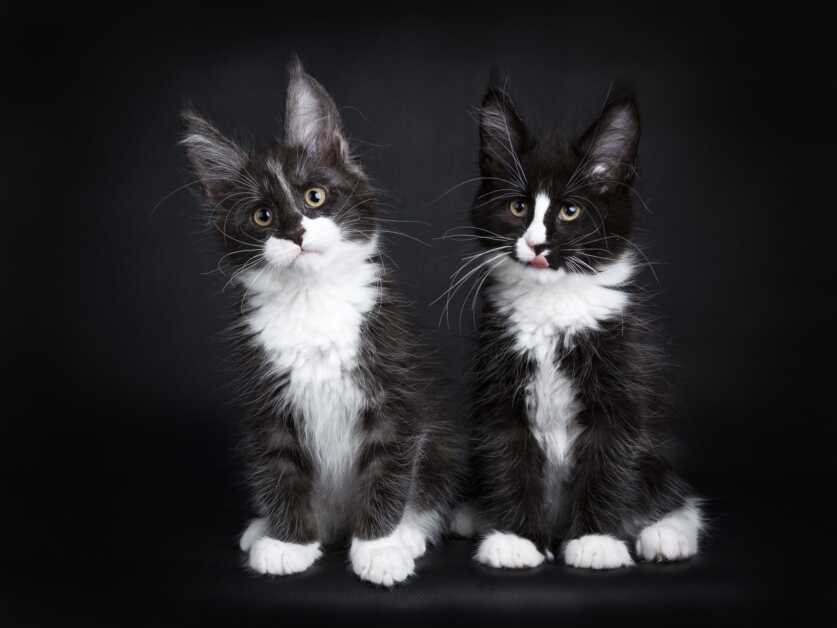
Black and white Maine Coons are especially striking because their huge frames, shaggy coats, and flowing tails make the contrast between dark and white fur look dramatic.
Some resemble tiny cats in tuxedos. Others have broad white chests, white legs, facial blazes, or so much white that only a few large black areas remain. But a black-and-white Maine Coon isn’t a separate type of Maine Coon with its own personality or size. It is a Maine Coon whose black coloration appears alongside areas of white spotting.
And not every dark-and-white Maine Coon is technically the same coat type. A black smoke with white or a tabby with white may look similar in photographs, but these are different patterns.
Here is how to tell them apart.
Quick Answer
A black-and-white Maine Coon combines black fur with areas of white spotting.
The white may appear on the:
Chest
Belly
Chin
Face
Paws
Legs
Body
“Tuxedo” is an informal description for certain black-and-white arrangements rather than a separate Maine Coon variety. Black and white Maine Coons are not inherently rarer, larger, friendlier, or healthier than other Maine Coons.
Black And White Maine Coon At A Glance
| Feature | Black And White Maine Coon |
|---|---|
| Breed | Maine Coon |
| Coat | Black with areas of white |
| White typically caused by | White spotting |
| Tuxedo | Informal pattern description |
| Recognized color | Yes |
| Size | Normal Maine Coon size range |
| Eye colors | Usually green/gold shades; blue or odd eyes can occur with white |
| Nose | Black, pink, or mixed |
| Paw pads | Black, pink, or mixed |
| Personality | Normal Maine Coon variation |
| Rare? | Generally no |
| Pedigree proof | Registration and ancestry, not coat color |
For the wider range of accepted colors and patterns, see my complete Maine Coon colors and patterns guide.
1. What Is A Black And White Maine Coon?
A black and white Maine Coon combines black-colored fur with white areas where pigment is absent.
The Cat Fanciers’ Association Maine Coon standard recognizes black and white as an accepted Maine Coon color class. For CFA showing purposes, the black-and-white class includes cats with black and white coloring, with or without white on the face, and white on areas including the bib, belly, and paws.
The International Cat Association Maine Coon information also accepts Maine Coons in a broad range of traditional colors and patterns, including colors combined with white.
Outside the show ring, owners usually use “black and white Maine Coon” more broadly for cats with obvious black and white markings. The important point is that black and white describes appearance, not a separate breed variety.
2. What Causes The Black And White Coat?
The dark and white areas have different genetic explanations. The black areas contain dark eumelanin pigment. The white areas are typically produced by white spotting, where pigment-producing cells do not populate certain areas of the skin.
The UC Davis Veterinary Genetics Laboratory identifies variants in the KIT gene associated with dominant white and white spotting in cats.
White spotting is dominant, but the exact amount and placement of white can vary considerably. That is why two black-and-white kittens from similar lines can have completely different markings.
There is also no special “tuxedo gene” producing a perfectly arranged suit-like pattern. “Tuxedo” simply describes how the black and white happen to be distributed.
3. Black And White Maine Coon Patterns
The amount and location of white can create very different appearances.
Tuxedo Maine Coon
A classic tuxedo Maine Coon is usually predominantly black with white on areas such as the:
- Chest
- Chin
- Belly
- Paws
The result resembles a black dinner jacket over a white shirt.
But tuxedo is an informal visual description, not a separate Maine Coon color genetically. I cover this appearance in more detail in my tuxedo Maine Coon guide.
Bicolor Maine Coon
Bicolor is a broader description. A black-and-white bicolor Maine Coon may have much larger white areas than a classic tuxedo cat. For example, one side of the face may be black while the other contains a large white blaze, or the legs may be predominantly white.
High-White Patterns
Some Maine Coons have so much white that the cat appears mostly white with only a few dark patches.
Terms such as harlequin and van-patterned may be used for high-white cats, although terminology varies between cat registries.
A van-style pattern is largely white with color concentrated around areas such as the head and tail.
So: Every black tuxedo Maine Coon is black and white, but not every black and white Maine Coon is a tuxedo.
4. Black And White Vs Black Smoke With White
A black smoke Maine Coon with white can easily be mistaken for a straightforward black-and-white cat. The easiest clue is hidden in the dark fur.
In a black smoke, the outer part of the hair is dark, but the hair roots are much paler or silver. When the coat moves or you gently part the fur, that pale undercoat becomes visible. A solid black-and-white Maine Coon does not have that characteristic pale smoke base throughout its dark areas.
So if a cat looks black until the coat separates and reveals dramatically silver roots, it may be black smoke with white instead.
If your cat has this pale root effect, my smoke Maine Coon guide explains how smoke coloration develops and how to identify it.
5. What About A Black Tabby With White?
Tabby-and-white cats are another common source of confusion.
If the dark areas contain obvious:
- Stripes
- Swirls
- Spots
- Tabby facial markings
the cat is usually better described according to its tabby color and pattern with white, rather than as a solid black-and-white Maine Coon.
You might therefore have a:
- Brown tabby with white
- Black silver tabby with white
- Other tabby-and-white combination
My tabby Maine Coon guide explains the major tabby patterns in more detail.
6. What Color Eyes Do Black And White Maine Coons Have?
The eyes do not need to match the coat. Black-and-white Maine Coons may have shades of:
- Green
- Yellow-green
- Gold
- Copper-gold
Blue or odd-colored eyes can also occur in Maine Coons with white under accepted breed standards.
My guide to Maine Coon eyes explains eye colors, kitten eye changes, and the striking eyeliner-like facial markings seen in some Maine Coons.
7. What Color Are Their Nose And Paw Pads?
Nose leather and paw pads can vary depending on where pigmentation falls. They may be:
- Black
- Pink
- A mixture of black and pink
A white paw may have pink pads while a darker paw has black pads.
Likewise, a cat with white extending across the muzzle may have a pink nose, whereas another black-and-white Maine Coon may have a dark nose. These small differences make individual bicolor cats especially distinctive.
8. How Big Do Black And White Maine Coons Get?
Coat color does not affect Maine Coon size.
TICA currently lists healthy adult Maine Coons at approximately:
- Males: 18-22 pounds
- Females: 12-15 pounds
Individual cats vary, but black-and-white Maine Coons should have the same substantial frame and slow development as Maine Coons of other colors.
My Maine Coon size and growth guide explains their development in more detail.
9. Does Coat Color Affect Personality?
There is no good evidence that being black and white gives a Maine Coon a special temperament. Claims that tuxedo Maine Coons are more affectionate, more mischievous, or that males and females of this color behave differently should not be presented as facts.
I’ve lived with three pedigree Maine Coons for more than 14 years, and their personalities have been very different despite all belonging to the same breed.
Pippin regularly greeted us at the door. Mika is cautious, highly food-motivated, excellent at difficult food puzzles, follows us around the house, and has developed a strange obsession with sitting on my husband’s gym bag wherever it happens to be left. His brother Bali is much more confident and loves repeatedly bringing his toy mouse back to play fetch.
That experience has reinforced one thing for me: individual personality matters far more than coat color.
You can read more about typical breed behavior in my Maine Coon personality guide.
10. Are Black And White Maine Coons Rare?
Black and white is not considered a special or genetically exotic Maine Coon color category. CFA recognizes black and white as an established bicolor class, although reliable registry-wide statistics showing exactly how frequently each Maine Coon color occurs are not readily available. So claims that tuxedo Maine Coons are ‘extremely rare’ should be treated cautiously.
Be cautious if a breeder uses phrases such as:
- “Ultra-rare tuxedo Maine Coon”
- “Exclusive tuxedo genetics”
- “Rare formal coat”
to justify a substantial price premium.
Unique markings and rare genetics are not the same thing.
11. Are Black And White Maine Coons More Expensive?
Not automatically. Maine Coon prices should be influenced far more by:
- Pedigree
- Breeder quality
- Health screening
- Veterinary care
- Registration
- Region
- Breeding or showing rights
than by whether the kitten happens to have tuxedo-style markings.
My current Maine Coon price guide explains the factors that genuinely influence cost.
12. Does The Coat Cause Health Problems?
Black-and-white Maine Coons do not have a unique set of breed diseases.
The major health concerns are those affecting Maine Coons generally, including:
- Hypertrophic cardiomyopathy
- Hip dysplasia
- Spinal muscular atrophy
- Pyruvate kinase deficiency
These are covered in my Maine Coon health and wellness guide.
It is also important not to confuse white spotting with being completely white. UC Davis distinguishes white spotting from dominant white genetically. Dominant white can have associations with hearing impairment. That does not mean an ordinary black-and-white Maine Coon with a white chest and paws should automatically be considered prone to deafness.
13. Do Black And White Kittens Change Color?
The basic distribution of black and white usually remains recognizable as the kitten matures.
However, the appearance can change as:
- The adult coat becomes longer
- The chest ruff fills out
- White areas appear larger because of longer fur
- Black fur looks richer or softer in different lighting
- Faint kitten ghost markings become less obvious
Black fur can also develop a brownish or rusty cast in strong sunlight. For more on the solid black coat, see my black Maine Coon guide.
14. Is My Black And White Cat Really A Maine Coon?
Black-and-white or tuxedo markings cannot establish Maine Coon ancestry. These patterns occur widely in Domestic Shorthairs, Domestic Longhairs, and other pedigree breeds.
If an unknown cat looks Maine Coon-like, examine the whole structure rather than the coat alone:
- Strong square muzzle
- Large ears
- Long rectangular body
- Substantial paws
- Shaggy uneven coat
- Long flowing tail
Even then, physical appearance establishes resemblance rather than pedigree.
For a genuine pedigree Maine Coon, documented ancestry and registration provide the strongest evidence. My guide on how to tell if your cat is part Maine Coon explains the limits of visual identification.
15. Buying A Black And White Maine Coon Kitten
If you specifically want black-and-white markings, choose the breeder before choosing the pattern.
A reputable breeder should be able to discuss pedigree, parentage, appropriate HCM and DNA screening, veterinary care, socialization, registration, and contract terms.
A beautiful tuxedo pattern does not compensate for poor breeding practices.
See my guide on how to find a reputable Maine Coon breeder before paying a deposit.
Frequently Asked Questions
What Is A Black And White Maine Coon Called?
“Black and white Maine Coon” is a recognized color description. Some are informally called tuxedo Maine Coons when their markings resemble formal clothing.
Are All Black And White Maine Coons Tuxedos?
Tuxedo describes a particular arrangement of dark and white fur. A mostly white Maine Coon with large black patches is still black and white but would not usually be described as a classic tuxedo.
Are Black And White Maine Coons Rare?
Not generally. Black and white is an established color combination within the breed, although reliable registry-wide figures showing exactly how common each Maine Coon color is are not readily available.
Can A Black And White Maine Coon Have Blue Eyes?
Blue or odd-colored eyes can occur in Maine Coons with white, although many have green or gold-toned eyes.
Is Black Smoke And White The Same As Black And White?
Black smoke with white has pale or silver roots in the dark areas of the coat. Straightforward black-and-white Maine Coons do not have that characteristic smoke undercoat.
Does A Black And White Coat Affect Personality?
There is no convincing evidence that this coat combination creates a special personality. Individual temperament matters much more than color.
Conclusion
A black and white Maine Coon is not a separate breed, personality type, or exceptionally rare Maine Coon variety. It is a Maine Coon whose black coloration appears alongside areas of white spotting. Those markings can create a neat tuxedo, broad bicolor patches, a facial blaze, white legs, or an extensively white coat with dramatic black areas.
The key distinctions are simple: Tuxedo describes appearance. Black and white describes color. Smoke and tabby patterns are different again.
If you are trying to determine whether a black-and-white cat is genuinely a Maine Coon, documented ancestry matters far more than where its black and white patches happen to fall.