Male Vs Female Maine Coon Cats: Size, Personality, And Care Differences

Choosing between a male and female Maine Coon can feel surprisingly difficult. Both genders can be affectionate, intelligent, playful, and family-friendly, but there are some common differences owners often notice.
Male Maine Coons are usually larger, heavier, and often more openly affectionate, while female Maine Coons are usually smaller, slightly more independent, and sometimes more reserved.
However, the cat’s gender is only one part of the picture. A Maine Coon’s personality is also shaped by:
- Genetics
- Early socialisation
- Neutering or spaying
- Health
- Previous life experience
- Individual temperament
I have personally only ever owned male Maine Coon cats, so my direct personal experience is with boys. I have lived with Pippin, Bali, and Mika, and even within three male Maine Coons the differences have been obvious.
Pippin weighed 20 lbs, whereas Bali weighs around 18lbs, and Mika weighs almost 22 lbs! They are all male, all Maine Coons, and all completely different in personality. That is the most important point in this article: male and female trends can help guide your decision, but the individual cat matters more than gender alone.
For a broader overview of breed behaviour, read my full guide to Maine Coon personality.
Quick Answer
Male Maine Coons are usually larger, heavier, more openly affectionate, and more attention-seeking than females. Female Maine Coons are usually smaller, slightly more independent, and may be more selective about when they want affection.
Both male and female Maine Coons can make excellent family pets. The best choice depends on your home, lifestyle and the individual kitten’s temperament rather than gender alone.
According to The International Cat Association, Maine Coons are sweet-tempered, gentle, and friendly cats that usually get along well with people and other pets: https://tica.org/breed/maine-coon/
The Cat Fanciers’ Association also describes the breed as friendly, sweet-tempered and easy to train: https://cfa.org/breed/maine-coon-cat/
Male Vs Female Maine Coon Comparison
| Feature | Male Maine Coon | Female Maine Coon |
|---|---|---|
| Average weight | Usually 18-22 lbs | Usually 12-15 lbs |
| Build | Broader, heavier, and more muscular | Usually lighter, narrower and more refined |
| Affection | Often more openly affectionate and attention-seeking | Often affectionate, but more on her own terms |
| Confidence | Often bolder and more outwardly social | Can be more reserved or cautious |
| Play style | Often playful, interactive and people-focused | Often playful, but sometimes more independent |
| Independence | Usually more people-focused | Often a little more self-contained |
| Voice | May be more vocal and demanding of attention | May be quieter, though this varies |
| Grooming | Needs regular grooming; larger body means more coat to manage | Also needs regular grooming; coat texture matters more than gender |
| Health | Same breed risks, plus male urinary blockage risk | Same breed risks, plus reproductive health considerations if unspayed |
| Best suited to | Owners wanting a large, affectionate, interactive cat | Owners wanting a loving but possibly more independent cat |
Mainecooncentral.com
This table shows general trends, not rules. A confident female can be more outgoing than a shy male, and a calm male can be less demanding than a highly social female.
1. Size And Weight
The biggest difference between male and female Maine Coons is usually size.
Male Maine Coons are normally bigger, heavier, and broader than females. Females are still large cats compared with most domestic breeds, but they usually have a slightly lighter and more refined frame.
TICA gives the typical male Maine Coon weight as 18-22 lbs and the typical female weight as 12-15 lbs:

That matches my own experience with male Maine Coons very closely:
- Bali weighs around 18 lbs
- Pippin weighed around 20 lbs
- Mika weighs around 22 lbs
Even between three males, the size difference is easy to see. Bali is still a large cat, but Mika has the heavier frame and looks far more imposing in person.
If size is one of the reasons you love the breed, a male Maine Coon is more likely to give you that huge, heavy, impressive look. If you want a Maine Coon but prefer a slightly smaller cat, a female may be a better fit.
For more details, read my Maine Coon size and growth guide and Maine Coon growth chart.

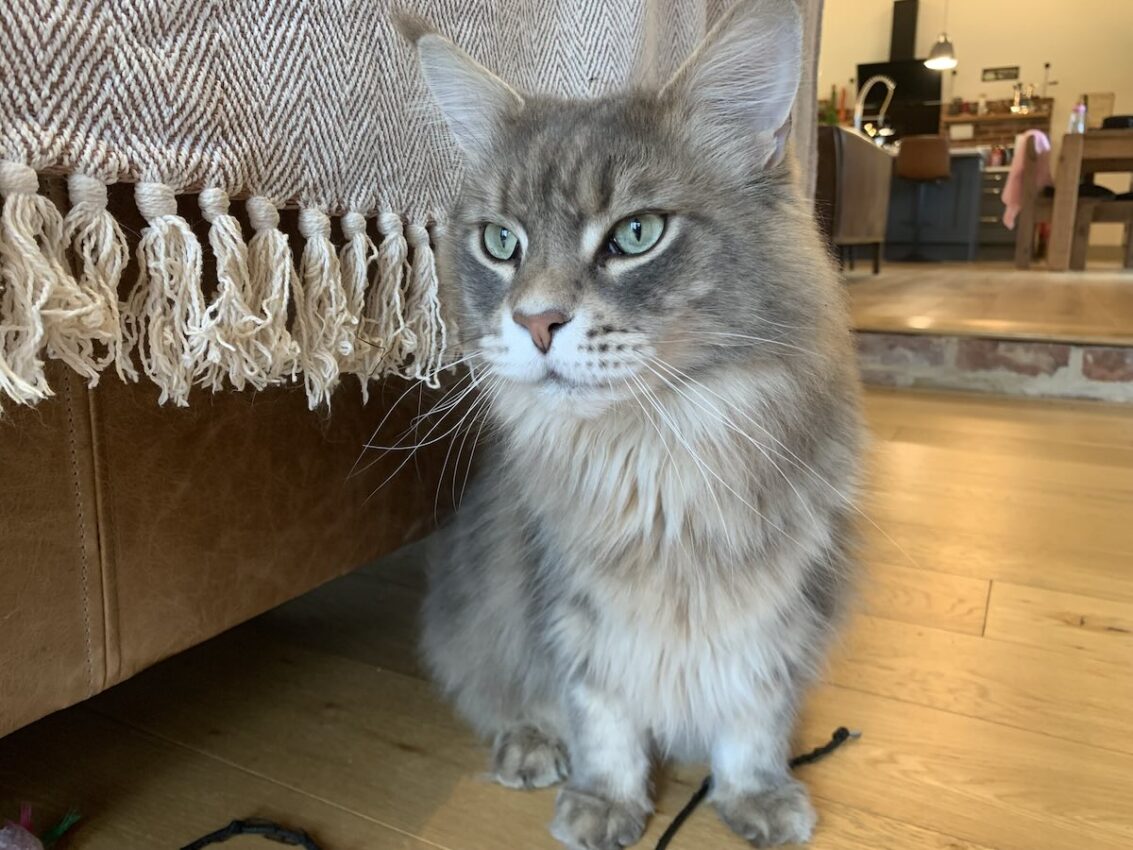


2. Body Shape And Build
Male Maine Coons usually look broader and more powerful.
They often have:
- Wider chests
- Larger paws
- Heavier bone structure
- Thicker necks
- More muscular bodies
- Larger heads and muzzles
Female Maine Coons are usually still strong and athletic, but their frame is often slightly smaller and more elegant. They may look longer, lighter, and less bulky than males.
This does not make females delicate cats. A female Maine Coon is still a substantial long-haired cat. The difference is that males often have the more dramatic “giant breed” appearance.
The CFA breed standard describes the Maine Coon as a sturdy, rugged breed and notes that proportion and balance should not be sacrificed for size.
That is important because bigger is not automatically better. A healthy, well-proportioned Maine Coon is more important than the largest possible cat.

3. Personality Differences
Male Maine Coons are often described as more outgoing, social, and openly affectionate. Female Maine Coons are often described as more independent, observant, and selective. This is a useful generalisation, but it should not be treated as a guarantee.
My own male Maine Coons prove how different cats of the same gender can be.
For instance, Pippin was the most confident. He was raised with us from kittenhood and was extremely people-focused. He was labelled a complete “love bug” because he forced affection on you in the funniest way. If he wanted to be affectionate and you were busy, he would still push himself onto you. He would head-bump you over and over, lick your arms and hands, and insist on cuddles or strokes.
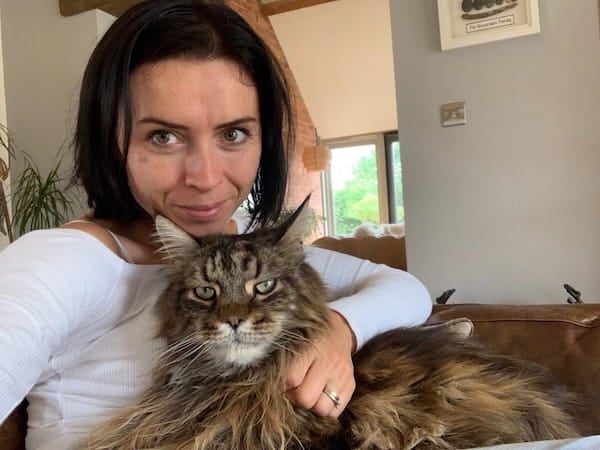
Bali is affectionate too, but more softly and less forcefully. He enjoys physical contact and will happily lie on his back while being stroked. He is more confident than Mika, but not as bold as Pippin was.

Mika is the least confident of the three, even though he is the biggest. He is sensitive, easily overstimulated, and much more likely to react quickly. He hates his belly being rubbed, and you have to read his mood carefully before trying to handle him in that way.

This is why I would not say all male Maine Coons are the same. Gender gives you clues, but personality is still individual.
For a wider discussion of breed traits, read Maine Coon personality.
4. Affection And Handling
Male Maine Coons are often more openly affectionate than females. They may seek attention, follow owners around, sit near the family, and demand interaction.
Pippin was the clearest example of this in our home. He did not just enjoy affection; he actively demanded it. He would head-bump repeatedly, lick hands and arms, and push himself into cuddles even if you were trying to do something else.
He was also unusually gentle. Pippin rarely attacked or used his claws aggressively. He seemed to understand that humans had bare skin rather than fur, and that rough play could hurt.

Mika is very different. He can be loving, but he is much more reactive. If you misread him, especially around his belly, he can attack quickly. Over time, we learned that he is not trying to be vicious. He simply likes rough play, has strong boundaries, and reacts fast when overstimulated.
Bali is different again. He enjoys physical affection and seems to lap up being stroked, especially when lying on his back. He is much more tolerant of touch than Mika.
That is why I would tell any new owner to look at the cat in front of them. Some Maine Coons love full-body affection. Others prefer controlled contact. Neither is wrong.
If your Maine Coon follows you constantly, read Why does my Maine Coon follow me?.
5. Play Style
Male Maine Coons are often playful, interactive, and people-focused. They may enjoy games that involve the owner, especially chasing, fetching, pouncing, and catching.
All three of my male Maine Coons are playful, but they each have their own preferences:
- Mika loves playing catch the ribbon.
- Bali loves chasing toy mice.
- Pippin loved catching the feather wand.
- Pippin also loved his battery-powered fish that flipped and flopped when turned on.
Below is a YouTube video of Pippin playing with his awesome flip and flop blue fish:
This is one of the joys of Maine Coons. They are intelligent cats, but they do not all enjoy the same type of play. Some prefer fetch, some prefer ribbon games, some prefer realistic prey movement, and some prefer food puzzles.
Bali enjoys chasing toy mice and playing fetch, which fits the breed’s reputation for being trainable and interactive. You can read more in my guide on how to train a Maine Coon to play fetch. Here’s a short video of Bali running to fetch his favorite mouse toy!!
For toy ideas, read the best toys for Maine Coon cats and how to keep a Maine Coon entertained.
6. Confidence And Socialisation
Many people assume male Maine Coons are automatically friendlier than females, but confidence and socialisation can matter just as much as gender.
In my home, the confidence order has been:
- Pippin
- Bali
- Mika
Pippin was the most confident, and he was the cat we had from kittenhood. Bali and Mika were adopted later, and they are both less confident overall. Bali is more secure than Mika, but both adopted cats are more cautious than Pippin was.
This makes me cautious about over-crediting a cat’s gender for their personality, since all three of my Maine Coons have been male, but they are not equally confident.
A well-socialised female from a responsible breeder may be more confident than a male who had a difficult start. A nervous male may be less affectionate than a relaxed female.
When choosing a kitten or rescue cat, ask about:
- Early handling
- Household noise
- Exposure to people
- Reaction to visitors
- Confidence with siblings
- Response to being picked up
- Parent temperament
- Breeder socialisation practices
Gender matters, but it is not the whole story.
7. Are Female Maine Coons Less Affectionate?
Female Maine Coons are not necessarily less affectionate. They may simply show affection differently.
Many owners describe female Maine Coons as loving but more independent. They may sit nearby rather than on top of you, choose when they want contact, and take longer to warm up to new people.
That can be ideal for owners who want a companionable cat without constant physical demands.
A female Maine Coon may be affectionate in quieter ways, such as:
- Sitting beside you
- Sleeping nearby
- Greeting you calmly
- Following from room to room
- Accepting strokes when relaxed
- Watching family life from a favourite perch
This is why I would avoid saying males are better pets. They are often more openly affectionate, but females can be deeply bonded too.
8. Grooming Needs
Both male and female Maine Coons need regular grooming. The grooming difference is not really about gender. It is more about coat texture, size, lifestyle, and tolerance.
A larger male may take longer to groom because there is simply more cat. However, a female with a dense, mat-prone coat may need more grooming than a silky-coated male like Bali.
In my own cats:
- Mika’s coat tangles easily, so he needs frequent brushing.
- Bali’s coat is silkier and mats far less.
- Pippin became more sensitive to grooming as he aged and developed discomfort around his hips and spine.
Mika and Pippin have both reacted defensively around mats or sensitive areas. Bali is easier because his coat is smoother and he accepts handling better.
For grooming help, read the best brushes for Maine Coons and how to groom a Maine Coon cat.
9. Health Differences
Male and female Maine Coons share many of the same breed-related health risks.
These include:
- Hypertrophic cardiomyopathy
- Hip dysplasia
- Joint problems
- Spinal muscular atrophy
- Obesity-related strain
- Dental disease
- Coat and skin issues
Cornell Feline Health Center explains that hypertrophic cardiomyopathy is a condition where the muscular walls of a cat’s heart thicken, reducing the heart’s efficiency. You can read more in my guide to Maine Coon hypertrophic cardiomyopathy.
Male cats can also be at risk of urinary blockage, which can become a medical emergency. Bali had a serious urinary issue and spent three days in the pet hospital. It was frightening, expensive, and made me very grateful we had pet insurance.
Read Maine Coon pet insurance if you are deciding whether insurance is worth it.
Pippin also developed hip dysplasia and spinal/muscle wastage later in life, which changed how he moved, climbed, and tolerated grooming. These experiences are why I take size, weight, and joint health seriously in large male Maine Coons.
In fact, all three of my cats love taking their joint supplements in a Lic-e-lix cat yoghurt each evening.
Read Maine Coon hip dysplasia facts and Maine Coon joint problems for more details.
10. Neutering And Spaying
When comparing male and female Maine Coons, it is important to remember that neutering and spaying can affect behaviour. An unneutered male may be more likely to roam, spray urine, fight, or become restless around females. A neutered male is usually easier to live with as a family pet.
Unspayed females can come into heat repeatedly, which may cause loud calling, restlessness, increased affection, rolling, and attempts to escape.
Cats Protection explains that neutering prevents unwanted litters and helps reduce the number of cats being born without homes available.
For most pet homes, neutering or spaying is part of responsible ownership. Your vet can advise on timing, weight, recovery, and the best approach for your individual cat.
11. Training And Intelligence
Both male and female Maine Coons are intelligent and trainable.
Males may sometimes appear easier to train because they are often more people-focused and eager to interact. However, females may be just as intelligent but may need stronger motivation if they are more independent.
Maine Coons can often learn:
- Fetch
- Sit
- Paw
- Come
- Carrier training
- Harness training
- Recall
- Food puzzle routines
The key is positive reinforcement. Use treats, praise, play, and short sessions. Do not force training or punish mistakes.
For more help, read how to train a Maine Coon cat and how to train a Maine Coon to walk on a leash.
12. Home Environment
Male Maine Coons often need plenty of space, interaction, and enrichment because of their size, playfulness, and social nature.
They benefit from:
- Large cat trees
- Scratching posts
- Puzzle feeders
- Interactive play
- Window views
- Safe outdoor access or catios where possible
- Owner involvement
Read the best Maine Coon cat trees if you need large, stable climbing furniture.
Female Maine Coons may also need all of these things, but some may be slightly better at entertaining themselves for short periods.
Both genders can live indoors or in apartments if their needs are met. Read are Maine Coons good indoor cats? and can Maine Coons live in apartments? for more setup advice.
13. Which Gender Is Better With Children?
Both male and female Maine Coons can be good with children if they are well-socialised and treated kindly.
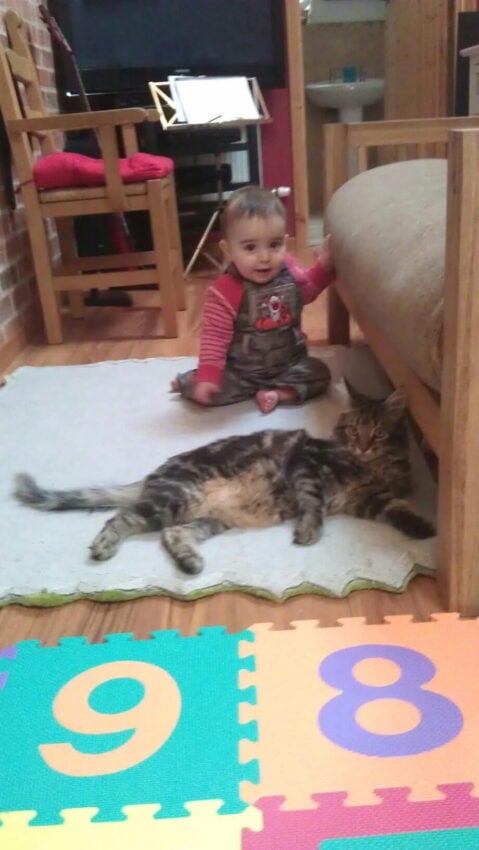
Male Maine Coons may appeal to families because they are often playful, interactive, and affectionate. My male Maine Coons have had wonderful personalities for family life, especially Pippin, who was confident, gentle, and people-focused.
However, children still need to be taught how to interact safely.
They should learn not to:
- Pull tails
- Grab fur
- Chase the cat
- Touch the belly without permission
- Disturb a sleeping cat
- Force cuddles
- Ignore warning signs
Mika has taught us this clearly. He can be loving, but he needs his mood read carefully. He is not vicious, but he does enjoy rougher play and reacts quickly if overstimulated.
A calm, well-socialised female may be better for some families than a very excitable male. Again, individual temperament matters more than gender alone.
14. Which Is Better With Other Pets?
Male Maine Coons are often described as sociable and accepting of other pets, but this depends on personality and introductions. A confident, relaxed male may adjust well to another cat or dog. A nervous or territorial male may need much slower introductions.
Female Maine Coons can also live happily with other pets, but some may be more selective or cautious, especially with other females.
The safest approach is always a gradual introduction, separate resources, and careful monitoring.
Make sure each cat has:
- Their own food area
- Their own water access
- Multiple litter trays
- Several resting spaces
- Scratching options
- Escape routes
- Vertical territory
For related guidance, read do Maine Coons get along with other cats?.
Should You Choose A Male Or Female Maine Coon?
Choose a male Maine Coon if you want the best chance of a very large, openly affectionate, interactive, and people-focused cat.
Choose a female Maine Coon if you prefer a slightly smaller cat who may be affectionate but more independent and less physically demanding.
However, do not choose by gender alone.
The best Maine Coon is one that is:
- Healthy
- Well-socialised
- Confident
- Suited to your home
- From a responsible breeder or rescue
- Matched to your lifestyle
- Comfortable with the level of handling your family expects
If I were choosing again, I would still happily choose a male Maine Coon. I have loved living with Pippin, Bali, and Mika. But I would also look closely at confidence, temperament, and socialisation rather than assuming every male will behave like Pippin.
For more decision-making help, read the pros and cons of Maine Coon cats and reasons to get a Maine Coon.
FAQs About Male Vs Female Maine Coons
Are Male Maine Coons Bigger Than Females?
Yes. Male Maine Coons are usually larger and heavier than females. TICA lists males at around 18-22 lbs and females at around 12-15 lbs.
Are Male Maine Coons More Affectionate?
Male Maine Coons are often more openly affectionate and attention-seeking. However, females can also be very loving, especially when well-socialised.
Are Female Maine Coons More Independent?
Female Maine Coons are often described as slightly more independent and selective with affection, but this varies between individuals.
Are Male Maine Coons Better Pets?
Not automatically. Male Maine Coons can be wonderful pets, but the best choice depends on temperament, health, upbringing, and your home.
Are Female Maine Coons Better For Apartments?
Not always. Females may be slightly smaller and more independent, but both males and females can live in apartments if they have enough enrichment, climbing space, and play.
Do Male Maine Coons Play More?
Many male Maine Coons are very playful and interactive, but females also need regular play and stimulation.
Which Is Better With Children?
Both genders can be good with children. A confident, gentle, well-socialised cat is more important than its gender.
Do Male And Female Maine Coons Need Different Grooming?
Not really. Both need regular grooming. Coat texture, matting, size, and tolerance matter more than gender.
Do Male Maine Coons Have More Health Problems?
Both genders share major breed risks such as HCM and hip dysplasia. Male cats can be at greater risk of urinary blockage, while females need spaying considerations.
Should I Get A Male Or Female Maine Coon?
Choose a male if you want a larger, often more openly affectionate cat. Choose a female if you want a slightly smaller, possibly more independent cat. But always prioritise health, confidence and temperament.
Final Verdict
Male and female Maine Coons can both make wonderful pets.
The biggest reliable difference is size. Males are usually heavier, broader, and more physically impressive. Females are usually smaller and may be a little more independent.
Personality differences are less predictable. Male Maine Coons are often more openly affectionate, playful, and attention-seeking, but individual temperament matters far more than gender alone.
My own three males prove that. Pippin was a confident love bug who demanded affection. Bali is affectionate, playful, and loves physical contact. Mika is huge, sensitive, feisty, and more easily overstimulated. They are all male Maine Coons, but they are not the same.
The best choice is not simply male or female. It is the Maine Coon whose health, confidence, upbringing, and personality fit your home.

This topic is part of a broader look at how Maine Coons grow and develop, which is covered in our Maine Coon size and growth guide.