Do Maine Coons Have a Primordial Pouch? The Truth About Their Saggy Belly
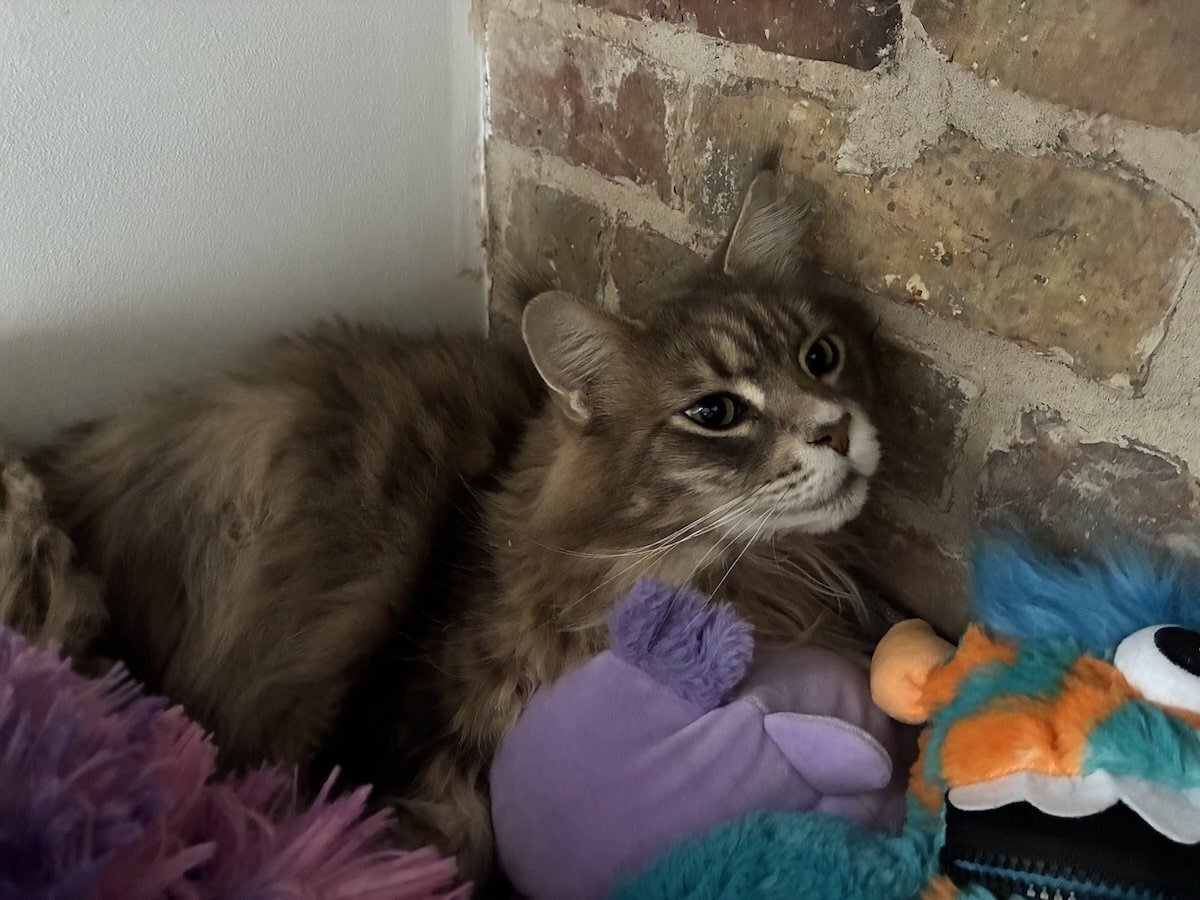
If your Maine Coon has a saggy, swinging belly, it is easy to assume they are overweight. However, in most cases, what you are seeing is normal – a feature called the primordial pouch.
All cats, including Maine Coons, naturally develop this loose flap of skin along their abdomen as they mature.
Because Maine Coons are large, long-bodied cats with thick fur, their pouch can sometimes look more dramatic than in other breeds. This often leads owners to worry unnecessarily about weight or health.
Understanding what a primordial pouch is, and how it differs from fat is essential if you want to:
- Accurately assess your cat’s weight
- Avoid overfeeding or unnecessary dieting
- Recognise what is normal for the breed
In this guide, you’ll learn exactly why Maine Coons have a primordial pouch, what it looks like, and when you should (and shouldn’t) be concerned.
Quick Answer
According to Hillspet.co.uk, the answer is yes, Maine Coons have a primordial pouch. In fact, all cats are born with this loose flap of skin and fat along the belly, although it becomes more noticeable as they mature. It is completely normal, not a sign of being overweight, and helps with flexibility, protection, and movement.
What Exactly Is A Primordial Pouch?
According to Hillspet, a primordial pouch (or belly flap) is a loose flap of skin, and in some cats, also fat, hanging from the lower abdomen between the rear legs.
It’s sometimes referred to as a “saggy belly,” but medically it’s simply an anatomical feature commonly seen in many cats. This structure is not unique to Maine Coons, it appears in many breeds and even in wild cat species.
The pouch is made up of loose skin, some subcutaneous fat, and fur (especially in long-haired cats like Maine Coons). It doesn’t interfere with movement; indeed, it may help with flexibility in certain motions.
Because of all that fur, it often looks more pronounced in long-haired breeds.
Why Do Cats Have A Primordial Pouch?
Veterinary sources and behavioral experts have proposed several plausible functions of the primordial pouch. While none are 100% proven, the combined evidence suggests multiple overlapping benefits:
Protection Of Vital Organs During Kicks And Fights
Cats often use their hind legs to kick backward when defending themselves or fighting. The pouch’s extra skin and padding help protect the lower belly, an area that could otherwise be vulnerable.
Added Flexibility For Movement
The extra skin allows stretching, twisting, and extending the body during leaps or when the cat twists to wriggle out of tight spots.
Without that slack, the abdominal skin may pull uncomfortably during such movements.
Room For Food / Energy Storage
In wild or semi-wild cats, periods of feast and famine are common. Having a belly flap gives some extra space for the stomach to expand, and perhaps carries a bit of stored energy.
Domestic cats don’t usually need this as much, but the trait persists.
Loose Skin For Evasiveness
In tricky or dangerous situations (crowded underbrush, tight squeezes, predators), loose abdominal skin may make it a bit easier for a cat to twist or bend away.
This is more speculative but often cited in discussions of cat anatomy.
Evolutionary Remnant
Some scientists believe the pouch is a feature inherited from wild ancestors, useful long ago, and though many cats no longer need those functions, the trait remains.
It may have become more visible in certain breeds due to selective breeding or because domestic conditions make excess padding more noticeable.
When And How The Primordial Pouch Develops
You don’t see the primordial pouch in very young kittens.
Key points in its development:
- It typically begins becoming noticeable during adolescence, around 4-9 months of age, with many cats showing it clearly by 6 months onward.
- In Maine Coons, because of their long fur and slowly developing bodies, the pouch often becomes more visible as they get larger and their belly and skin stretch with growth.
- As a cat ages, the skin loses some elasticity, which sometimes makes the pouch look more pronounced. Old cats may appear to have a more sagging pouch than younger ones.
Myths & Misconceptions
There are several common misunderstandings about primordial pouches. Sorting myth from fact helps you know what’s normal and when to consult a vet.
| Myth | Fact |
|---|---|
| The pouch is because the cat is overweight. | While fat can accumulate in the same region, a pouch is not by itself a sign of obesity. Healthy-weight cats often have pronounced pouches. You can check via body condition score (feel ribs, waistline, etc.). |
| Spaying or neutering causes the pouch. | Not directly. Spaying/neutering can change metabolism, possibly contributing to weight gain, but it doesn’t cause the anatomical pouch to appear. |
| It’s purely a cosmetic flaw or a breed defect. | No, it’s a natural, functional trait seen in many cats. Some breeds like Maine Coons, Pixiebobs, Bengals, etc., show it more. |
| If my cat has a pouch, they’ll eventually outgrow it. | Usually not. The pouch remains; what changes is how lean or how much fat surrounds it as the cat’s body condition changes. Older age may make it more pronounced. |
How To Tell If It’s Excess Weight Or A Pouch
Because it’s easy to confuse a pouch with excess fat, here are ways to evaluate:
- Check the waist from above: Healthy cats have a slight indentation behind the ribs. If the belly pouch is present but the waist is still visible, that’s a good sign.
- Palpate the ribs gently: If you can feel the ribs easily beneath the fur and skin, your cat is likely not overweight. If ribs are hard to locate, excess fat may be covering them.
- Watch how the flap moves when the cat walks: A primordial pouch often swings freely, whereas fat tends to be bulkier, firmer, and less mobile.
- Consider age, breed, and overall body shape: Older cats, long-haired cats, and those bred from lines with more pronounced pouches will show it more. Maine Coons are one such breed.
- Use a body condition score (BCS) chart: Many vets and cat care guides provide scoring systems (1-9 or similar) that help assess whether your cat’s weight is healthy.
What To Do About A Primordial Pouch
In many cases, you don’t need to do much since it’s a normal trait.
However, there are situations where action is helpful:
- If the pouch looks excessively large or fatty, meaning there is very little waist, ribs are hard to feel, or the cat is visibly uncomfortable or less agile, then consider evaluating diet and exercise with your vet.
- Maintain a healthy weight: Feed balanced food, avoid overfeeding, and provide plenty of play and movement. Even though the pouch itself won’t go away, keeping your cat lean helps prevent associated risks (joint strain, etc.).
- Grooming: Because the pouch area may get droopy or touch surfaces, it can be prone to fouling (dirt, moisture). Regular brushing and keeping the area clean help prevent matting or skin irritation.
- Vet checkups: If you ever feel lumps in the pouch area, sudden changes in size, or if the cat seems in discomfort, get it examined. Sometimes tumors or other issues can occur in the abdominal area.
Final Thoughts
A Maine Coon’s saggy belly is not a flaw; it is a completely normal anatomical feature shared by all cats.
The primordial pouch plays a role in flexibility, protection, and movement, and it becomes more noticeable as your cat matures.
For Maine Coon owners, the key takeaway is simple:
- A soft, swinging belly is normal
- It does not mean your cat is overweight
- It should only be a concern if accompanied by other unusual symptoms
By understanding this feature, you can avoid common misconceptions and feel confident that your Maine Coon’s “belly flap” is simply part of what makes this breed so unique.
FAQ
1. Do all Maine Coons have a primordial pouch?
Yes, all Maine Coons have a primordial pouch because all cats have one. However, the size and visibility can vary depending on genetics, age, and body condition.
2. Is a primordial pouch the same as belly fat?
No, a primordial pouch is not the same as fat. It is a loose, saggy flap that swings when a cat walks, while fat is firmer and more evenly distributed across the body.
3. Why do Maine Coons have a primordial pouch?
The primordial pouch likely evolved to:
- Protect vital organs during fights
- Allow greater flexibility and stretching
- Store extra energy when food is scarce
4. At what age does the primordial pouch develop?
The pouch typically becomes noticeable between 6 months and 1 year of age as the cat matures.
5. Do Maine Coons have bigger primordial pouches than other cats?
Sometimes. Larger breeds like Maine Coons may appear to have bigger pouches due to their size and long fur, but the feature itself exists in all cats.
6. Should I worry about my Maine Coon’s saggy belly?
No, a soft, swinging pouch is normal. However, if the belly becomes firm, swollen, or rapidly enlarges, you should consult a veterinarian.
7. Can you get rid of a primordial pouch?
No, the primordial pouch is a natural part of a cat’s anatomy and cannot be removed. Weight loss may reduce excess fat, but the pouch itself will remain.