Maine Coon Bengal Mix: Size, Coat & Personality
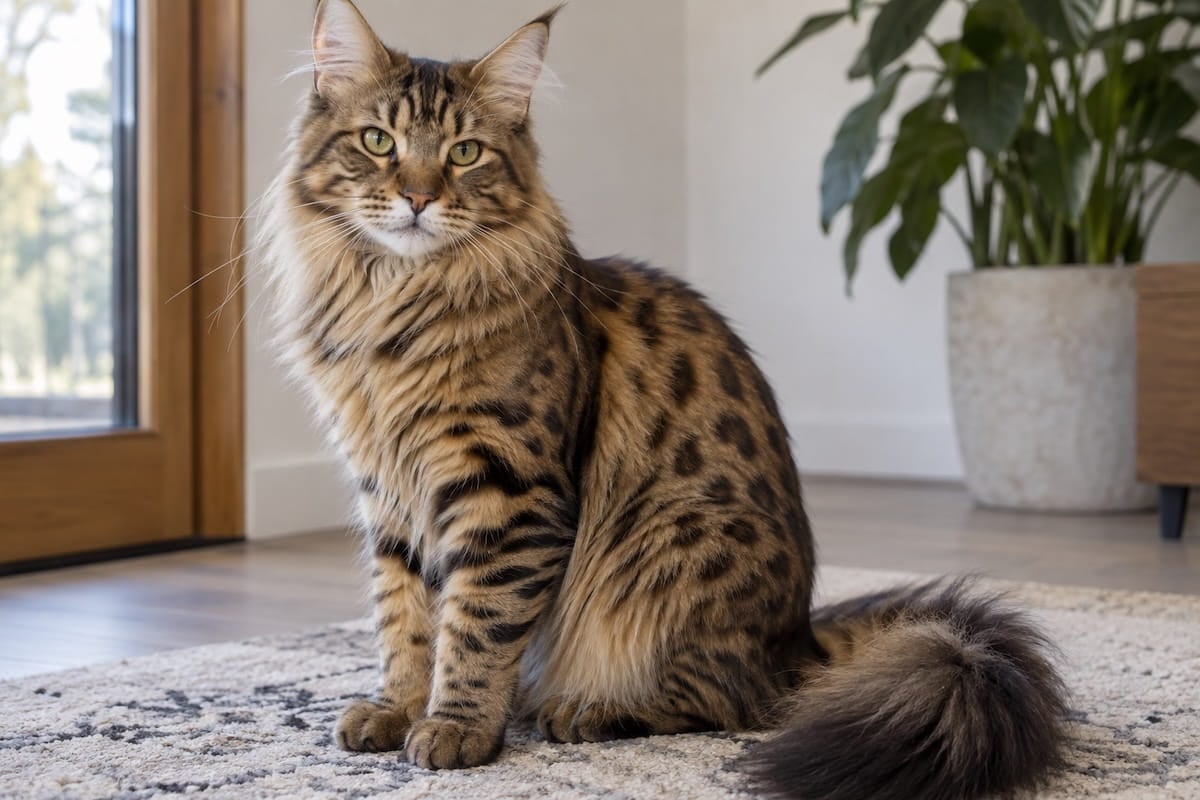
A Maine Coon Bengal mix combines two striking but very different pedigree cats.
Maine Coons are large, substantial cats with shaggy coats and easy-going personalities. Bengals are muscular, athletic cats known for short coats, bold markings, curiosity, and high activity levels.
There is no standardized Maine Coon Bengal mix size, coat, appearance, or personality. A kitten can inherit different combinations of characteristics from either parent, and even littermates may look very different.
Most importantly, a Maine Coon parent does not guarantee a huge, fluffy kitten, while a Bengal parent does not guarantee leopard-like rosettes.
Quick Answer
A Maine Coon Bengal mix is a mixed-breed cat with both Maine Coon and Bengal ancestry. Possible characteristics include:
Medium to large adult size
Muscular or substantial build
Short, medium, or potentially longer fur
Tabby, spotted, marbled, or other coloring
High intelligence
Playfulness and curiosity
Strong climbing and enrichment needs
An affectionate but active personality
These are possibilities, not guarantees. There is no official breed standard for this cross.
Maine Coon Bengal Mix At A Glance
| Trait | Maine Coon | Bengal | Possible Mix |
|---|---|---|---|
| Size | Large | Medium to large | Variable |
| Build | Long, rectangular, substantial | Muscular, athletic | Substantial to athletic |
| Coat | Shaggy, semi-long | Short, dense | Variable; long hair not guaranteed |
| Pattern | Many traditional patterns | Spotted or marbled | Variable |
| Rosettes | No | Possible/characteristic | Not guaranteed |
| Activity | Moderate to high | High | Moderate to very high |
| Personality | Social, playful, easy-going | Curious, active, interactive | Variable |
| Grooming | Regular | Low | Depends on coat |
| Recognized breed | Yes | Yes | No |
If you are unfamiliar with the Maine Coon parent, my guide explaining what a Maine Coon is covers the breed in more detail.
What Is A Maine Coon Bengal Mix?
A Maine Coon Bengal mix has ancestry from both breeds but is not a recognized pedigree breed with its own standard.
The parent breeds also have very different backgrounds.
The International Cat Association’s Maine Coon profile describes the Maine Coon as America’s native longhair.
The TICA Bengal profile explains that Bengals were originally developed from domestic cats crossed with the Asian leopard cat.
Modern pedigree Bengals are now bred Bengal-to-Bengal and are many generations removed from those original wild-cat crosses.
So a modern Maine Coon Bengal mix is not the same thing as directly crossing a Maine Coon with an Asian leopard cat.
How Big Does A Maine Coon Bengal Mix Get?
There is no reliable established adult weight range for this cross.
TICA currently lists typical Maine Coon weights of approximately:
- Males: 18-22 pounds
- Females: 12-15 pounds
Bengals are generally lighter:
- Males: around 9-15 pounds
- Females: around 6-12 pounds
My Maine Coon size and growth guide explains why Maine Coons can continue developing for several years.
A Maine Coon Bengal mix might become:
- A large, heavily built cat
- A medium-large muscular cat
- Something closer to Bengal size
- Something between the two
I would not give this cross a fixed range such as “12-20 pounds”. There is no standardized population that justifies that precision.
What Does A Maine Coon Bengal Mix Look Like?
Appearance can vary considerably. Maine Coons tend to have:
- Long rectangular bodies
- Broad chests
- Substantial bone
- Square muzzles
- Large furnished ears
- Large paws
- Long flowing tails
Bengals are typically more athletic, with muscular bodies, prominent whisker pads, rounded ears, and short dense coats. A mix may therefore look:
- Substantial and athletic
- Longer-bodied
- More muscular
- Broad- or square-muzzled
- Large-eared
- Thick-tailed
- More Bengal-like or more Maine Coon-like
There is no single correct appearance.
Will A Maine Coon Bengal Mix Have Long Hair?
This is one of the most misunderstood features of the cross. The UC Davis Veterinary Genetics Laboratory confirms that the common genetic variants responsible for long hair in cats are recessive. A long-haired Maine Coon passes a long-hair variant to every kitten.
But if the Bengal parent is short-haired and does not carry a compatible long-hair variant, first-generation kittens would generally be short-haired carriers rather than long-haired cats.
If the Bengal carries a relevant long-hair variant, longer-haired kittens become possible.
A mix could therefore have:
- Short dense fur
- Plush short fur
- Slightly longer fur
- Semi-long fur
- A shaggier Maine Coon-like coat
So a Maine Coon parent does not automatically produce a fluffy kitten.
Will It Have Bengal Spots Or Rosettes?
Possibly, but not necessarily. Bengals are famous for spotted and marbled coats, including distinctive rosettes.
A mixed kitten may inherit visible Bengal-style patterning, but you should not expect every kitten to have:
- Rosettes
- Leopard-like spots
- Dramatic marbling
- Bengal glitter
Longer fur can also make pattern edges look less distinct. Some kittens may simply look tabby or more Maine Coon-like.
Maine Coons themselves come in many colors and patterns, which you can see in my Maine Coon colors and patterns guide.
Personality And Activity
Both parent breeds are intelligent and interactive, but Bengals are generally more intense. TICA describes Bengals as active, curious, playful, and highly trainable.
They often enjoy:
- Climbing
- Fetch
- Puzzle toys
- Harness walking
- Water
- Investigating everything around them
Maine Coons are also playful and intelligent but tend to be more easy-going.
My Maine Coon personality guide explores that social, curious temperament in more detail.
A mix may therefore be:
- Highly intelligent
- Curious
- Sociable
- Affectionate
- Very playful
- Trainable
- Confident
- Strongly interested in climbing or water
But temperament cannot be guaranteed. Early socialization, environment, and the individual cat matter too.
Exercise And Enrichment
Many cats from this cross are likely to benefit from substantial enrichment. Useful options include:
- Tall cat trees
- Puzzle feeders
- Interactive toys
- Fetch
- Training
- Climbing areas
- Window perches
- Safe outdoor enclosures
A cat that inherits more of the Bengal’s activity level may need considerably more stimulation than an average house cat.
My Experience With The Maine Coon Side
I have lived with three pedigree Maine Coons for more than 14 years: Pippin, Mika, and Bali. Even within one pedigree breed, their personalities differ considerably. Bali is confident and loves repeatedly fetching his toy mouse. Mika is more cautious but exceptionally good at difficult food puzzles and investigates almost everything around him. Their coats, confidence, food motivation, and grooming tolerance differ too.
That is one reason I am cautious when articles claim every Maine Coon Bengal mix will look or behave in a particular way. For the Bengal side, I rely on current breed-registry information rather than pretending my Maine Coon experience applies to Bengals.
Mixed-breed characteristics are possibilities, not promises.
How Can You Tell If A Cat Is Really A Maine Coon Bengal Mix?
Appearance alone cannot confirm that a cat is a Maine Coon Bengal mix. A spotted coat, large body, fluffy tail, tufted ears, or playful personality may resemble one or both parent breeds, but these characteristics also occur in cats with completely different ancestry. The strongest evidence is documented parentage showing genuine Maine Coon and Bengal ancestry.
If your cat’s background is unknown, physical characteristics can suggest resemblance but cannot establish the cross. DNA ancestry testing may provide additional clues, but it should not be treated as equivalent to pedigree or parentage records.
If the Maine Coon side is what you are trying to identify, my guide explaining how to tell if your cat is part Maine Coon covers the most useful characteristics in greater detail.
Grooming Requirements
Grooming depends heavily on the coat inherited. A short-coated Bengal-like mix may need little brushing. A longer-haired cat may require regular combing and mat checks.
My Maine Coon grooming guide explains how grooming needs can vary even among pedigree Maine Coons.
The individual cat’s coat length, density, and texture matter more than the name of the cross.
Health Considerations
Being mixed does not automatically make a cat healthier. The important question is which risks exist in the parental lines.
For Maine Coons, relevant considerations include:
- Hypertrophic cardiomyopathy (HCM)
- Hip dysplasia
- Spinal muscular atrophy (SMA)
- Pyruvate kinase deficiency
My Maine Coon health and wellness guide covers these in more detail.
For Bengals, TICA recommends appropriate screening for conditions including:
- HCM
- Progressive retinal atrophy
- Pyruvate kinase deficiency
A genuine cross should therefore be assessed in the context of both parental lines.
Should You Buy A Maine Coon Bengal Mix?
Be cautious about sellers presenting these cats as a standardized “designer breed.” They are not.
If someone deliberately breeds a pedigree Maine Coon to a Bengal, ask for:
- Pedigree or registration records
- Evidence of parentage
- Relevant DNA testing
- Cardiac screening
- Other appropriate health checks
- Veterinary history
Be skeptical of guarantees that every kitten will have:
- Maine Coon size
- Long fur
- Bengal rosettes
- A particular temperament
- A fixed adult weight
Genetics does not guarantee that combination.
If you are considering a Maine Coon-related kitten, my guide to finding a reputable Maine Coon breeder explains what breeder practices and health documentation to look for.
Frequently Asked Questions
Is A Maine Coon Bengal Mix A Recognized Breed?
It is a mixed-breed cat rather than a recognized pedigree breed with its own standard.
How Big Does A Maine Coon Bengal Mix Get?
There is no established adult weight range. The Maine Coon parent provides the potential for substantial size, while Bengals are generally lighter and more athletic.
Will A Maine Coon Bengal Mix Have Long Hair?
Not necessarily. Long hair is recessive. If the Bengal parent does not carry a compatible long-hair variant, first-generation kittens would generally be short-haired carriers.
Will A Maine Coon Bengal Mix Have Rosettes?
Not necessarily. Bengal-style spots, marbling, or rosettes may be inherited, but none is guaranteed.
Are Maine Coon Bengal Mixes High Energy?
They may be. Bengals are high-energy cats, and Maine Coons are playful, so some mixes may require considerable activity and mental stimulation.
Conclusion
A Maine Coon Bengal mix can inherit traits from two intelligent, distinctive breeds, but there is no standard version of this cross. Size, coat length, pattern, activity level, and personality can all vary.
The best clues come from the actual parents, documented ancestry, health screening, and the individual kitten — not promises attached to the name “Maine Coon Bengal mix”.