Maine Coon vs Manx: Size, Personality, Health & Care
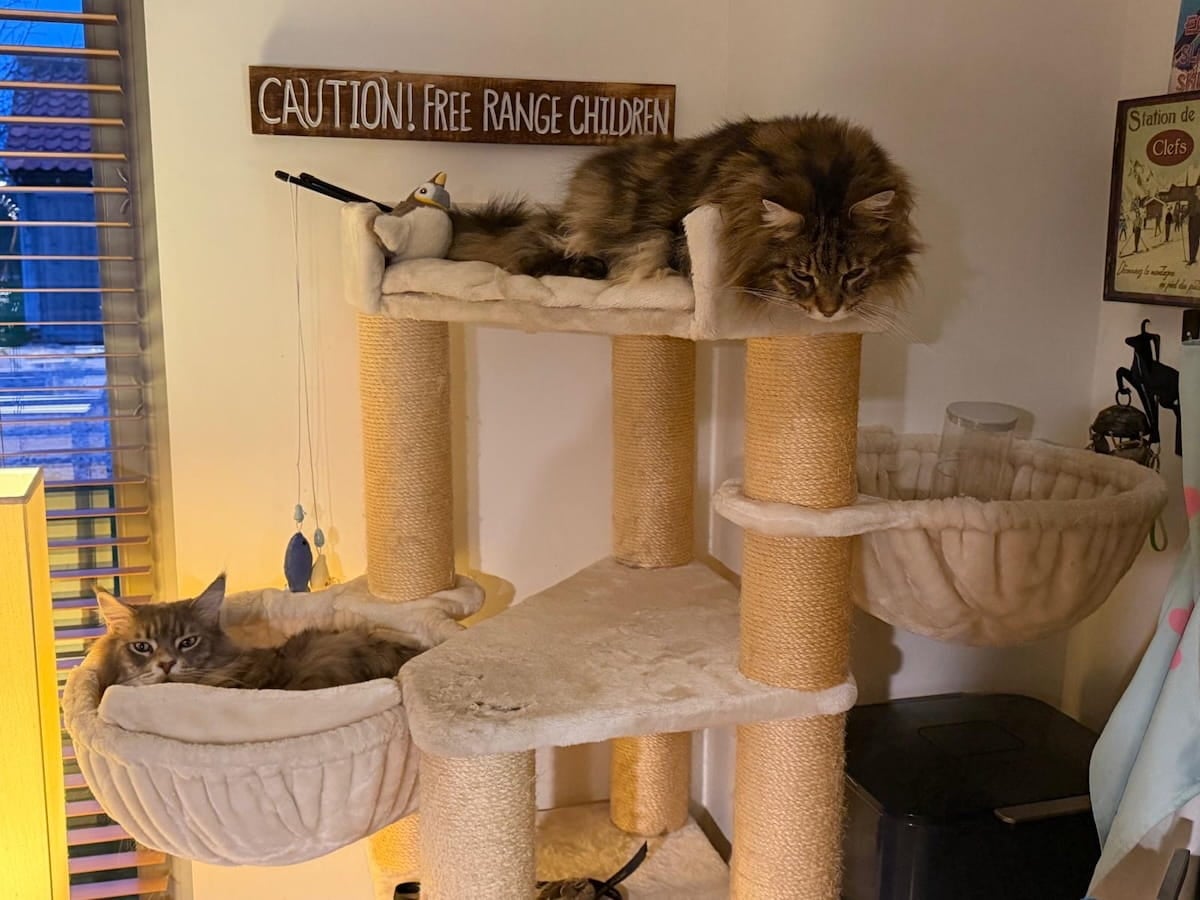
At first glance, the Maine Coon and Manx look almost like opposites. The Maine Coon is a large, long-bodied cat famous for its shaggy coat and enormous bushy tail. The Manx is smaller and rounder and is best known for having a shortened tail, or sometimes no visible tail at all. Yet their personalities have more in common than their appearance suggests. Both breeds can be intelligent, playful, affectionate, and strongly attached to their families.
I’ve owned Maine Coons for more than 14 years, including Pippin, Mika and Bali, so I can compare the Maine Coon temperament from genuine experience. I’ve never owned a Manx, so for the Manx side of this comparison I’ve relied on breed information from organizations including TICA, CFA and GCCF rather than pretending to have firsthand experience I don’t have.
My three Maine Coons have also taught me why breed descriptions only tell part of the story. Pippin was exceptionally sociable and loved meeting people. Mika is highly intelligent and funny but can be surprisingly cautious. Bali joined us as an adult and was initially much warier, yet over time he became confident enough to greet visitors and even enjoys playing fetch.
So, which breed is right for you?
Quick Answer
Maine Coons and Manx cats can both be affectionate, intelligent, and playful, but physically they are very different.
Maine Coons are considerably larger, with long rectangular bodies, semi-long coats, and long bushy tails. Adult males commonly weigh around 18-22 pounds, while females are usually around 12-15 pounds. TICA – The International Cat Association
Manx cats are medium-sized and compact, with rounded bodies and powerful hind legs that are longer than their front legs. Adult males average around 10-12 pounds and females around 8-10 pounds. Not every Manx is completely tailless; kittens can be born with no visible tail, a short tail, or a full-length tail. TICA – The International Cat Association
For me, the biggest consideration beyond appearance is health. Maine Coons have inherited conditions worth screening for, while the gene responsible for Manx taillessness can occasionally affect spinal and nerve development. Responsible breeding is therefore particularly important with the Manx. The Governing Council of the Cat Fancy
Maine Coon Vs Manx At A Glance
| Feature | Maine Coon | Manx |
|---|---|---|
| Origin | Maine, United States | Isle of Man |
| Size | Large | Medium |
| Male weight | Approx. 18-22 lb | Approx. 10-12 lb |
| Female weight | Approx. 12-15 lb | Approx. 8-10 lb |
| Body | Long, rectangular, muscular | Compact, rounded, muscular |
| Tail | Long and bushy | None, short, partial or full length |
| Hind legs | Proportionate | Longer and more powerful than front legs |
| Coat | Semi-long, shaggy | Dense short coat; longhaired varieties also exist |
| Temperament | Sociable, playful, gentle | Affectionate, intelligent, playful |
| Grooming | Moderate | Usually lower for shorthaired Manx |
| Major health considerations | HCM, hip dysplasia, SMA | Manx-associated spinal/neurological problems |
| Famous feature | Huge size and tail | Shortened or absent tail |
1. Maine Coon vs Manx Size
The Maine Coon is clearly the larger breed. TICA describes adult male Maine Coons as typically around 18-22 pounds, with females usually weighing 12-15 pounds. They have long, rectangular bodies, substantial bone, and broad chests.
The Manx is much more compact. GCCF describes males at around 10-12 pounds and females around 8-10 pounds. Their bodies are rounded, with deep flanks and particularly powerful hindquarters. That difference is obvious visually.
A Maine Coon tends to look long and substantial, whereas a Manx is much more compact and rounded.
Having lived with Maine Coons for so long, their scale becomes strangely normal to you. It’s often visitors who remind me how large they actually are. Even ordinary furniture, cat beds, and carriers can look undersized beside a substantial Maine Coon.
If size is one of the main reasons you’re considering the breed, my Maine Coon Size and Growth guide goes into realistic adult dimensions in much more detail.
2. The Tail Difference
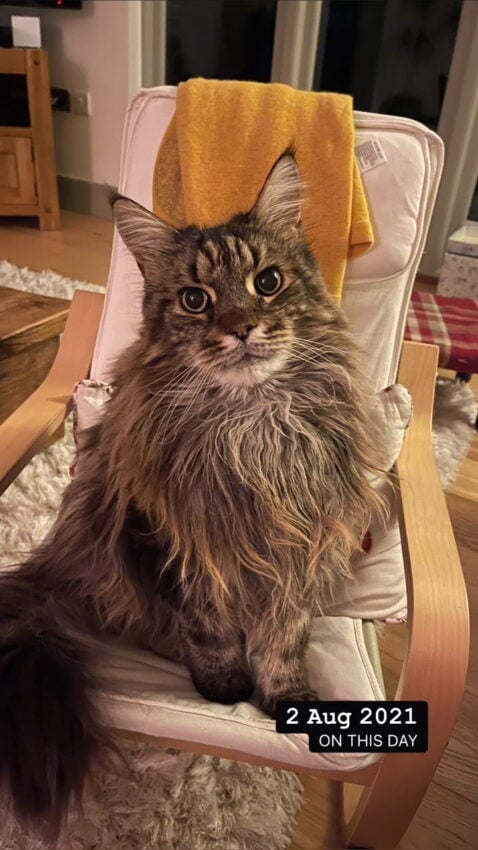
This is the easiest way to distinguish the breeds. The Maine Coon has a long, heavily furred tail that forms a major part of its distinctive appearance. The Manx is famous for having little or no tail. However, saying that all Manx cats are completely tailless is incorrect.
Different Manx kittens can have:
- No visible tail;
- A slight rise where the tail would normally begin;
- A short partial tail;
- Or a full-length tail.
CFA currently recognizes both tailless and tailed Manx varieties. This creates quite a striking contrast with the Maine Coon, because the enormous bushy tail is one of the features I most strongly associate with the breed.
3. Body Shape And Movement
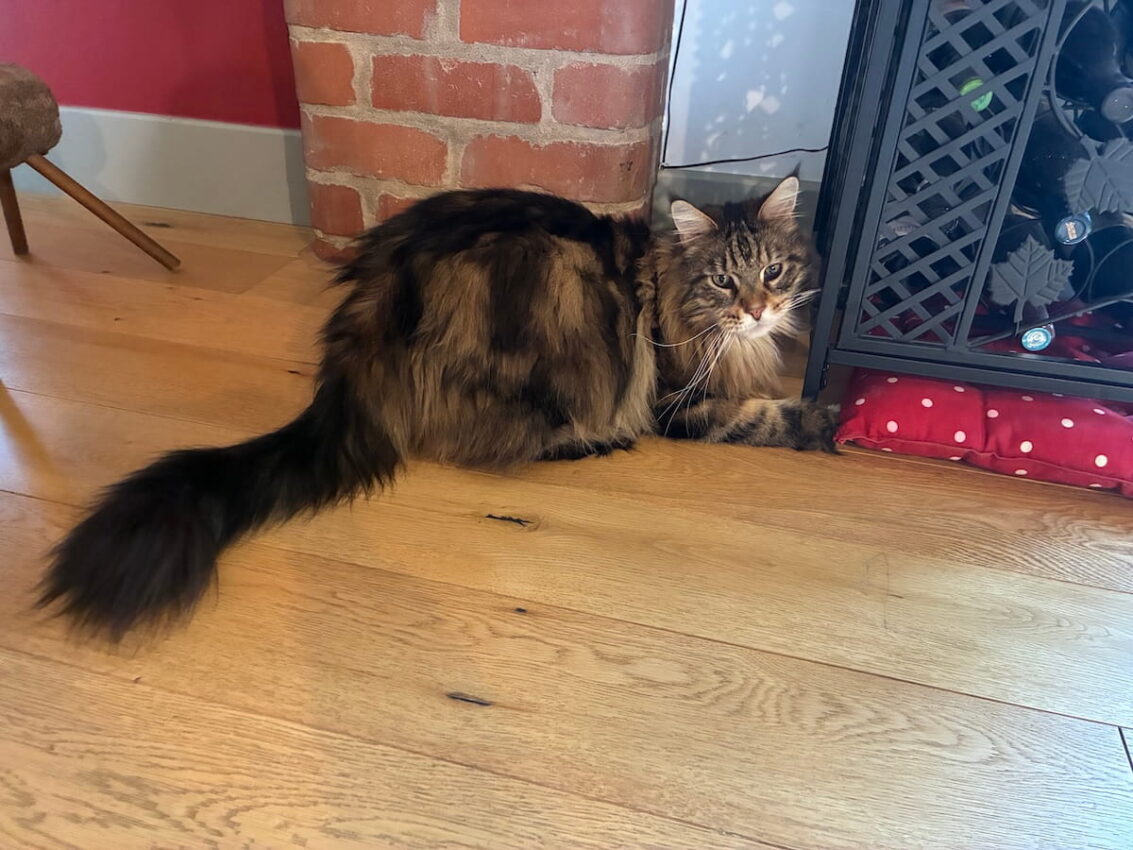
The breeds aren’t simply different sizes. Their proportions are fundamentally different. A Maine Coon should have a long, muscular, rectangular body. The Manx is deliberately much rounder in appearance. Its hind legs are longer than its front legs, creating a raised rump and providing considerable jumping power. TICA describes the breed as heavy, compact, and rounded, almost like a bowling ball.
Older descriptions sometimes characterize Manx cats as having a rabbit-like hopping movement. That shouldn’t be considered the normal ideal. GCCF specifically notes that pronounced hopping has historically been associated with excessive shortening of the spine and is not regarded as a normal breed characteristic.
4. Coat And Grooming
A Maine Coon generally requires more coat maintenance. Their semi-long coat is shaggy and particularly substantial around areas such as the stomach, hindquarters, and tail. Regular grooming is useful for removing loose hair and preventing tangles.
Manx cats have a dense double coat but are generally easier to maintain when shorthaired. Longhaired Manx also exist, although registries differ in how they classify them. CFA recommends regular grooming but notes that the Manx coat isn’t particularly prone to matting.
So if you want the lower-maintenance coat, a shorthaired Manx has the advantage. I wouldn’t choose between them on grooming alone, though. Coat texture can vary considerably even between individual Maine Coons.
5. Maine Coon Vs Manx Personality
This is where the comparison becomes much more interesting. Despite looking completely different, both breeds have reputations for being intelligent, playful, and strongly connected to people.
TICA describes Maine Coons as gentle, friendly, and sociable, while the Manx is described as affectionate and family-oriented.
My experience also demonstrates why I wouldn’t promise anyone a particular personality simply because they’re buying a Maine Coon.
Pippin was extraordinarily sociable. He loved people and wanted to be involved in family life. Mika is quite different. He’s clever, funny, and very food-motivated, but he’s also cautious and can be frightened by unfamiliar situations. Bali changed enormously after adoption. He initially appeared friendly but wary. As he became secure in our home, his confidence increased, and he now willingly goes to greet visitors and cat sitters.
They are all unmistakably Maine Coons, but they aren’t carbon copies of one another. That’s why I treat registry descriptions as tendencies rather than guarantees.
6. Which Breed Is More Intelligent?
I wouldn’t name a winner. Both breeds have strong reputations for intelligence.
Maine Coons often learn household routines quickly, enjoy interactive toys, and can learn behaviors such as fetch. I’ve seen that directly. Mika is particularly good with puzzle toys, especially when food is involved! Watch him complete a dog treat toy on the Maine Coon Central YouTube Channel. He’s also fascinated by his water fountain and will spend far more time investigating it than you’d expect from a cat.
Bali plays fetch, which is one of those behaviors people associate with the supposedly “dog-like” side of Maine Coon personality.
Manx cats are also regarded as intelligent and interactive. GCCF describes them as playful and intelligent, while TICA highlights their affectionate and engaging temperament. So I would not repeat the old claim that Maine Coons are inherently faster learners than Manx cats. There isn’t enough evidence for that. Individual intelligence, curiosity, and motivation probably matter far more.

7. Activity And Play
Neither is a breed I would regard as purely decorative. Maine Coons can remain playful well into adulthood. That’s certainly been my experience. Bali still enjoys fetch, while Mika’s interest in puzzles and anything food-related means mental stimulation is often as important as physical exercise.
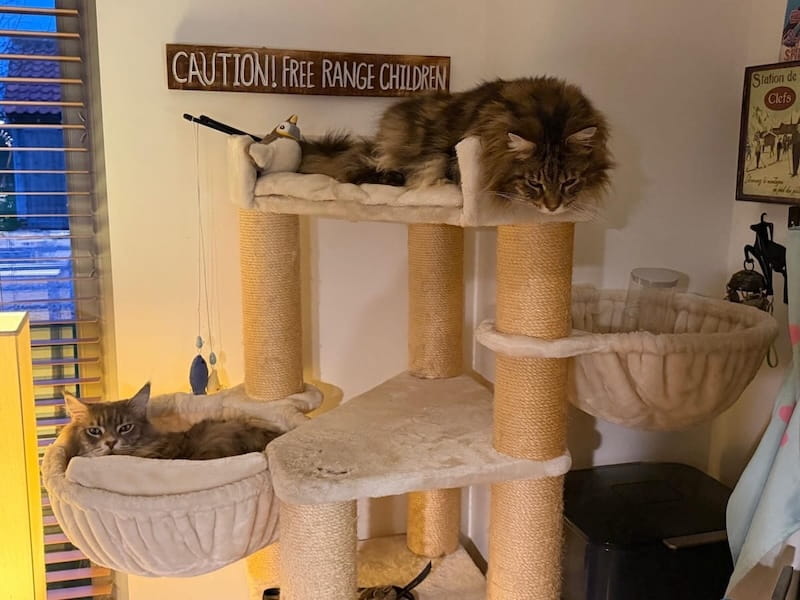
Their size does mean equipment needs to be appropriately sturdy. A cat tree designed for a much smaller domestic cat can look rather optimistic once a large Maine Coon climbs onto it.
Manx cats are smaller but can be extremely athletic. Their powerful hindquarters allow them to jump impressively, and GCCF describes them as capable of quick acceleration and sharp turns.
Both breeds therefore benefit from interactive play, climbing opportunities and mental enrichment.
8. Which Is Better With Children And Other Pets?
Both breeds can make good family cats. Maine Coons have a strong reputation for their gentle, sociable nature, while TICA describes Manx cats as getting along well with children and other family pets.
Manx cats are not particularly likely to be aggressive toward dogs. But again, the individual cat matters. A well-socialized, confident cat and a nervous cat can react very differently to children, dogs, or another cat regardless of breed.
9. Maine Coon vs Manx Health
This is the most important difference to understand properly.
Maine Coon Health
Maine Coons have recognized inherited health concerns, including:
- Hypertrophic cardiomyopathy (HCM);
- Hip dysplasia;
- Spinal muscular atrophy (SMA).
That doesn’t mean every Maine Coon will develop these conditions. It does mean responsible breeding and health screening matter.
After owning Maine Coons for many years, I don’t think it helps prospective owners when breed websites present them as flawless, exceptionally hardy cats. They’re wonderful animals, but they can also generate substantial veterinary bills.
Manx Health
The Manx has a particularly unusual health consideration because its characteristic tail is caused by a genetic mutation that affects vertebral development. In most properly bred Manx cats, this doesn’t mean the cat is disabled. However, when spinal shortening extends too far, some kittens can develop abnormalities involving the spinal cord and nerves.
The collective term Manx syndrome is commonly used for these problems. Possible effects include difficulties involving the hind limbs, bladder or bowel function, and other neurological abnormalities.
GCCF provides a particularly useful balanced explanation: these serious problems are now considered relatively uncommon in responsibly bred modern Manx cats, but careful breeding practices are necessary to reduce the risk.
That’s more accurate than either extreme:
- “Manx cats are unhealthy” = too broad.
- “The missing tail is purely cosmetic” = also misleading
If I were buying a Manx kitten, breeder health practices would therefore be one of my first questions.
10. Which Breed Is Easier To Own?
It depends on what you consider difficult. A Maine Coon brings practical consequences simply because of its size. You’ll usually need larger carriers, larger litter trays, stronger cat trees, and more room. The semi-long coat also requires attention.
A shorthaired Manx is physically smaller and normally easier to groom. However, choosing a Manx means doing particularly careful homework around breeding and the health implications of the Manx gene.
Neither breed is automatically “easy.”
Maine Coon Or Manx: Which Should You Choose?
I would choose a Maine Coon if you particularly want:
- A very large cat;
- The famous long shaggy coat and huge tail;
- An interactive and often highly sociable companion;
- A cat likely to remain playful into adulthood;
- You don’t mind the additional grooming and equipment required by their size.
I would consider a Manx if you prefer:
- A medium-sized, compact cat;
- A shorter, easier-care coat;
- An athletic and playful personality;
- The breed’s unusual rounded appearance;
- You’re prepared to research its genetics and breeder carefully.
I wouldn’t choose either purely because of appearance. After living with Pippin, Mika, and Bali, personality would now be at least as important to me. Pippin’s confidence, Mika’s cautious intelligence, and Bali’s gradual transformation after adoption demonstrate just how much variation exists even within one breed.
Frequently Asked Questions
Are Maine Coons Bigger Than Manx Cats?
Adult Maine Coons are generally substantially larger. TICA lists healthy male Maine Coons at around 18-22 pounds, while adult male Manx average around 10-12 pounds.
Are All Manx Cats Born Without A Tail?
Some have no visible tail, while others have short, partial, or even full-length tails.
Are Manx Cats Unhealthy?
Not inherently. Most responsibly bred Manx cats can live normal lives, but the genetic mutation associated with taillessness can occasionally affect spinal and neurological development.
Which Breed Needs More Grooming?
Usually the Maine Coon. A shorthaired Manx has a dense coat but generally requires less grooming than a semi-longhaired Maine Coon.
Which Is More Intelligent?
There isn’t convincing evidence that one breed is inherently more intelligent. Both are regarded as intelligent and interactive cats.
Can You Cross A Manx With A Maine Coon?
Biologically, yes, but the offspring wouldn’t constitute a recognized new pedigree breed. Because the Manx mutation has genuine health implications, I would also be cautious about deliberately producing crosses primarily for an unusual appearance.
Final Thoughts
Maine Coons and Manx cats look dramatically different, but their personalities have more in common than you might initially expect. Both can be intelligent, affectionate, playful, and strongly connected to their families.
The physical differences are straightforward: Maine Coons are much larger, longer, and shaggier, with enormous bushy tails. Manx cats are smaller, rounder, and may have anything from no visible tail to a full-length one.
The health comparison deserves more thought. Maine Coons have several inherited conditions worth screening for, while the Manx tail mutation can occasionally affect spinal and neurological development. That doesn’t mean every Manx is unhealthy, but it does make responsible breeding particularly important.
My own experience is inevitably weighted toward the Maine Coon. Pippin showed me just how sociable the breed can be. Mika has shown me its clever, quirky, and cautious side. Bali has shown me how much an adult cat’s personality can develop as it becomes secure, from a slightly wary adopted cat to one that now greets visitors and plays fetch.
Those differences are also why I wouldn’t choose either breed based solely on a comparison chart. The breed tells you what characteristics are likely. The individual cat tells you who you’re actually going to live with.